Doosan Acquires Semiconductor Wafer Manufacturer
Balanced Portfolio with Three Major Cash Cows
From Wafer Production to Backend Testing
Doosan Group is set to restructure its business portfolio by acquiring SK Siltron, the world’s third-largest semiconductor wafer manufacturer. With this addition, Doosan will secure another stable cash-generating source alongside Doosan Bobcat, raising expectations for mid- to long-term performance improvements in line with the semiconductor industry’s recovery driven by the proliferation of artificial intelligence (AI). Doosan Group plans to make semiconductor materials a new growth axis and strengthen its business competitiveness over the long term.
On December 18, a Doosan official stated, “The integration of wafer manufacturing assets into the group is significant in that it expands both the scale and strategic options of our semiconductor business.” While Doosan Tesna has focused on testing processes for fabless and integrated semiconductor companies, SK Siltron supplies wafers to global semiconductor manufacturers, meaning their process stages and customer bases differ, allowing for mutual complementarity. This is seen as a foundation for expanding the group’s semiconductor business beyond a specific process to the entire value chain.
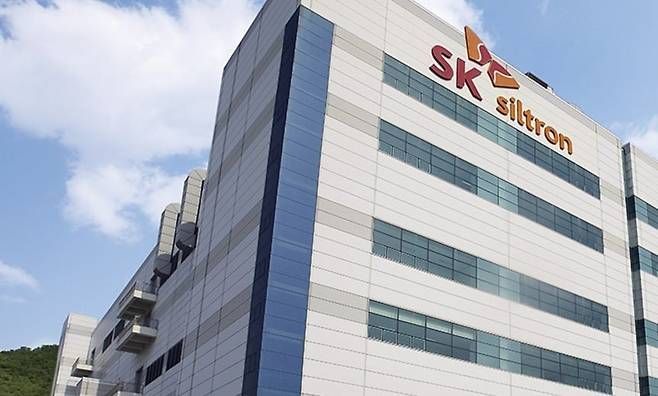
The previous day, SK Inc., the holding company of SK Group, selected Doosan Corporation as the preferred bidder for the sale of SK Siltron shares. The stake up for sale is reported to be 70.6% of SK Siltron, currently owned by SK. SK Siltron is the only domestic manufacturer of 300mm (12-inch) silicon wafers and counts major global semiconductor companies among its primary clients. SK Siltron’s annual operating profit has recently ranged between 400 billion and 600 billion won, maintaining a certain level of profitability even during downturns in the semiconductor market. With continued growth in wafer demand driven by AI, data centers, and high-performance computing (HPC), the company is also expected to secure strong mid- to long-term growth potential.
In particular, AI semiconductors are a sector where the transition to advanced processes is rapid and wafer consumption is structurally increasing. Industry insiders view this acquisition as Doosan securing an additional business portfolio centered on semiconductor materials and entering the early stages of a semiconductor supercycle. An industry official commented, “The direction of investment after the acquisition will be crucial. Since SK currently has limited capacity for further investment, if Doosan completes the acquisition, it could create an environment where facility investment and business expansion can be considered over the mid- to long-term.”
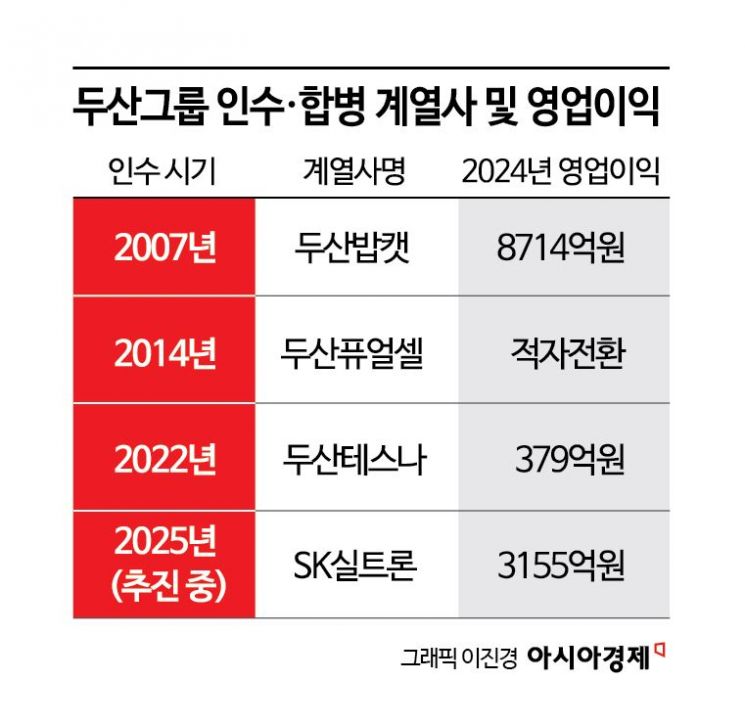
Doosan has already established a stable cash flow base through Doosan Enerbility, an affiliate specializing in energy and power generation facilities, alongside Doosan Bobcat. If SK Siltron is added, Doosan will complete a ‘three major cash cow’ system with Doosan Bobcat, Doosan Enerbility, and SK Siltron. Industry observers believe this acquisition will make Doosan’s business portfolio more balanced. Since the business axes-construction equipment, energy and power generation facilities, and semiconductor materials-are linked to different industry cycles, a downturn in one sector will have a mitigated impact on the group’s overall performance. While Doosan Bobcat is sensitive to the construction and infrastructure cycle, SK Siltron is affected by semiconductor market conditions tied to AI and IT demand, suggesting that Doosan can expect a decoupling effect across its portfolio.
Until now, Doosan has been seen as highly dependent on cash flow from Doosan Bobcat. Among its acquired affiliates, Doosan Bobcat has been the only one to firmly establish itself as a cash cow. Doosan Tesna, acquired in 2022, has served as a bridgehead for entry into the semiconductor back-end process business, but its profit scale remains limited, and Doosan Fuel Cell, acquired in 2014, continues to post operating losses. The acquisition of SK Siltron is expected to address these shortcomings and enhance the overall cash flow stability of the group.
© The Asia Business Daily(www.asiae.co.kr). All rights reserved.
![Clutching a Stolen Dior Bag, Saying "I Hate Being Poor but Real"... The Grotesque Con of a "Human Knockoff" [Slate]](https://cwcontent.asiae.co.kr/asiaresize/183/2026021902243444107_1771435474.jpg)
















