Continued Decline in Chinese Real Estate Investment
Tightening Liquidity Further Weakens Domestic Demand
"Foreign Capital Outflows and Exchange Rate Risks May Intensify"
As the slowdown of the Chinese economy accelerates faster than expected, experts in the securities industry are advising caution regarding its potential impact on the global economy.
On the 19th, Park Sanghyun, a researcher at iM Securities, stated, "The growth rate of retail sales, which represents domestic demand in China, stood at only 1.3% year-on-year in November, falling significantly short of market expectations."
"China's Fixed Investment Expected to Decline for the First Time in Over 30 Years on an Annual Basis This Year"
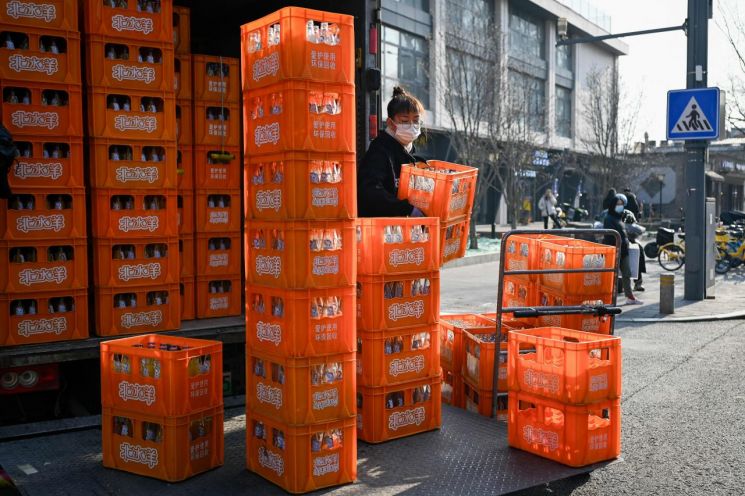 On the 11th, a worker is loading beverage boxes onto a truck on a street in Beijing, China. Photo by AFP
In addition, the slump in the housing market has deepened. Park pointed out, "The housing market serves as another barometer of domestic demand," adding, "The decline in new home prices has continued for 44 consecutive months, yet there are no signs of improvement in key indicators such as housing prices and sales."
Investment indicators are also fueling market concerns. The growth rate of fixed investment has been declining for three consecutive months year-on-year, with the pace of decline accelerating. It is now almost certain that China's fixed investment will record an annual decrease for the first time in over 30 years. While real estate investment continues to fall, even manufacturing investment-which has supported overall investment-remained at just 1.9% year-on-year for the January to November period.
Park commented, "Such a decline in China's fixed investment is a very unusual phenomenon," explaining, "As issues of over-investment or debt risk remain unresolved, the investment cycle is now entering an under-investment phase." He added, "At the same time, there are growing doubts as to whether the Chinese economy is entering a full-fledged deflationary phase, characterized by economic stagnation and falling prices."
Liquidity Crisis at Major Real Estate Developer Vanke
The liquidity crisis facing major real estate developer Vanke is also heightening concerns. On the 15th, Vanke attempted to extend the maturity of its debt by one year but failed due to opposition from creditors. Park explained, "If Vanke faces a default crisis similar to Evergrande, it would deal a severe blow not only to China's real estate market but also to the broader economy." He added, "Goldman Sachs has estimated that if a Vanke default materializes, China's growth rate next year could fall by as much as 0.5 percentage points."
He continued, "The Chinese government may not stand by idly, so it remains uncertain whether a liquidity crisis will materialize immediately. However, even if Vanke reaches an agreement to extend its debt, it is unlikely to escape the liquidity crisis easily." Park emphasized, "The continued decline in real estate investment and other factors could further weaken domestic demand, posing a significant burden on China's economy next year."
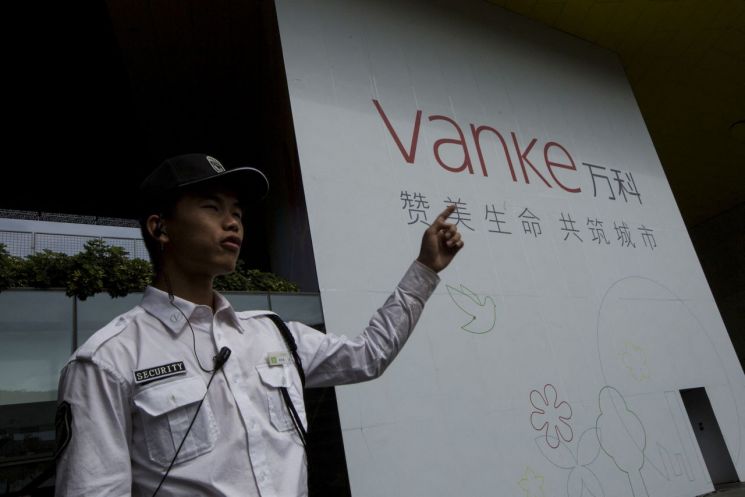 A security guard is on duty at the Wanker headquarters in Shenzhen, China. Photo by Reuters Yonhap News Agency
An even greater concern is the potential ripple effect of China's economic slowdown risk on the global economy. Park stated, "The risk of an economic slowdown in China may no longer be just a domestic issue," explaining, "Since China, along with the United States, leads the global economy, it will have a negative impact on the global economy both directly and indirectly." He further noted, "This is a negative factor that could weigh on financial markets, including the foreign exchange and stock markets. In other words, the outflow of global funds from China could lead to additional foreign capital outflows from the domestic stock market and act as a negative factor for the Korean won exchange rate."
There is also a high possibility that China's aggressive low-cost export strategy will intensify. Park added, "If China becomes even more aggressive in exporting its deflation risk, it will be a setback for the recovery of the global manufacturing sector." He continued, "The previously underestimated risks of China's economic slowdown and debt could be amplified by worsening domestic demand and another liquidity crisis. This is a risk factor that financial markets worldwide, including Korea, must remain vigilant about."
© The Asia Business Daily(www.asiae.co.kr). All rights reserved.
![Clutching a Stolen Dior Bag, Saying "I Hate Being Poor but Real"... The Grotesque Con of a "Human Knockoff" [Slate]](https://cwcontent.asiae.co.kr/asiaresize/183/2026021902243444107_1771435474.jpg)
















