Netflix Share Reaches 14.6%... Growth Extends to Convenience Stores
From Platform Usage to Tourism and Consumer Spending
Exports Enter a "Balanced and Stable Period" with New Performance Indicators
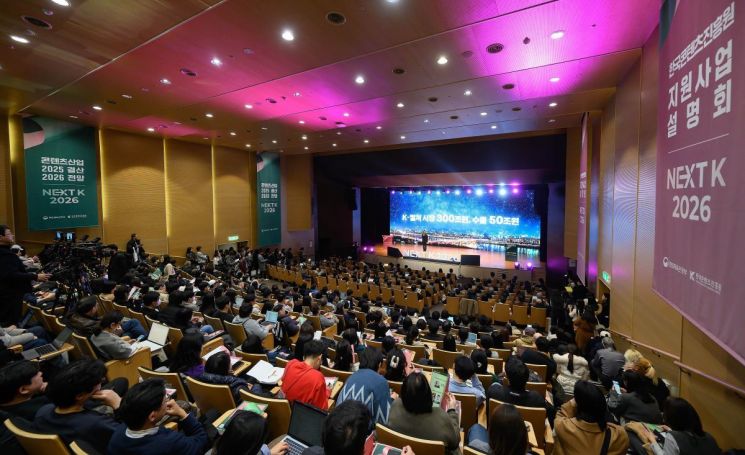
Exports of K-content have moved beyond reliance on specific markets. Compared to 2021, exports to Latin America increased by 391%, and to the Middle East by 328%.
The Ministry of Culture, Sports and Tourism and the Korea Creative Content Agency announced the "2025 Year-End Review" at the "NEXT K 2026" event held at COEX in Seoul on the 17th, defining the years 2021 to 2025 as a "balanced and stable period" for K-content exports. They explained that, after a period of growth centered on China and Asia and an expansion phase into North America, K-content has now entered a stage of simultaneous expansion into multiple regions.
Regional growth rates support this assessment. Song Jin, Director of the Content Industry Policy Research Center at the Korea Creative Content Agency, stated, "Compared to 2021, Latin America grew by 391%, the Middle East by 328%, and other regions including Australia by 636.4%," adding, "Exports are no longer concentrated in specific regions but are spreading into new markets." North America and Asia maintained steady growth rather than sharp increases.
Global platform indicators also reflect this trend. This year, four out of the top twenty most-watched dramas on Netflix were K-dramas.
Hyunseok Yoo, Acting President of the Korea Creative Content Agency, said, "As of the first half of 2025, K-dramas accounted for 14.6% of total viewing hours on Netflix." He explained that the presence of K-dramas has grown not only in terms of the number of titles but also in total viewing time.
The status of K-content within the platform has also become clear. Director Song stated, "K-content ranked second globally in viewership among all non-U.S. content on Netflix."

The change in consumption patterns is also noteworthy. After the release of new seasons, there was a simultaneous trend of viewers rewatching previous seasons and binge-watching. Rather than being limited to one-off hits, cumulative viewing has become more prominent. This pattern demonstrates that K-dramas are establishing a stable consumption base within global platforms.
K-pop has also solidified its presence on global charts. Stray Kids achieved first place on the main Billboard album chart, the "Billboard 200," for eight consecutive times. This was unprecedented in Billboard's 70-year history. Acting President Yoo explained, "This is not a one-off achievement, but evidence that long-term global consumption is possible."
This year, seventeen K-pop songs made it onto Billboard's annual "Global 200" chart, with some tracks remaining in the top ranks for extended periods.
The spread of K-content has extended to related industries as well. The number of foreign visitors to Korea increased by approximately 23% compared to the previous year. Exports of K-food also rose by about 8.9% during the same period. From July to September 2025, the number of overseas payments at convenience stores increased by 157% year-on-year. These are signs that K-content consumption is expanding into everyday purchasing behavior.
Director Song noted, "'K-Pop Demon Hunters' has created globally recognized narratives not only about Korea's traditional culture but also about modern Seoul life, including gimbap and ramen, through the power of animation and music," adding, "The number of foreign tourists at Namsan Seoul Tower reached an all-time high."
 On the 4th, near Hongdae in Mapo-gu, Seoul, foreign tourists are taking commemorative photos as snow falls. Photo by Yonhap News Agency
It is now a common sight to see foreigners purchasing instant foods via easy payment methods at convenience stores in areas like Myeongdong and Hongdae. The structure of content consumption is evolving from simply watching videos to encompassing tourism, food, and consumer goods purchases.
Acting President Yoo stated, "This year, we provided close B2B support based at thirty business centers worldwide. The overseas promotional center, Korea 360, welcomed about 200,000 visitors and achieved sales exceeding 4 billion won."
The most remarkable growth was seen in Latin America and the Middle East. The surge is attributed to the localization strategies of global OTT platforms. The expansion of multilingual subtitles and dubbing, along with improved accessibility to non-English content, is considered to have contributed to the increased consumption of K-content. Rather than simply exporting content as-is, distribution strategies were adjusted to fit the cultures and languages of each region.
Director Song said, "K-content is transitioning from being an export product focused on a single market to content consumed simultaneously across multiple regions."
Accordingly, the criteria for evaluating global performance are also changing. Beyond sales volume or individual hits, platform usage indicators and changes in related industries have become key metrics demonstrating the influence of K-content.
© The Asia Business Daily(www.asiae.co.kr). All rights reserved.
![Clutching a Stolen Dior Bag, Saying "I Hate Being Poor but Real"... The Grotesque Con of a "Human Knockoff" [Slate]](https://cwcontent.asiae.co.kr/asiaresize/183/2026021902243444107_1771435474.jpg)

















