Management Focused on Beneficiary Rate, Introduction of Block Funding
Strengthening University Competitiveness Through AI Centers
The government will completely overhaul the basic research investment structure, focusing on restoring fundamental research and providing long-term, stable research support. By introducing a management system centered on the beneficiary rate of researchers, the government aims to establish a framework in which 30% of all faculty members (50% of full-time faculty, 70% of early-career faculty) will be engaged in basic research by 2030. This initiative seeks to address the structural limitations of stagnant returns on investment and research instability, and to propel South Korea into the ranks of the world's top five basic research powerhouses by 2030, based on the "restoration of diversity and excellence."
On December 18, at the 2nd Meeting of Ministers Related to Science and Technology, the government reviewed and announced the "Plan to Foster the Basic Research Ecosystem," which contains these measures. This plan serves as a follow-up implementation strategy for the national policy task of "establishing a basic research ecosystem and realizing a nation strong in science and technology talent."
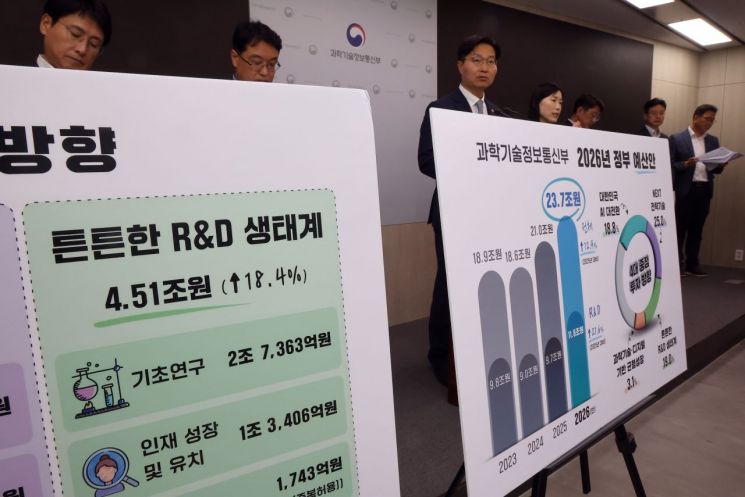 On September 9, Koo Hyuk-chae, First Vice Minister of the Ministry of Science and ICT, explained the 2026 budget plan at the Ministry of Science and ICT briefing room in the Government Sejong Complex. Photo by Yonhap News
Stagnant Results Despite Increased Investment... Concerns Over Research Stability
The government has assessed that, although investments in basic research have steadily increased, there are clear limitations in terms of outcomes. As of 2025, Korea has 76 Highly Cited Researchers (HCRs) in the top 1% worldwide, a lower proportion compared to major advanced countries. The number of domestic research institutions ranked in the top 200 of the Nature Index has also declined to five.
In addition, recent fluctuations in research and development (R&D) budgets have led to a contraction in academic diversity and have undermined the stability and predictability of the research environment. The government believes that unless these structural issues are addressed, it will be difficult to continuously generate world-class research achievements, and has therefore embarked on a comprehensive redesign of the basic research ecosystem.
As a first step, the government will work to establish a stable and sustainable investment system for basic research. It will restore fundamental research, which has been strongly demanded by the research community, and will expand the base of basic research by prioritizing groups with weaker research foundations, such as first-time researchers, those with career interruptions, and researchers based in regional areas.
The duration of individual research projects will be extended from the current 1-3 years to 3-5 years, and follow-up studies on the same research topic will be eligible for up to two additional rounds of support, making long-term research of up to 11 years possible. This institutional support for so-called "deep-dive research" is intended to foster continuity and depth in research.
Furthermore, the management of basic research outcomes will shift from the number of projects selected to a focus on the beneficiary rate of researchers. The government plans to gradually increase investment to achieve a basic research beneficiary rate of 30% for all faculty, 50% for full-time faculty, and 70% for early-career faculty by 2030. To this end, the government will also pursue amendments to the "Basic Research Promotion Act" to allocate a certain proportion of government R&D investment to basic research.
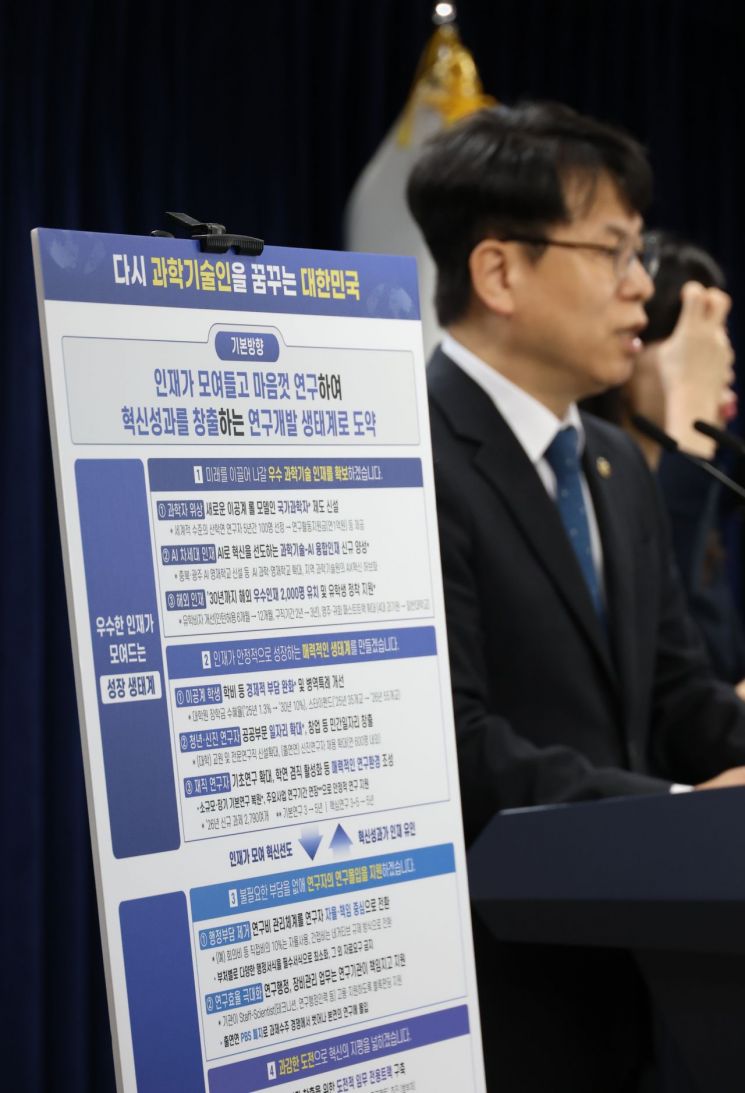 Park Ingyu, Director of the Innovation Headquarters at the Ministry of Science and ICT, announced the strategy for securing scientific and technological talent and plans to innovate the research and development ecosystem at the Government Seoul Office Building on the 7th of last month. Photo by Yonhap News
Support for 10,000 Young Researchers... Fostering Top-Tier Leaders
Support for young researchers will also be significantly strengthened. Focusing on postdoctoral fellows and early-career faculty, the government will support 10,000 young researchers over the next five years and establish a customized support system that covers every stage of their development without gaps.
To help researchers reach the highest global standards, the government will launch the "Top-Tier Leader Research" program. The most outstanding researchers will receive approximately 1.6 billion won (about 1.2 million US dollars) annually for up to nine years, with support linked to global joint research and partnership building. In addition, a council of leader researchers will be established to promote science culture, foster STEM talent, and provide policy advice.
To strengthen the research competitiveness of universities, a performance-based "block funding" system will be introduced. Universities will be encouraged to autonomously allocate resources to invest in staff scientists, research support personnel, and the expansion of advanced research facilities and equipment, thereby improving the research ecosystem. The specific details, including eligible recipients and funding scale, will be determined through future consultation with stakeholders.
From the perspective of regional balance, a regional track will be added to the National Research Laboratory (NRL 2.0) program, and support for Regional Leading Research Centers (RLRC) will be expanded. The Institute for Basic Science (IBS) will be developed as a central institution in advanced basic science, and its international competitiveness will be strengthened by establishing overseas branches and attracting global research teams.
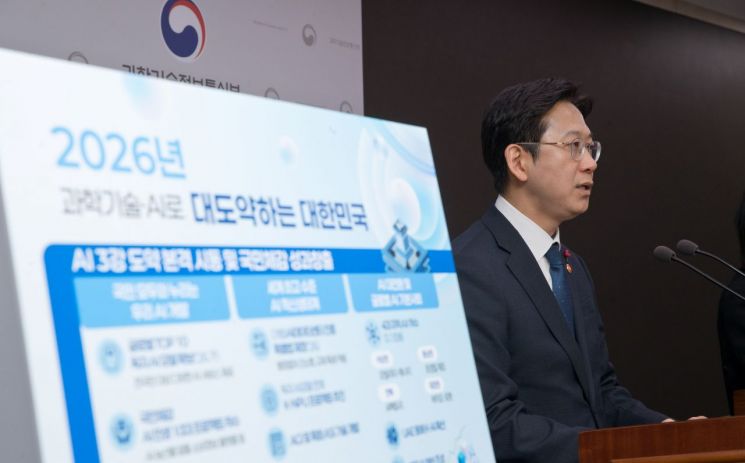 Deputy Prime Minister and Minister of Science and ICT, Paik Kyung-hoon, is giving a briefing on the '2026 Ministry of Science and ICT Work Plan Report' at the government Sejong Government Complex press room on the 12th. Photo by Yonhap News
Full-Scale Basic Research-AI Convergence... 40 AI Centers to Be Established
The government will also actively promote the convergence of basic research and artificial intelligence (AI). By 2030, 40 "Basic Research AI Centers" will be designated and operated at universities, with tailored AI environments and dedicated infrastructure established for each domain. Through this initiative, the government aims to train 2,000 researchers specializing in basic research-AI convergence.
To allow researchers to focus on their work, the government will also reduce administrative burdens. Stage-based evaluations will be abolished and selection evaluations will be simplified. At the same time, AI technology will be gradually introduced throughout the evaluation process to enhance the reliability and expertise of assessments.
Deputy Prime Minister and Minister of Science and ICT, Paik Kyung-hoon, stated, "Basic research, which explores fundamental principles and accumulates the foundation of knowledge, is the cornerstone of our country's scientific and technological development and the starting point for future innovation. Through these measures, we will create a basic research ecosystem where researchers can carry out creative work over the long term and with stability, without concerns, and where world-class achievements are continuously produced."
© The Asia Business Daily(www.asiae.co.kr). All rights reserved.
![Clutching a Stolen Dior Bag, Saying "I Hate Being Poor but Real"... The Grotesque Con of a "Human Knockoff" [Slate]](https://cwcontent.asiae.co.kr/asiaresize/183/2026021902243444107_1771435474.jpg)

















