Work Plan Reported to the President
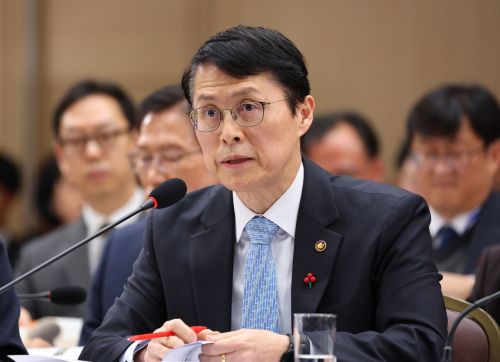 Choi Wonho, Chairman of the Nuclear Safety Commission, is reporting to President Lee Jae-myung at the Government Sejong Convention Center on the 17th. 2025.12.17 Yonhap News Photo by Yonhap
The Nuclear Safety Commission has announced plans to overhaul the safety regulatory framework for Small Modular Reactors (SMRs) next year. A preliminary review system for SMR licensing will be introduced.
On December 17, Choi Wonho, Chairman of the Nuclear Safety Commission, reported this work plan to President Lee Jaemyung at the Government Sejong Convention Center.
The Commission will improve the regulatory system to verify the safety of SMR models, which have various design characteristics distinct from existing large-scale nuclear power plants. The scope of regulation, currently limited to power generation, research, and educational purposes, will be expanded to include applications such as marine propulsion, heat supply, and hydrogen production. Additionally, dedicated SMR standards will be established to verify the unique safety features of innovative designs.
To this end, starting in 2026, the Commission will operate regulatory research groups for each reactor type, involving a diverse range of developers and researchers, to discuss technical characteristics and key safety issues. The Nuclear Safety Act will be amended to institutionalize preliminary reviews, allowing regulatory authorities to conduct assessments even before formal licensing applications are submitted. A roadmap for establishing the SMR regulatory framework will be formulated and announced in 2026, alongside efforts to amend the Nuclear Safety Act.
For spent nuclear fuel disposal facilities, the Commission will separate construction and operation permits to enable step-by-step safety reviews, considering the construction period of over 30 years. In collaboration with the High-Level Radioactive Waste Management Committee and the Korea Radioactive Waste Agency, proactive measures will be taken to identify safety issues in advance.
Regarding the continued operation permit for Kori Unit 2 this year, the Commission plans to clarify the scope of accident scenarios subject to radiological environmental impact assessment, addressing previous concerns about regulatory ambiguity.
To better reflect the opinions of residents living near nuclear power plants, the Commission will require the provision of explanatory documents that present radiological environmental impact assessment reports in easy-to-understand language.
The Commission also plans to significantly improve its information-sharing system to transparently provide nuclear safety information of high public interest-such as continued operation, new nuclear plants, and the impact of climate change on nuclear safety-and to make technical terms and documents more accessible.
Original regulatory texts written in technical language will be supplemented with easy-to-understand explanatory materials, and all information currently dispersed among nuclear operators and regulatory agencies will be integrated into a unified online one-stop information service.
Additionally, newly established offline information sharing centers near nuclear facilities will be used to provide residents with face-to-face explanations of local licensing information and safety issues, ensuring continuous communication.
© The Asia Business Daily(www.asiae.co.kr). All rights reserved.
![Clutching a Stolen Dior Bag, Saying "I Hate Being Poor but Real"... The Grotesque Con of a "Human Knockoff" [Slate]](https://cwcontent.asiae.co.kr/asiaresize/183/2026021902243444107_1771435474.jpg)















