Targeting a Cumulative 105.5 Trillion Won by 2030
Average Annual Growth of 7.5%
UNESCO World Heritage Committee to Convene in Busan Next July

The National Heritage Administration plans to expand the scale of the K-Heritage industry to a cumulative total of 105.5 trillion won by 2030. The agency aims to foster related industries such as gaming, film, and tourism through a major transformation driven by artificial intelligence (AI) and digital technologies.
On December 17, the National Heritage Administration announced its "Key Work Plans for 2026," which include these objectives. Currently, the K-Heritage industry market is valued at about 9 trillion won, encompassing sectors such as content and tourism. The agency has set an annual average growth target of 7.5%.
The annual targets are 17.4 trillion won in 2026, 19 trillion won in 2027, 20.9 trillion won in 2028, 23 trillion won in 2029, and 25.2 trillion won in 2030. By sector, tourism is expected to show the greatest growth, rising from 4.4 trillion won to 50.4 trillion won. The content sector is projected to expand from 2.75 trillion won to 33 trillion won, related industries from 1.6 trillion won to 17.2 trillion won, and the intellectual property (IP) sector from 300 billion won to 4.9 trillion won.
As the foundation for this growth strategy, the National Heritage Administration will accelerate the establishment of digital heritage data. The agency plans to systematically accumulate and standardize original data, converting it into IP. By the end of next year, 510 additional original data sets will be added for a total of 3,827, and 700 new assets will be produced, bringing the cumulative total to 3,551. The agency will also build approximately 460,000 AI training data sets to improve the accuracy of AI models using image- and text-based data.
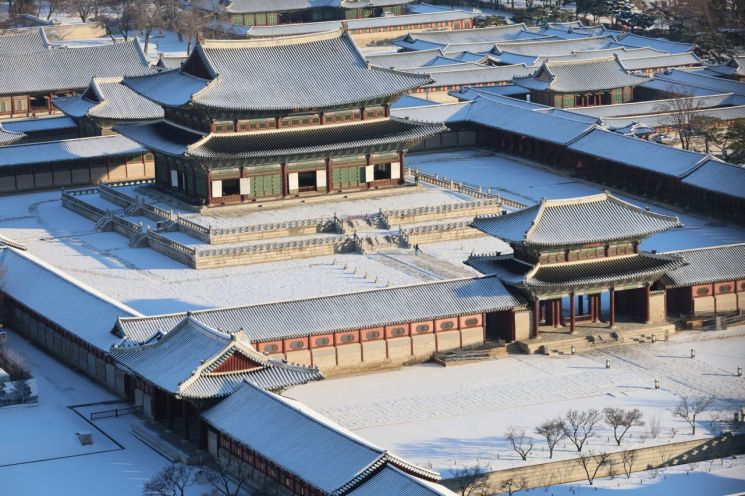
The digital heritage data being established will be utilized for on-site interpretation services. The National Heritage Administration will develop a multilingual, customized AI interpretation service for the Four Major Palaces and Jongmyo Shrine. Selected as one of the Ministry of Science and ICT's "Top 10 AI Projects for Public Life," this initiative will receive a total investment of 3 billion won over two years from 2026 to 2027. The service will be implemented based on approximately 250,000 original data sets. With the number of foreign visitors to palaces and royal tombs surpassing 4 million this year, the agency aims to enhance accessibility for international tourists and boost tourism demand.
The agency will also continue to advance the national heritage management system by establishing H-BIM. This system visualizes the repair history and structural information of architectural heritage in three dimensions (3D) for better management. Next year, 1.3 billion won will be invested in seven sites, including Gwandeokjeong Pavilion and Daeseongjeon Hall at Jeju Hyanggyo. To date, H-BIM has been implemented at 117 sites.
A flagship store for exhibiting and selling national heritage cultural products will be established at Gyeongbokgung Palace between 2026 and 2027. Next year, 800 million won will be allocated for design, including basic service contracts and the formation of an advisory group, to respond to the growing domestic and international demand for traditional cultural products.
On the institutional side, the agency will promote the enactment of the "Act on the Promotion and Support of the National Heritage Industry." Proposed in June, this bill covers the definition and scope of the industry, information system establishment, research and development, human resource training, and the promotion of digital content. In line with the legislation, an industry status survey will be conducted, sampling 2,000 businesses with at least one employee in the special classification of national heritage. The survey will take place from February to December next year, with the results to be published in February 2027.
Infrastructure expansion will also proceed in parallel. The agency plans to establish the National Heritage Digital Center, which will support collection research and develop systems for establishment and operation. Construction and exhibition installation will take place in 2027, with the center scheduled to open in 2028.
 Heo Min, Commissioner of the Cultural Heritage Administration, Visits National Heritage Repair Materials Center Photo by Yonhap News
The National Heritage Administration will also strengthen support for research and development (R&D). By applying AI and digital twin technologies, the agency aims to advance diagnostic and restoration technologies for national heritage damage. With a budget of 4.4 billion won, eight projects will be pursued, including restoration design for architectural heritage and the development and standardization of unmanned autonomous underwater cultural heritage exploration technologies. For research on recovery technologies addressing national heritage damage caused by climate change, 9.6 billion won will be invested in 21 projects, including the development and demonstration of intelligent damage function estimation models and integrated control platforms.
The agency will also increase the practical use of research results. It will promote both paid and free technology transfers of major R&D achievements and expand connections to commercialization. A representative example is "Arch3D Liner," a product developed through the "Development of Intelligent Solutions for Creating Digital Survey Drawings of Cultural Heritage" project. Designated as an innovative product by the Ministry of SMEs and Startups, it was included in the Public Procurement Service's pilot purchase program for innovative products and has already been supplied to five institutions this year alone.
From July 19 to 29 next year, the 48th Session of the UNESCO World Heritage Committee will be held at BEXCO in Busan. Approximately 3,000 participants from about 200 countries are expected to attend. The National Heritage Administration will use this opportunity to actively promote Korean heritage, including world heritage sites, and will seek to adopt an international declaration emphasizing peace and cooperation in the field of world heritage.
 Paek Min, Director of the National Heritage Administration, Meets with Director of UNESCO World Heritage Centre - Yonhap News
The agency will also expand cultural events to enhance the international recognition of national heritage. Aiming to globalize the Royal Culture Festival, the agency will increase overseas outdoor advertising and provide ticketing services through the global tourism platform "Creatrip." The agency will operate an English-language website and strengthen multilingual services, including foreign-language promotional materials and guides. Programs exclusively for international visitors, such as the Moonlight Tour and Starlight Night Walk, will be linked to further improve accessibility for overseas tourists.
Domestically, the agency will actively identify so-called "heritage of our time," which refers to heritage created or formed less than 50 years ago. Key targets include the birthplaces of independence activists, heritage related to forced mobilization during the Japanese occupation, modern and contemporary architectural and industrial heritage (such as railways, shipyards, and coal mines), popular culture heritage (early materials related to films, popular music, and dramas), and digital and informatization heritage (such as PC communication and Hangul word processors).
Huh Min, Commissioner of the National Heritage Administration, stated, "2026 will be the year when the achievements of the new government's national heritage policy are fully realized. As the root of a culturally strong nation and the source of K-culture, national heritage will reach into the future and out to the world. We will develop a variety of policies and implement them swiftly so that the public can truly feel the impact."
© The Asia Business Daily(www.asiae.co.kr). All rights reserved.
![Clutching a Stolen Dior Bag, Saying "I Hate Being Poor but Real"... The Grotesque Con of a "Human Knockoff" [Slate]](https://cwcontent.asiae.co.kr/asiaresize/183/2026021902243444107_1771435474.jpg)

















