The Korea Atomic Energy Research Institute (KAERI) announced on December 17 that it has begun clinical trials of 'Technekitty,' an injectable diagnostic agent for feline hyperthyroidism.
Following last year's 'Thyrokitty Injection (I-131),' Technekitty is the second veterinary radiopharmaceutical to receive clinical approval in Korea.
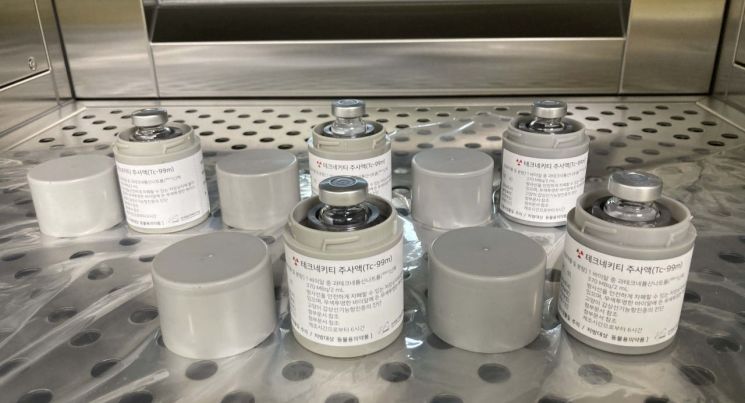 The Korea Atomic Energy Research Institute has developed 'Technekitty,' a diagnostic agent for feline hyperthyroidism, and has begun clinical trials. Photo by Korea Atomic Energy Research Institute
Feline hyperthyroidism is a common hormonal disorder affecting about 10% of senior cats aged 10 and older. If left untreated, it can lead to cardiovascular complications and other health issues, making early diagnosis and treatment essential.
Until now, blood tests and ultrasound examinations have been primarily used to determine whether a cat has developed the disease. However, at early stages, blood levels often appear normal, making it difficult to diagnose, and ultrasound alone has limitations in detecting functional abnormalities.
In response, KAERI received approval for the clinical trial plan for Technekitty from the Animal and Plant Quarantine Agency in April. Starting on December 16, the institute began a one-year clinical trial at Chungbuk National University Animal Hospital, targeting 42 cats. The trial includes both a healthy control group and a test group of cats suspected of having hyperthyroidism.
The thyroid gland absorbs iodine to synthesize thyroid hormones. KAERI noted that Technekitty acts similarly to iodine. After administering Technekitty, the institute plans to use single-photon emission computed tomography (SPECT) imaging to determine whether a cat has developed hyperthyroidism.
SPECT is a device that provides three-dimensional images showing how much and how quickly a radiopharmaceutical accumulates in the body. It is widely used to evaluate organ function.
According to KAERI, in SPECT images, areas with higher absorption of the radiopharmaceutical Technekitty appear brighter. By analyzing the brightness and distribution patterns in the images, it is possible to accurately determine hyperthyroidism or hypothyroidism, identify the location of abnormal areas, and detect possible metastasis.
Previously, since 2022, KAERI has conducted joint research with LCGen and Chungbuk National University College of Veterinary Medicine, supported by the Ministry of Agriculture, Food and Rural Affairs and the Korea Institute of Planning and Evaluation for Technology in Food, Agriculture, and Forestry’s pet industry technology development project.
Additionally, based on the regulatory experience accumulated during the development of the therapeutic agent Thyrokitty, KAERI quickly completed the necessary preclinical safety reviews and in vivo evaluations, securing clinical approval for Technekitty as a follow-up product.
Jung Youngwook, Director of the HANARO Quantum Science Research Center at KAERI, stated, "The clinical approval of Technekitty is not a one-off achievement but signifies the establishment of a sustainable process for developing new veterinary drugs. By localizing both therapeutic and diagnostic agents, we aim to lead not only the domestic companion animal healthcare market but also exports to the broader Asian region in the future."
© The Asia Business Daily(www.asiae.co.kr). All rights reserved.
![Clutching a Stolen Dior Bag, Saying "I Hate Being Poor but Real"... The Grotesque Con of a "Human Knockoff" [Slate]](https://cwcontent.asiae.co.kr/asiaresize/183/2026021902243444107_1771435474.jpg)















