Despite Policy Adjustments, S-UAM Moves Forward as Planned
Business Strategy Streamlined from Four to Three Stages: "Accelerated Implementation"
Pilot Operations to Begin Over the Han River Immediately Upon Aircraft Certification
Seoul City is accelerating the establishment of the "Seoul-type Urban Air Mobility (S-UAM)" system. Although the government has postponed its domestic commercialization target to 2028 due to delays in aircraft certification, the city plans to make early preparations by adjusting its business strategy, including the commencement of pilot operations.
On the 17th, Seoul City announced that it will begin full-scale preparations for S-UAM pilot operations in line with the "Seoul-type UAM Blueprint" released last year.
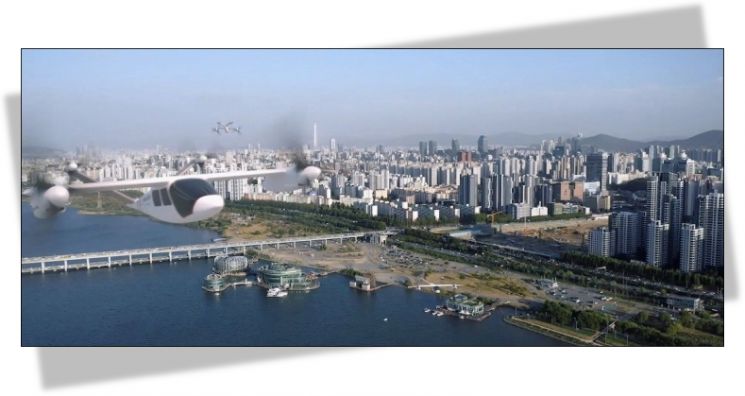
Previously, in August, the government postponed the domestic commercialization target to 2028 and revised the K-UAM policy to allow urban entry only after sufficient demonstration in non-urban areas. This decision is linked to the global trend of UAM projects being delayed. Currently, aircraft development is underway mainly in the United States and China, but progress has stalled at the stage of international certification, causing commercialization to stagnate just before launch.
In response, Seoul City has proposed a plan to connect UAM commercialization without a demonstration project by specifying an implementation strategy that reflects urban characteristics, such as demand and location.
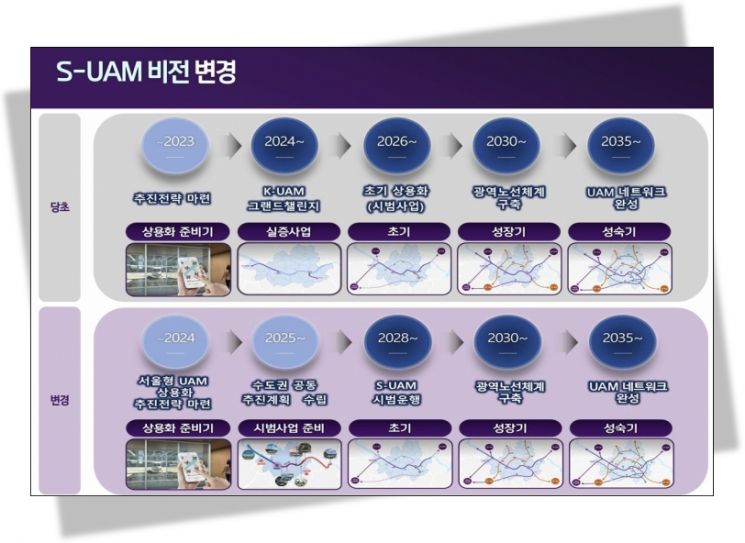
First, based on the S-UAM vision announced last year, the city will begin preparations to foster a market led by the private sector. Since the "Seoul and Greater Seoul Area UAM" project is directly related to the level of domestic commercialization, the city will push forward the business stages more intensively to take the lead in introducing urban UAM. In particular, expecting international certification to be completed within the next two to three years, the city will quickly introduce aircraft and enable immediate commercialization. The "Demonstration~Initial~Growth~Maturity" four-stage business strategy presented in the "S-UAM Future Vision" in November last year will be revised to a three-stage strategy: "Initial Commercialization~Growth~Maturity."
Related research is also underway to specify major routes and operational systems by next year. The main route will be designed around the Han River, and preparations will be made so that pilot operations can begin immediately over the Han River as soon as the aircraft receives final certification. The Han River is considered optimal due to its few obstacles, high connectivity and safety, and excellent accessibility between downtown, sub-centers, and airport areas. In addition, it is evaluated as the best section to verify both the marketability and safety of UAM, given the high tourism demand and clear willingness of operators to participate.
The city expects that, with the relocation of the presidential office, the use of airspace over the Han River will expand, making the Han River the core stage for UAM and a catalyst for early commercialization.
The city is also preparing the foundation for "safe operation." This includes completing the operational system, such as aircraft introduction and vertiport safety, as well as thoroughly preparing real-time risk monitoring systems and emergency response manuals. By 2027, the city will proactively conduct surveys and impact analyses on public acceptance regarding safety and noise, creating conditions for citizens to use UAM with confidence. Once aircraft certification is complete, operations will begin in phases.
Cooperation with the private sector will also be strengthened. As the private sector will lead commercialization, the city will leverage Seoul's high market potential to build partnerships with domestic and international private operators. Even as the commercialization schedule is adjusted, the city plans to ensure the initial market forms naturally through close partnerships with the private sector.
This will be expanded into a joint pilot project with local governments in the greater Seoul area. Seoul City and Incheon City will jointly launch a "Greater Seoul Area UAM Pilot Project Planning Study" to secure a regional hub network and integrated operational system in advance. The planning study will include analysis of regional demand in the greater Seoul area, route scenarios between key hubs, technical evaluation of candidate sites, basic vertiport plans, service models, and implementation strategies.
Yeo Jangkwon, Director of Transportation at Seoul City, stated, "While realistically reflecting the postponement of the national commercialization target, if we maximize the opportunities of the Han River route and enhance execution through cooperation in the greater Seoul area, UAM commercialization will become a reality more quickly," adding, "We will thoroughly prepare for a safe and efficient era of UAM."
© The Asia Business Daily(www.asiae.co.kr). All rights reserved.
![Clutching a Stolen Dior Bag, Saying "I Hate Being Poor but Real"... The Grotesque Con of a "Human Knockoff" [Slate]](https://cwcontent.asiae.co.kr/asiaresize/183/2026021902243444107_1771435474.jpg)
















