Unemployment Rate Hits Four-Year High Despite Better-Than-Expected November Jobs Report
Retail Sales Stagnate in October
Mixed Employment Data Heightens Uncertainty Over Interest Rate Path
December Jobs Report in Early January Becomes Key Indicator
The three major indices of the U.S. stock market declined on the 16th (local time). Although the November employment report confirmed a slowdown in the labor market, the simultaneous increase in employment and the rise in the unemployment rate have heightened uncertainty over the future path of interest rates. International oil prices have fallen to their lowest levels in more than four years since early 2021, as ceasefire talks between Ukraine and Russia have gained momentum.
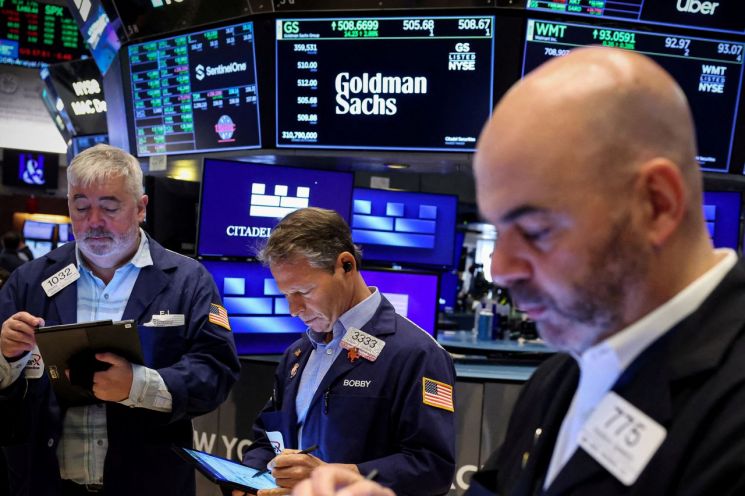 Traders are working on the floor of the New York Stock Exchange (NYSE) in the United States. Photo by Reuters Yonhap News Agency
As of 12:36 p.m. on the New York Stock Exchange, the blue-chip Dow Jones Industrial Average was down 263.21 points (0.54%) from the previous trading day at 48,153.35. The large-cap S&P 500 Index fell 28.03 points (0.41%) to 6,788.48, while the tech-heavy Nasdaq Composite declined 29.044 points (0.13%) to 23,028.369.
According to the November employment report released by the U.S. Department of Labor's Bureau of Labor Statistics (BLS), nonfarm payrolls increased by 64,000. This figure surpassed the market expectation of 45,000 compiled by Dow Jones. Compared to October, when nonfarm employment fell by 105,000 due to federal government workforce reductions, this marks a return to growth.
However, the unemployment rate rose to 4.6% in November. This is higher than both September's 4.4% and the market forecast of 4.5%, marking the highest level since September 2021. While the employment figures align with the overall trend of a slowing labor market, the mixed signals of increased hiring and a higher unemployment rate did not significantly boost expectations for additional interest rate cuts.
Kevin O'Neill, Associate Portfolio Manager at Brandywine Global, stated, "This report shows enough signs of (economic) slowdown to justify previous rate cuts, but there is little evidence to support further substantial easing going forward." He added, "With the labor market sending mixed signals, the next inflation data to be released at the start of the new year is likely to become the main driver for the market."
Scott Helfstein, Head of Investment Strategy at Global X, commented, "While employment growth was better than expected, the rise in the unemployment rate means that warning signals have not been completely eliminated." He analyzed, "This leaves open the possibility of additional rate cuts by the Federal Reserve early next year, which could contribute to some degree of stock market stability through the end of the year."
However, it is not expected that this employment report will become a decisive variable for the future course of monetary policy. The December employment report, to be released in early January, is expected to be a more important indicator for determining the policy direction at the Federal Open Market Committee (FOMC) meeting scheduled for the 28th of next month.
Meanwhile, U.S. consumer spending appears to have stagnated. According to the U.S. Census Bureau under the Department of Commerce, retail sales in October of this year stood at $732.6 billion, unchanged from the previous month and below Bloomberg's forecast of a 0.1% increase. This is attributed to weak sales of automobiles and gasoline. Employment instability, economic uncertainty, and high inflation are all contributing to consumers becoming more cautious about increasing their spending. The retail sales growth rate for September was revised downward from 0.2% to 0.1%. However, as consumption has not declined sharply, it is still seen as providing a buffer for the economy.
Investors' attention is now focused on the November Consumer Price Index (CPI), which will be released on the 18th. Both headline CPI and core CPI are expected to have risen 3.1% year-on-year, a slight increase from September's 3.0%. This signals a phase where labor market slowdown and high inflation are occurring simultaneously.
U.S. Treasury yields are trending lower. The benchmark 10-year U.S. Treasury yield, a global bond market indicator, stood at 4.15%, down 3 basis points (1bp = 0.01 percentage point) from the previous day. The 2-year Treasury yield, which is sensitive to monetary policy, fell 2 basis points to 3.48%.
By sector, energy stocks are weak, with ExxonMobil and Chevron down 2.37% and 1.96%, respectively. Broadcom is down 0.15%, and Microsoft (MS) is falling 0.33%. Oracle is showing strength, up 1.09%.
International oil prices continued their decline, reaching their lowest levels in more than four years. The possibility of a ceasefire between Ukraine and Russia, as well as increased oil production by oil-producing countries, are putting downward pressure on prices. West Texas Intermediate (WTI) crude is trading at $55.28 per barrel, down $1.39 (2.45%) from the previous session, and at one point during the session fell below $55, marking its lowest point since early 2021. Brent crude, the global oil price benchmark, is trading at $59.08 per barrel, down $1.48 (2.44%) from the previous day.
© The Asia Business Daily(www.asiae.co.kr). All rights reserved.
![Clutching a Stolen Dior Bag, Saying "I Hate Being Poor but Real"... The Grotesque Con of a "Human Knockoff" [Slate]](https://cwcontent.asiae.co.kr/asiaresize/183/2026021902243444107_1771435474.jpg)















