"Avatar: Bulgwa Jae" Proves the Power of the Big Screen
Elevating Cinema from Mere "Viewing" to an Immersive "Experience"

With the absence of blockbuster films, changes in viewing habits, and the rise of OTT-centered consumption, movie theaters are increasingly becoming selective spaces. Director James Cameron's "Avatar: Bulgwa Jae" directly challenges this trend, creating an experience on the screen that cannot be completed at home.
The depth of this film's experience varies depending on the viewing conditions. The entire screening environment-including screen size, sound, and three-dimensionality-is used as a means of expression. In particular, the landscape of Pandora, stained with fire and ashes, is intentionally contrasted with the blue seas of the previous installment, "Avatar: The Way of Water" (2022), maximizing the visual impact. Weta FX, which produced 3,382 VFX shots, delivered even denser depictions of creatures, terrain, and battlefields. Nature is visualized not just as a backdrop but as a language of emotion.
The evolution of the series does not stop at the sophistication of computer graphics (CG). The core lies in how the actors' real performances are transferred into the digital world. Cameron advanced underwater performance capture to a new level, creating scenes that convincingly depict both above and below the water. The actors performed in actual underwater environments, and their movements, breathing, and subtle emotional changes were captured directly as data.
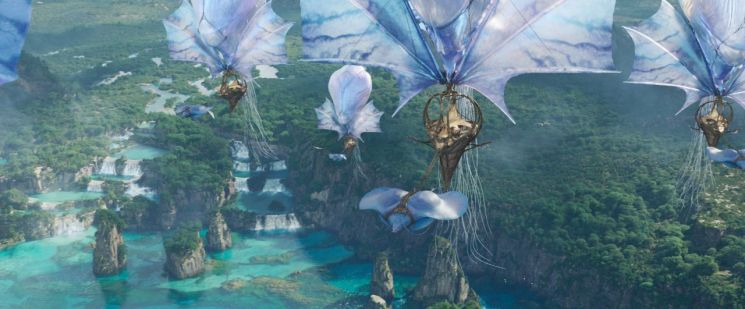
The depiction of the newly introduced Mangkwan tribe is also noteworthy. The flames and ashes emitted by those carrying the trauma of a volcanic eruption leap toward the audience through three-dimensional (3D) effects. While in the previous film it felt as if the water was within reach, this time, sparks and debris cut through the space.
The massive creatures Medusoid and Windray, ridden by the Tilarim tribe, are another visual spectacle. Inspired by jellyfish and cuttlefish, these lifeforms combine translucent textures, smooth, gliding movements, and immense scale to become new symbols that succeed the Tulkun from the previous film.
Within this seemingly real world, Cameron delves relentlessly into the meaning of family, blood ties, and chosen relationships over 197 minutes. In particular, Loak, who wavers between responsibility and recognition after his brother's death, and Kiri and Spider, who rise to the center of the narrative, demonstrate that the series is expanding into a story for the next generation.
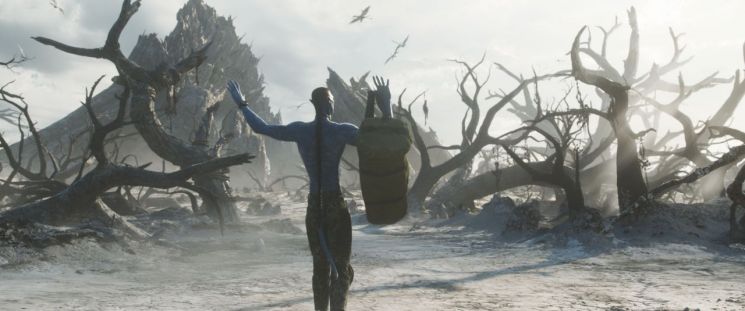
The message of humanity's repeated destruction and the sublimity of nature that resists it becomes even clearer in this installment. Fire is a metaphor for emotions such as hatred, anger, violence, and trauma. The Mangkwan tribe, who bear these scars, are portrayed not as evil, but as products of loss.
All these emotions and messages are most effectively delivered in the theater. In particular, the three-dimensionality and sound realized in premium theaters such as IMAX, Dolby Cinema, and ScreenX elevate this work from mere "viewing" to an immersive "experience." It is a level of depth that can never be achieved on a smartphone or tablet screen. This clearly demonstrates why theaters remain essential spaces.
© The Asia Business Daily(www.asiae.co.kr). All rights reserved.
![Clutching a Stolen Dior Bag, Saying "I Hate Being Poor but Real"... The Grotesque Con of a "Human Knockoff" [Slate]](https://cwcontent.asiae.co.kr/asiaresize/183/2026021902243444107_1771435474.jpg)


















