Briefing Session for Journalists on December 16: Naju's Bid for Artificial Sun Research Facility
From Site Selection to Building an Industrial Ecosystem: Operational Plans Unveiled
Talent Development Centered on Korea Institute of Energy Technology, with Administrative Support Promised
1.2 Trillion Won Project: Groundbreaking in 2028, Completion Targeted for 2036
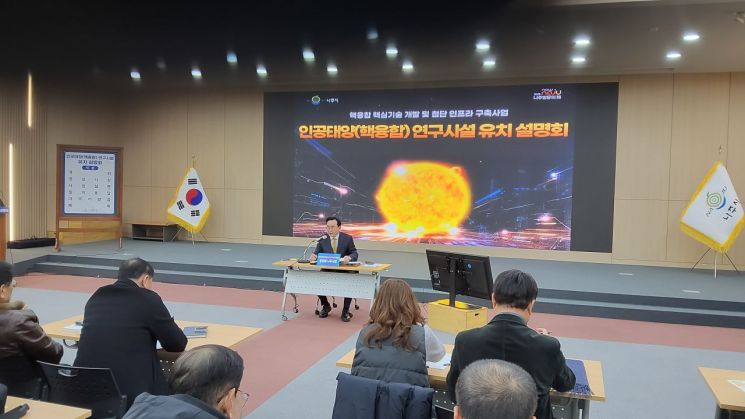 Yoon Byungtae, Mayor of Naju City, is conducting a briefing session on the attraction of the artificial sun research facility for journalists at the main conference room of Naju City Hall on the 16th. Photo by Shim Jinseok
Yoon Byungtae, Mayor of Naju in South Jeolla Province, has outlined a blueprint to develop Naju into a "global leading city for fusion energy" by leveraging the artificial sun (nuclear fusion) research facility.
On the afternoon of December 16, Naju City held a briefing session for journalists at the main conference room of City Hall regarding its bid to attract the artificial sun research facility. The event drew significant attention, with representatives from around 200 media outlets, including broadcasters, news agencies, and newspapers, in attendance.
The session was conducted in a Q&A format between Mayor Yoon and the journalists, focusing on the significance of attracting the artificial sun research facility and its future operational direction.
Mayor Yoon stated, "The Energy National Industrial Complex in Wanggok-myeon, Naju, where the artificial sun research facility will be located, is founded on a stable granite bedrock and, since the beginning of meteorological observations, has never recorded a single earthquake of magnitude 3.0 or higher. Based on this site stability, we aim to establish the optimal research complex, featuring infrastructure for training research personnel in collaboration with Korea Institute of Energy Technology and Gwangju Institute of Science and Technology, as well as excellent transportation links with KTX Naju Station and Muan International Airport nearby."
Naju City received a "very excellent" rating in all categories of the site selection evaluation for the "Core Fusion Technology Development and Advanced Infrastructure Construction Project," including basic requirements (40 points), site conditions (50 points), and policy alignment (10 points).
Mayor Yoon assessed, "These conditions provide an ideal environment for synergy, enabling the rapid expansion of fusion demonstration technology and related industries after the research facility is established." He especially expressed high expectations for collaboration with Korea Institute of Energy Technology.
He said, "There are four professors at Korea Institute of Energy Technology specializing in fusion research, and a fusion research network is already in place. By establishing superconducting conductor test facilities on campus, we will be able to lead joint research on superconducting magnet technology and the localization of core technologies even after the facility is completed."
He continued, "Fusion research is a high-level field that encompasses advanced science and technology, including physics, electrical engineering, materials, mechanical engineering, and control. Training specialized personnel is a key task. We will provide full administrative support so that talented individuals can combine experiments and education at the research facilities concentrated in Naju."
He also revealed plans to develop Naju as a hub for demonstration and commercialization across the entire power and energy industry. In fact, attracting the artificial sun research facility is expected to result in the establishment of over 300 companies, the creation of more than 10,000 jobs, and an economic ripple effect of around 10 trillion won.
Mayor Yoon said, "Centered around Bitgaram Innovation City, Naju is already the heart of Korea's energy industry, with more than 670 energy-related companies and research institutions, including Korea Electric Power Corporation, clustered here. We have all the necessary conditions to build an 'advanced industrial ecosystem' that links company attraction, technology demonstration, localization of components, and the creation of new businesses."
He further explained, "A single AI server consumes as much electricity as dozens of households, and global data center power demand is expected to more than double in the next 10 years. This is why the artificial sun is drawing attention as a sustainable and clean energy source to support the AI era."
He added, "Attracting the artificial sun research facility will innovate the industrial structure of Gwangju and South Jeolla, completing a future energy industry system where research, demonstration, commercialization, industrialization, and power supply form a virtuous cycle. This will serve as a new model for balanced national development. This project is a national and regional collaboration to be pursued over 10 years, and the financial burden is sufficiently manageable in the long term, considering the expansion of tax revenue and revitalization of the local economy."
Meanwhile, the artificial sun is a technology that produces energy by replicating the nuclear fusion reactions occurring inside the sun here on Earth, and is referred to as "clean, infinite, and safe energy." One gram of hydrogen can generate as much energy as eight tons of oil, with almost no greenhouse gas emissions and extremely little radioactive waste, making it a next-generation energy source expected to address the climate crisis and energy depletion issues. The Naju artificial sun research facility, with a total project cost of 1.2 trillion won, is scheduled to break ground in 2028 and be completed by 2036.
© The Asia Business Daily(www.asiae.co.kr). All rights reserved.
![Clutching a Stolen Dior Bag, Saying "I Hate Being Poor but Real"... The Grotesque Con of a "Human Knockoff" [Slate]](https://cwcontent.asiae.co.kr/asiaresize/183/2026021902243444107_1771435474.jpg)















