More Purchases, Lower Average Spend per Transaction... Total Expenditure Surges
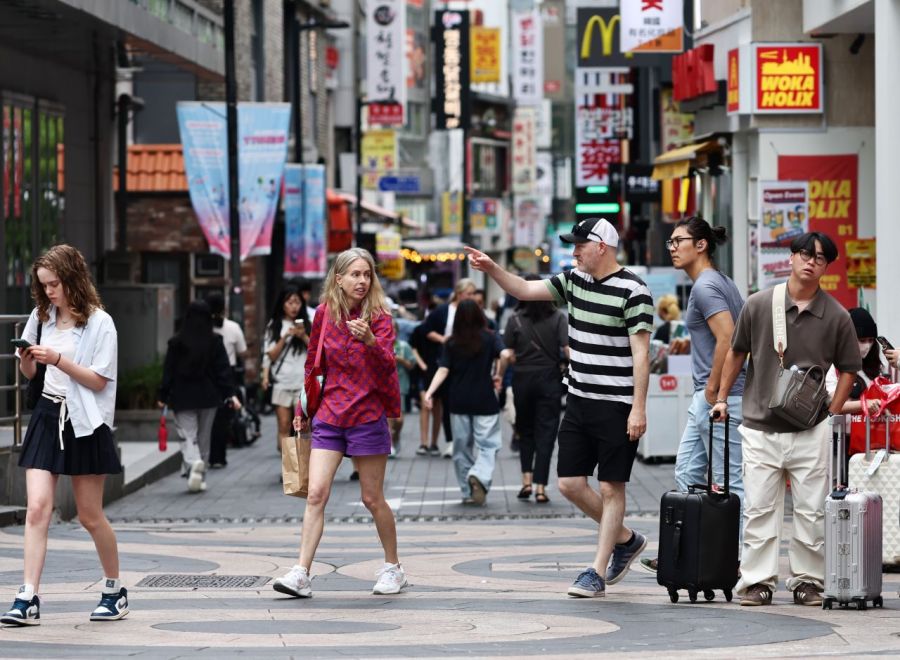
The spending patterns of foreign tourists visiting Korea have shifted from focusing on high-priced goods to 'value for money' purchases that reflect individual preferences.
The Korea Tourism Organization announced on the 16th that, according to an analysis of foreign credit card transaction data from the Korea Tourism Data Lab covering the period from 2018 to September 2025, shopping accounted for 51% of total tourist expenditures by foreign visitors to Korea.
The average amount spent per purchase decreased from 150,000 won in 2019 to 120,000 won this year, but the total spending per person increased by 83%. This is due to a 124% increase in the number of purchases, indicating a shift from buying high-priced goods to purchasing multiple mid- to low-priced items.
From January to September this year, the number of foreign card transactions increased by 142.0% for gacha shops, 48.7% for stationery, and 39.9% for bookstores compared to the same period last year. The stationery brand 'Artbox' saw balanced growth across airports, major transportation hubs, and local commercial districts, with increases of 550.0% in Yeongjongdo, 325.0% in Isu, and 85.4% in Seomyeon, Busan.
During the same period, the number of fashion purchases by foreigners rose by 23.4%, with accessories up 33.0%, sportswear up 32.8%, sporting goods up 33.4%, and underwear up 59.1%. Underwear, in particular, has seen even steeper growth since the pandemic, with significant increases in Japan (16.7%), the United States (15.8%), Singapore (139%), and Taiwan (114%).
By region, Seongsu 2(i)-ga 1-dong recorded the fastest growth at 650%, while Myeongdong grew by 62.9% and Yeonnam-dong by 13.9%, continuing their upward trends.
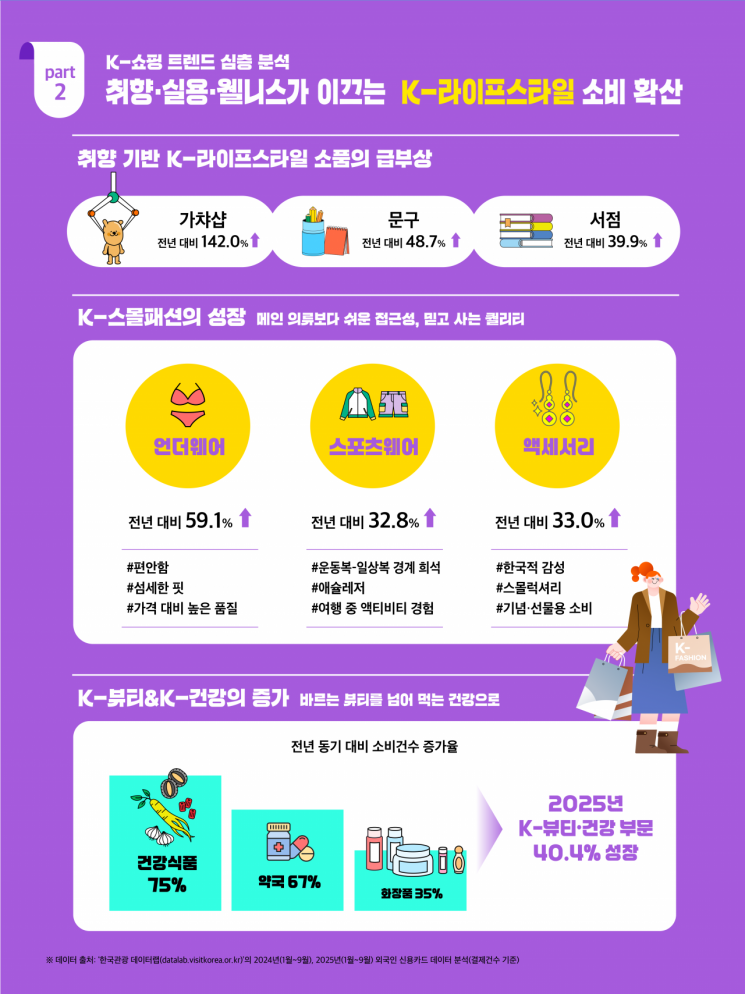
Foreigners' consumption of beauty and health products grew at an average annual rate of 19.1% from 2018 to 2024, and by 40.4% in 2025. By category, cosmetics increased by 35%, pharmacies by 67%, and health supplements by 75%. In the cosmetics sector, Olive Young expanded not only in Myeongdong and Gangnam but also in various locations, with growth of 381% at Seongsu Yeonbang, 425% at Gyeongbokgung Station, and 536% at Songdo Premium Outlet.
Foreign tourists tended to focus their spending on everyday wellness products such as skincare and nutritional supplements, rather than on medical treatments. Ointments, patches, supplements, and over-the-counter medicines were major items, with pharmacy spending surging by 342% in Taiwan and 304% in Lithuania. Health supplement consumption recorded the highest growth rate, increasing by 75.1% in 2025.
Lee Misook, Head of the Tourism Data Strategy Team at the Korea Tourism Organization, said, "Foreigners' shopping habits are shifting from high-priced goods to practical purchases focused on daily life, personal preferences, and wellness. This demonstrates that the global influence of the Korean lifestyle and K-content is expanding into tourism consumption."
© The Asia Business Daily(www.asiae.co.kr). All rights reserved.
![Clutching a Stolen Dior Bag, Saying "I Hate Being Poor but Real"... The Grotesque Con of a "Human Knockoff" [Slate]](https://cwcontent.asiae.co.kr/asiaresize/183/2026021902243444107_1771435474.jpg)
















