Concerns Over Next Year's Local Elections Raised at Opposition Forum
"Extremely Risky" to Push for Nomination Rule Changes
People Power Party Re-elected Lawmakers Host Forum, Call for Innovation
At a discussion forum hosted by re-elected lawmakers of the People Power Party on the 16th, many participants advised that, in order to secure victory in next year's local elections, the Yoon Suk-yeol administration must acknowledge the public's judgment, and the party should reflect public sentiment more than party sentiment when selecting candidates. The prevailing view was that, under the current direction of the People Power Party leadership, it would be difficult to win the local elections next year.
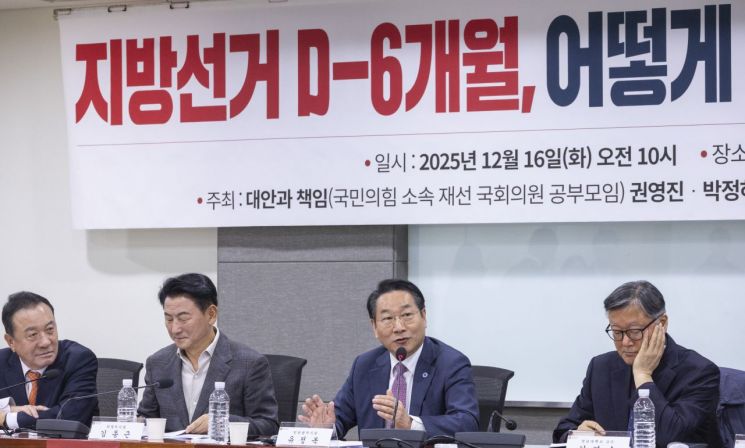 Yoo Jeong-bok, Mayor of Incheon Metropolitan City, is presenting at the discussion titled "How to Win Six Months Before the Local Elections?" held on the 16th at the National Assembly Members' Office Building by the People Power Party's re-elected lawmakers' study group "Alternatives and Responsibilities." Photo by Yonhap News Agency
Yoo Jeong-bok, Mayor of Incheon, delivered a keynote speech at the forum titled "How to Win Six Months Before the Local Elections?" held at the National Assembly Members' Office Building that morning. He stated, "Right now, the public does not trust the Democratic Party and feels uneasy about them, but they trust the People Power Party even less. They simply cannot support us." He pointed out, "People commonly say that the People Power Party is in danger, but there are no efforts to address this."
Mayor Yoo continued, "Even before the 17th general election, when things were even more difficult, our party was on the verge of collapse, but at that time, we donated our party headquarters and training center to the state and moved into a tent headquarters. During the 19th general election, even though President Lee Myung-bak's approval rating was low and the ruling party was on the brink of collapse, we adopted the color red-something unimaginable for our party-and took the lead on economic democratization, which was previously the opposition's agenda."
He added, "We must inspire the public through innovation and recruitment of new talent. We should bring in popular and well-known figures that the public can relate to, and deliver a strong message by discovering fresh faces." He emphasized, "Lawmakers here need to consider relinquishing vested interests. It may seem trivial, but it moves the public."
Regarding the recent move by the People Power Party's Local Election Planning Committee to change the primary rules to '70% party members, 30% public opinion polls,' he said, "When our party's approval rating is nearly half of the Democratic Party's, discussing such changes is extremely risky. Candidate nominations are not a right. The party leader, leadership, and all lawmakers must declare that 'we do not have the authority to nominate candidates.'" He further stressed, "We need to reform the system, recruit talent, and conduct in-depth analyses of local characteristics."
Kim Youngsoo, a professor at Yeungnam University, said, "From the perspective of Korean democracy, regardless of elections, martial law is unacceptable. If the party does not resolve this, it will ultimately be impossible to unite, and this will significantly influence voters' choices in the local elections." Professor Kim also remarked, "The People Power Party has lost three general elections. If a party that represents a country loses three general elections, it is on the path to dissolution."
Park Dongwon, CEO of the election consulting firm Polycom, explained, "To be competitive in the finals, we need candidates who can appeal to moderates. Therefore, when party approval ratings are low, it is only logical to increase the weight of public sentiment in the primaries. Many say that targeting the party base will bring moderates along, but those who work in politics and elections do not agree at all."
The forum was hosted by "Alternatives and Responsibility," a group led by re-elected lawmakers of the People Power Party. On the first anniversary of the declaration of martial law on the 3rd, this group issued a statement calling for a break with former President Yoon and an apology for martial law. Attendees at the forum included lawmakers who signed the statement at the time, such as Lee Sungkwon, Cho Eunhee, Kim Yongtae, and Um Taeyoung, as well as Policy Committee Chair Kim Doeup, Supreme Council member Yang Hyangja, and many others including Ahn Cheolsoo and Kim Gi-hyeon.
 Lee Sungkwon (right), a member of the People Power Party and host of the discussion, speaks at the "How to Win 6 Months Before the Local Elections?" forum held on the 16th at the National Assembly Members' Office Building by 'Alternatives and Responsibility,' a study group of re-elected lawmakers. Photo by Yonhap News Agency
Lee Sungkwon, a lawmaker, stated, "Last year, the National Assembly election handed the legislature over to the Democratic Party, and the anti-constitutional, unlawful martial law led to a presidential election that handed over executive power. Now, as the Democratic Party seeks to seize control of the judiciary, if we also lose local power in next year's local elections, there is a high risk that South Korea will devolve into a totalitarian state."
He continued, "The People Power Party is desperate to prevent this, but unfortunately, according to media and poll analysis, President Lee Jaemyung's approval rating is in the 60% range, the Democratic Party's approval is in the 40% range, while the People Power Party is stuck in the 20% range. In such circumstances, can the People Power Party really win the local elections? Especially in the Seoul metropolitan area, can our party even survive?"
On the same day, first-term lawmakers of the People Power Party also held a meeting to discuss current party issues. Kim Daesik, a former representative of the first-term lawmakers' group, told reporters, "It is clear that we cannot win the public's support through confrontation alone. Instead of being a party that fights against someone, we must become a party that approaches the people. While strong fighters are needed, with six months to go before the local elections, it is more important to read the public's sentiment and present a path forward."
© The Asia Business Daily(www.asiae.co.kr). All rights reserved.
![Clutching a Stolen Dior Bag, Saying "I Hate Being Poor but Real"... The Grotesque Con of a "Human Knockoff" [Slate]](https://cwcontent.asiae.co.kr/asiaresize/183/2026021902243444107_1771435474.jpg)
















