Korea Financial Services Association Hosts Consumer Finance Conference
Former Governor Yoon Seokhun Opposes Interest Rate Limitation Act Lowering Cap to 15% Per Annum
Professor Kim Sangbong of Hansung University: "Revitalize Private Lending Finance to Promote Financial Inclusion for Vulnerable Groups"
Yoon Seokhun, former Governor of the Financial Supervisory Service, suggested that the private lending industry should establish and operate a responsible lending governance system. He also emphasized the need for the private lending sector to differentiate itself from illegal private finance and to establish a new image for consumer finance.
On December 16, at the Korea Chamber of Commerce and Industry in Jung-gu, Seoul, Yoon made these remarks during the Consumer Finance Conference hosted by the Korea Financial Services Association. At the conference, he gave a presentation on "Environmental Changes in the Korean Economy and Financial Reform Measures."
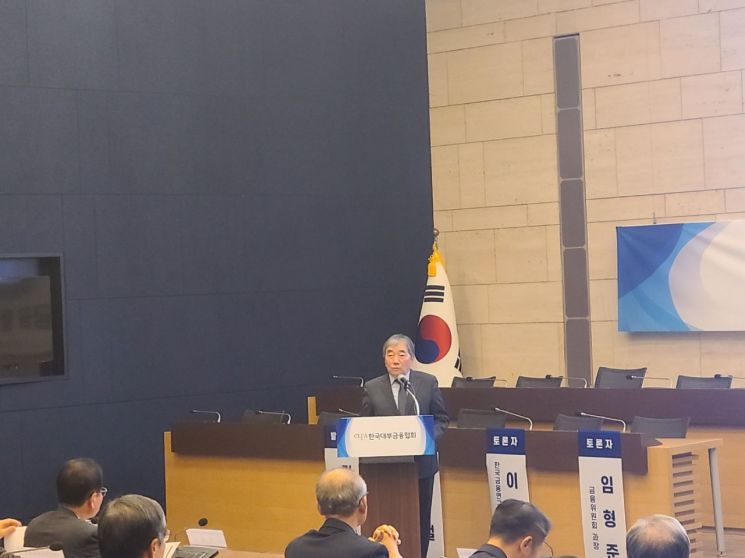 Yoon Seokhun, former Financial Supervisory Service Governor, is giving a lecture at the Consumer Finance Conference hosted by the Korea Financial Services Association on the 16th. Photo by Choi Donghyun
The responsible lending governance that Yoon proposes involves building a data-driven credit evaluation system led by registered private lenders, instead of relying solely on interest rate-based strategies. The aim is to help borrowers improve their repayment capacity. Yoon stated, "We need to integrate and utilize non-financial information, such as telecommunications fees and online transactions, for vulnerable groups, and reassess their repayment ability to enhance the transparency of credit information and expand financial accessibility for these groups." He added, "The industry should also serve as a credit ladder by offering gradual interest rate reductions to those who repay diligently, even if they initially borrow at high interest rates."
Yoon also said that efforts should be made to encourage private lenders registered with local governments to switch to registration with the Financial Supervisory Service. This is necessary to improve the negative image associated with the private lending industry and to help it become a true provider of consumer finance.
Yoon expressed opposition to both the Interest Rate Limitation Act and the amendments to the Private Lending Act, which are being promoted by the political sector to lower the maximum legal interest rate to 15% per annum. These bills have gained momentum since President Lee Jaemyung described the minimum interest rate for low-credit loans in the 15% range as "cruel" during a cabinet meeting in September.
Yoon argued that even if these bills are implemented, it is unlikely that private lenders will comply, which would ultimately only expand the role of the government. He said, "Individual financial companies facing deteriorating profitability are more likely to respond by rejecting loan applications rather than lowering interest rates. This would reduce access to funds for low-credit borrowers in the market and run counter to the goal of inclusive finance," he cautioned.
Instead of a simplistic and uniform interest rate control policy, Yoon suggested linking funding rates and base interest rates as an alternative. He said, "We should consider linking banks' lending support rates and private loan rates, or diversifying funding methods through securitization and other means. In the mid- to long-term, we should encourage private lenders to register, thereby promoting transparency, information sharing, responsible lending, and stronger supervision," he said.
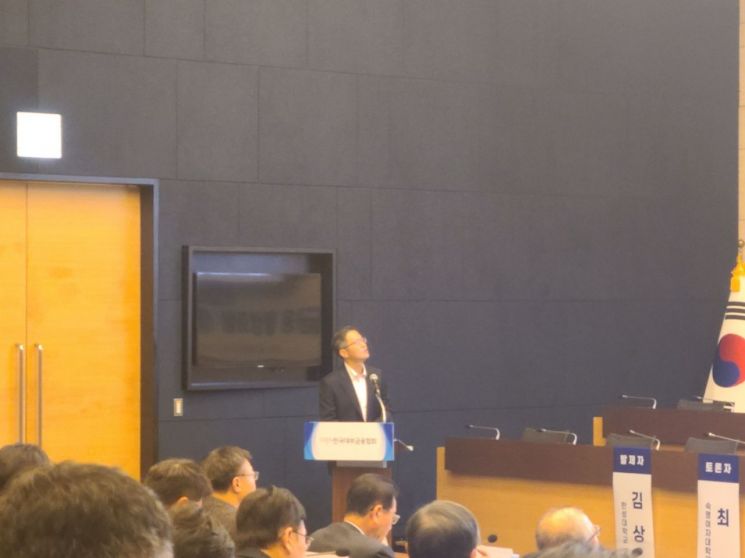 Professor Sangbong Kim of Hansung University’s Department of Economics is giving a lecture at the Consumer Finance Conference hosted by the Korea P2P Finance Association. Photo by Donghyun Choi
As the second speaker, Professor Kim Sangbong of Hansung University's Department of Economics gave a presentation on ways to promote financial inclusion for vulnerable groups through the revitalization of private lending finance.
The number of private lenders in Korea has continuously decreased during the process of lowering the maximum legal interest rate, resulting in a market dominated by large companies with assets of 10 billion won or more. As of the end of last year, the legal maximum interest rate was 20%, and the number of private lenders stood at 8,182. This is a 1.5% decrease compared to the end of 2018, when the maximum legal interest rate was 44% and there were 8,310 companies. Professor Kim explained, "The decrease in the number of private lenders is the result of a combination of factors: declining profitability due to the lower maximum interest rate, the tightening of registration requirements by financial authorities, and increased uncertainty due to the implementation of the Personal Debtor Protection Act. Because it is difficult for individual private lenders to meet these requirements, the number of private lenders is decreasing, and the supply function for low-credit borrowers is also deteriorating."
Professor Kim argued that improving the industry's image should be the first step in revitalizing private lending finance. Under the current Private Lending Act, private lenders are required to use the term "private lending" in their company names, unlike other sectors. The spread of negative perceptions about the term "private lending" distorts financial consumers' judgments and causes adverse selection, driving them toward illegal private finance. Professor Kim stated, "The Private Lending Act should be revised to reflect the essential role of private lending in supporting household finances, by changing the mandatory term 'private lending' to alternatives such as 'household finance (monetary lending)' or 'debt management (receivables collection).' Additionally, introducing a certification system, such as designating exemplary receivables collection companies that demonstrate best practices in consumer protection, would be a good alternative," he added.
Professor Kim also suggested that regulations in the funding market should be relaxed. Currently, private lenders who comply with financial laws and have strong records of supplying funds to low-credit borrowers can be designated as "outstanding private lenders for inclusive finance," allowing them to borrow from banks. However, only 12 out of 22 such designated companies currently have records of bank borrowing, accounting for just half. Bank loans to these outstanding private lenders amount to about 200 billion won, or approximately 6.7% of their total loans of 2.95 trillion won. Professor Kim said, "Bank funding for private lending should be included in banks' inclusive finance performance metrics to encourage voluntary participation by banks. It is also necessary to improve regulations under the Mutual Savings Bank Act that restrict credit provision to private lenders," he said.
Professor Kim also stated that the funding methods of private lenders need improvement. Because private lenders' funding sources are overly concentrated on borrowing from financial institutions, they are vulnerable to external shocks. Professor Kim explained, "To secure stable funding channels for low-credit individuals and to ease the tightening of the inclusive finance market, the financial authorities should permit the issuance of public bonds by private lenders through regulatory interpretation. Another alternative is to raise the collateral procurement ratio limit under the Debtor Protection Act to above 80% to support the liquidity expansion of receivables collection companies," he said.
Jung Sungwoong, President of the Korea Financial Services Association, stated, "Many financially vulnerable people who are excluded from the institutional system are, even at this moment, being forced into the tragedy of turning to illegal private loans. This is because, as the supply function of institutional private lending shrinks, legitimate options for vulnerable groups disappear, and enforcement and punishment alone have fundamental limitations in resolving the issue."
© The Asia Business Daily(www.asiae.co.kr). All rights reserved.
![Clutching a Stolen Dior Bag, Saying "I Hate Being Poor but Real"... The Grotesque Con of a "Human Knockoff" [Slate]](https://cwcontent.asiae.co.kr/asiaresize/183/2026021902243444107_1771435474.jpg)
















