Korea Federation of SMEs Announces Survey Results on Management Status and Plans
Direct Impact from Sluggish Domestic Demand, Rising Labor Costs, and Funding Shortages
Top Policy Priority: Financial and Tax Support
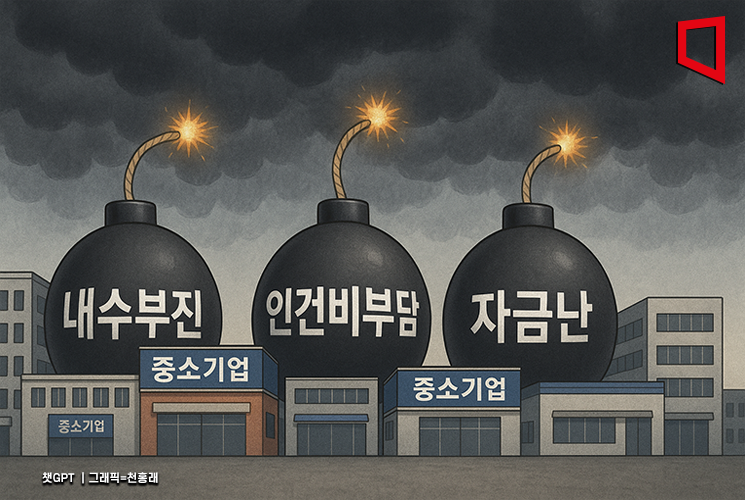
More than half of small and medium-sized enterprises (SMEs) evaluated this year's business environment as difficult due to sluggish domestic demand and increased cost burdens.
The Korea Federation of Small and Medium Business announced the results of the "Survey on Management Conditions and 2026 Management Plans of Small and Medium Enterprises" on December 15. The survey was conducted from December 1 to 5 with 1,000 SMEs participating.
According to the survey, 56.8% of responding SMEs assessed the business environment in 2025 as "difficult." Only 9.6% of companies responded that it was "not difficult." The main reason for management difficulties this year was "sluggish domestic demand" (79.8%), followed by "rising labor costs" (31.7%), "difficulty in securing funds" (27.1%), and "rising raw material prices" (23.6%).
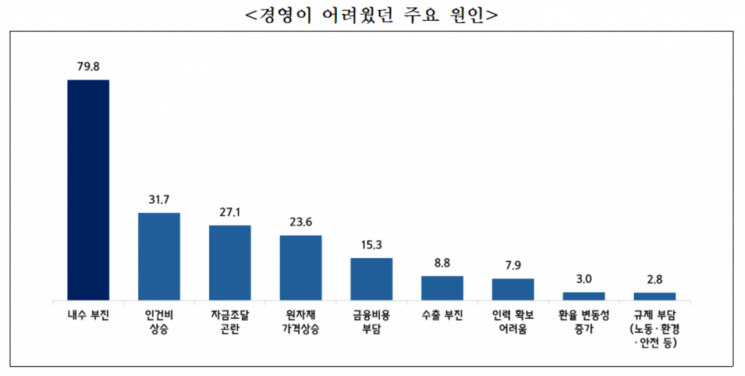 Korea Federation of Small and Medium Business 'Survey on the Management Status of Small and Medium Enterprises and Management Plans for 2026' Results. Korea Federation of Small and Medium Business
The primary efforts to improve the business environment were "cost reduction and productivity improvement," cited by 63.1%, followed by "expanding sales channels and improving marketing" (57.7%), and "expanding sources of funding" (23.5%). The most useful government policy this year was "tax reduction and payment deferral" (33.3%), followed by "support for business stability" (25.1%) and "loan maturity extension or deferral" (14.0%).
Regarding the business environment in 2026, 63.1% of responding companies said it would be "similar to this year," indicating that they expect next year's business environment to remain difficult. 21.7% of companies expected an "improvement," while 15.2% anticipated a "deterioration." The core management strategy for next year was "cost reduction and productivity improvement" (61.4%), followed by "expanding sales channels and improving marketing" (54.9%), and "focusing on maintaining the status quo and risk management" (21.2%).
The most needed economic policy for SMEs next year was "financial support and alleviation of tax burdens" (77.7%). In the medium to long term, "labor shortages and changes in the labor environment" (41.5%) and "regulations lagging behind industrial changes" (16.7%) were identified as factors that require preparation for SME management.
Choo Moonkab, Head of the Economic Policy Division at the Korea Federation of Small and Medium Business, stated, "As SMEs are striving to improve the business environment through cost reduction and productivity improvement, the government should also strengthen policy support for difficulties such as funding shortages and labor shortages so that SMEs can overcome challenging management conditions."
© The Asia Business Daily(www.asiae.co.kr). All rights reserved.
![Clutching a Stolen Dior Bag, Saying "I Hate Being Poor but Real"... The Grotesque Con of a "Human Knockoff" [Slate]](https://cwcontent.asiae.co.kr/asiaresize/183/2026021902243444107_1771435474.jpg)
















