National Health Insurance Service: Average of 17 Procedures per Patient at Hospital A
Patient Who Underwent 1,124 Procedures Exposed to Up to 127 mSv of Radiation
The cost of medical care for nerve block procedures performed in departments such as orthopedics, neurosurgery, and anesthesiology and pain medicine has more than doubled over the past five years. This is a particularly sharp increase compared to the 1.3-fold growth in total health insurance medical expenses over the same period.
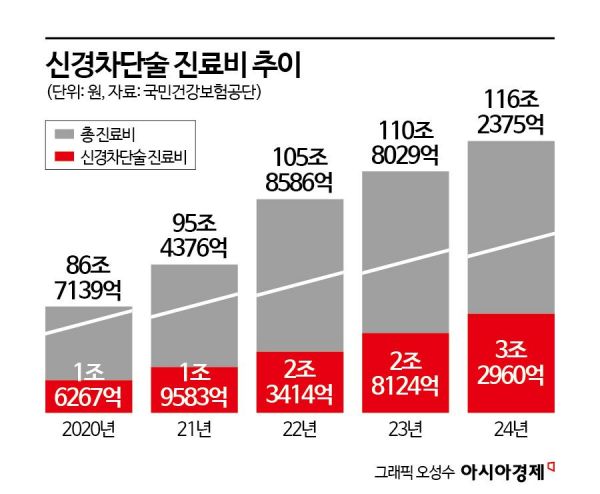
According to the National Health Insurance Service on December 15, last year 9.65 million patients underwent nerve block procedures, with a total of 65.04 million procedures performed. The associated medical expenses amounted to 3.296 trillion won, a 2.03-fold increase over five years compared to 1.6267 trillion won in 2020. During the same period, total health insurance medical expenses rose from 86.7 trillion won to 116.2 trillion won, a 1.34-fold increase.
Nerve block procedures involve injecting therapeutic drugs such as local anesthetics and steroids into nerves and surrounding tissues that cause pain, thereby blocking the neural pathways that transmit pain signals. These procedures can reduce pain and alleviate inflammation and swelling around nerves, but in rare cases, side effects such as infection, bleeding, temporary increase in pain at the procedure site, vascular puncture, intervertebral disc puncture, intravascular injection of medication, nerve damage, and abnormal sensations may occur.
Over the past five years, medical expenses for nerve block procedures have increased across all types of healthcare institutions-general hospitals (excluding tertiary general hospitals), hospitals, and clinics. Among these, clinics saw the largest increase at 2.16 times. Based on the eight types of nerve block procedures covered by health insurance, the number of procedures performed last year was 65.04 million, a 1.70-fold increase compared to 38.2 million in 2020.
The most commonly performed nerve block procedure in 2024 was "spinal plexus, nerve root, and ganglion block," with 30.6 million procedures performed-a 2.20-fold increase compared to 13.9 million in 2020. The nerve block procedure with the largest increase over the past five years was "cranial nerve and cranial peripheral branch block," which rose from 110,000 cases in 2020 to 250,000 cases in 2024, a 2.34-fold increase.
The institution that performed these two procedures the most was Hospital A, where, in just one year, each patient underwent spinal plexus, nerve root, and ganglion block an average of 16.73 times. This is 4.3 times higher than the average number of procedures per patient across all institutions (3.89 times). For cranial nerve and cranial peripheral branch block, the average was 8.19 times per patient, 3.9 times higher than the overall average (2.09 times).
Last year, Patient B received the most nerve block procedures, visiting 24 healthcare institutions 747 times in one year and undergoing seven types of nerve block procedures 1,124 times for conditions such as back pain, cervical disc disorders, and mononeuropathy of the arm. This is 201 times higher than the average number of procedures per patient (5.6 times), with annual medical expenses amounting to 67 million won. Patient C, who received the most "trigeminal nerve branch" nerve block procedures, visited Hospital A 105 times in one year and underwent a total of 347 procedures. The main diagnoses were "trigeminal nerve disorder" and "herpes zoster," and the patient was exempted from the reimbursement limit (15 times) due to these conditions.
The National Health Insurance Service pointed out that, for spinal plexus, nerve root, and ganglion block and cranial nerve and cranial peripheral branch block, some areas require the use of fluoroscopy devices such as C-Arm, which increases the risk of radiation exposure if the procedures are performed frequently. Considering that the average radiation exposure time per nerve block procedure is up to one minute during a typical 5-10 minute procedure, it is estimated that a patient would be exposed to 0.034-0.113 mSv (millisieverts) per procedure.
For Patient B, who underwent 1,124 nerve block procedures, the annual radiation exposure would range from a minimum of 38.216 mSv to a maximum of 127.012 mSv. The National Health Insurance Service noted, "An effective dose exceeding 100 mSv increases the risk of cancer by 0.5%. If the procedures are continued for eight years, the cancer risk increases by 5% (over 1,000 mSv), and if continued for 30 years, the mortality rate could rise to 50% (over 4,000 mSv)."
Regarding these findings, the Korean Society of Anesthesiology and Pain Medicine and the Korean Society of Neurology stated, "In pain specialty centers that mainly treat patients with intractable headaches, postherpetic neuralgia, and complex regional pain syndrome, the number of procedures per patient may increase." However, they also emphasized, "Performing the same procedure 347 times a year on a single patient is extremely exceptional. It is necessary to verify the appropriateness of the diagnosis and to consider a multidisciplinary approach, including assessment of treatment responsiveness, medication, physical therapy, and psychological therapy."
© The Asia Business Daily(www.asiae.co.kr). All rights reserved.
![Clutching a Stolen Dior Bag, Saying "I Hate Being Poor but Real"... The Grotesque Con of a "Human Knockoff" [Slate]](https://cwcontent.asiae.co.kr/asiaresize/183/2026021902243444107_1771435474.jpg)















