Financial Market Assessment Meeting Presided Over by Chairman Lee Eokwon
Liquidity Supply for Bond and Short-Term Money Market Stability
61 Trillion Won Real Estate PF Soft Landing Support Program Maintained
"Government Bond Yields Rising... Incr
Financial authorities will extend the 38 trillion won "market stabilization program" aimed at stabilizing the bond and short-term money markets through next year. The 61 trillion won support program for a soft landing of real estate project financing (PF) will also continue to be operated.
On the morning of December 15, Lee Eokwon, Chairman of the Financial Services Commission, held a financial market monitoring meeting with the Financial Supervisory Service, the Korea Institute of Finance, the Korea Development Institute (KDI), and macroeconomic and financial market experts, where he made this announcement.
Up to approximately 100 trillion won to be injected next year for bond and short-term money market stability and a soft landing of real estate PF
At the meeting, participants reviewed the domestic and global economic and financial markets over the past year and discussed future outlooks and risk factors. In particular, it was decided to extend and continue the currently operating market stabilization program. Chairman Lee assessed that this year, the market stabilization program played an active role as a safety net for the market by newly purchasing about 11.8 trillion won in non-investment grade corporate bonds and commercial paper (CP) to stabilize the bond market. He explained the reason for the extension, stating, "The role of a market safety net remains necessary to prepare for the possibility of increased volatility in the financial market."
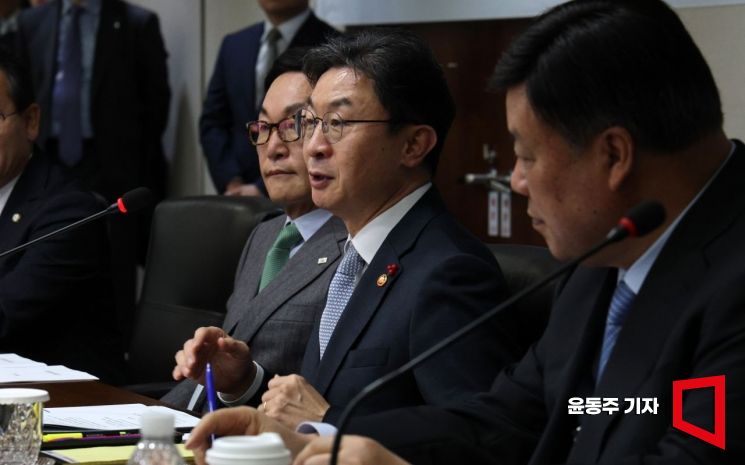 Lee Eokwon, Chairman of the Financial Services Commission, is attending the 'National Growth Fund Strategy Committee Meeting' held at the Korea Development Bank in Yeouido, Seoul, on the 11th, delivering opening remarks. 2025.12.11 Photo by Yoon Dongju
First, the Financial Services Commission and policy financial institutions (Korea Development Bank, IBK Industrial Bank of Korea, and Korea Credit Guarantee Fund) plan to supply up to 37.6 trillion won in liquidity next year to stabilize the bond and short-term money markets. Specifically, this includes: ▲ up to 20 trillion won for the Bond Market Stabilization Fund ▲ up to 10 trillion won for policy financial institutions’ corporate bond and CP purchase programs ▲ 2.8 trillion won for the Korea Credit Guarantee Fund’s primary collateralized bond obligation (P-CBO) program ▲ up to 1.8 trillion won for the financial investment industry’s joint project financing-asset-backed commercial paper (PF-ABCP) program ▲ and up to 3 trillion won in liquidity support for securities companies by Korea Securities Finance Corporation.
In addition, support programs for a soft landing of real estate PF, operated by the government, related agencies (Korea Housing Finance Corporation, Housing and Urban Fund, Construction Guarantee Cooperative), and the financial sector, with a maximum scale of 60.9 trillion won, will continue to be operated without disruption. This program includes a PF operator guarantee program (40 trillion won), among others.
Experts: "Growth rate in the high 1% range next year... Increased volatility due to changes in major economies' monetary easing policies"
Participants predicted that, driven by strong exports and a recovery in domestic demand, Korea’s economic growth rate next year would be in the high 1% range. They also forecast that the financial market’s risk of instability, such as a credit crunch, would be significantly lower than in the past, thanks to robust corporate performance, government efforts to vitalize capital markets, and the soundness and loss-absorbing capacity of financial institutions.
However, they identified risk factors such as the possibility of divergence in monetary policies among major countries like the United States and Japan, concerns about overheating in global artificial intelligence (AI), worries about the fiscal soundness of major economies leading to concerns over a rise in long-term government bonds, the potential for renewed geopolitical risks, concerns about vulnerable domestic industries, and household debt management issues. They particularly emphasized the need to pay attention to recent signs of change in the global monetary easing trend that has continued since last year. While the US Federal Reserve is likely to maintain its current policy of holding off on rate cuts for the time being, central banks in countries such as Japan, Australia, and Canada have recently signaled an end to rate cuts or the possibility of rate hikes, indicating that the direction of monetary policies among major economies is diverging. They pointed out that this could lead to increased volatility in global capital flows and greater pressure for corrections in risk asset prices going forward.
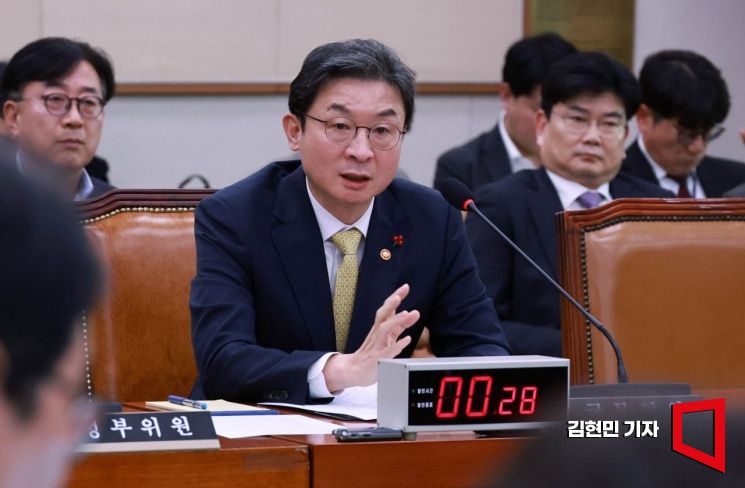 Lee Eokwon, Chairman of the Financial Services Commission, is attending the plenary session of the Legislation and Judiciary Committee held at the National Assembly on the 26th, responding to questions from lawmakers. 2025.11.26 Photo by Kim Hyunmin
"Limited risk of liquidity crunch in the bond market"
Regarding the bond and short-term money markets next year, experts anticipated that the risk of a sudden liquidity crunch would be limited. With the scheduled inclusion in the World Government Bond Index (WGBI) in April next year, up to 90 trillion won in foreign capital is expected to flow into the bond market. Considering Korea’s sound fiscal health and external creditworthiness, as well as expanded bond demand due to securities companies’ integrated investment account (IMA) operations, they forecast that a stable supply-demand flow would continue.
However, they suggested that risk factors such as diminished expectations for a rate cut by the Bank of Korea and the likely increase in government and public bond issuance next year could increase bond market volatility, making the government’s role in stabilizing the financial market essential. Meanwhile, they agreed that managing market expectations is most important for stabilizing the recently elevated won-dollar exchange rate, and that efforts to resolve foreign currency supply-demand imbalances and to structurally improve the economy are also crucial.
Chairman Lee stated, "Although vigilance is rising in the domestic financial market, with government bond yields on the rise and increased volatility in the foreign exchange market, Korea has sufficient resilience and crisis response capacity to handle various internal and external uncertainties, given its robust fundamentals such as the world’s ninth-largest foreign exchange reserves." He added, "The Financial Services Commission will closely monitor market conditions in close cooperation with the Financial Supervisory Service and other agencies, and will take bold and preemptive market stabilization measures as necessary."
© The Asia Business Daily(www.asiae.co.kr). All rights reserved.
![Clutching a Stolen Dior Bag, Saying "I Hate Being Poor but Real"... The Grotesque Con of a "Human Knockoff" [Slate]](https://cwcontent.asiae.co.kr/asiaresize/183/2026021902243444107_1771435474.jpg)
















