"Refrain from Answering Hypothetical Questions on a Taiwan Contingency" Specified
An analysis has emerged suggesting that Japanese Prime Minister Sanae Takaichi's remarks hinting at possible intervention in the event of a Taiwan contingency-one of the key reasons for escalating tensions between China and Japan-were likely her personal opinion.
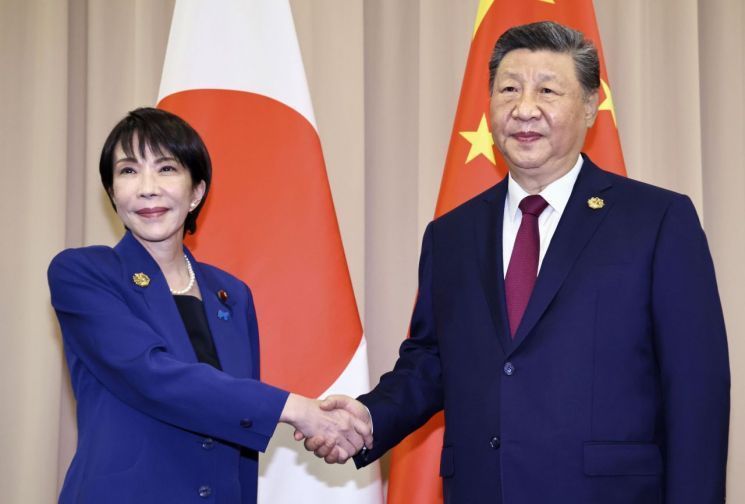 Chinese President Xi Jinping (right) and Japanese Prime Minister Sanae Takaichi meet at the China-Japan summit held in Gyeongju. Photo by Yonhap News
On December 14, major local media outlets including the Asahi Shimbun reported that on December 11, Kiyomi Tsujimoto, a lawmaker from the Constitutional Democratic Party, disclosed on her X (formerly Twitter) account a Cabinet Secretariat document related to Prime Minister Takaichi's comments on Taiwan. Citing this document, which was prepared by the Cabinet Secretariat and approved at a Cabinet meeting, Tsujimoto argued, "Prime Minister Takaichi's remarks on Taiwan were not drafted by government officials."
Previously, on November 7, Prime Minister Takaichi responded to a question in the National Diet from Katsuya Okada, a lawmaker from the Constitutional Democratic Party, regarding a possible Taiwan contingency. She stated, "If the use of a warship involves the exercise of force, then no matter how you look at it, this could constitute a survival-threatening situation that would allow for the exercise of collective self-defense."
According to the materials disclosed by Tsujimoto, Prime Minister Takaichi's remarks suggesting intervention in the event of a Taiwan contingency were not included. Instead, the response materials prepared by government officials stated, "We refrain from answering questions based on hypothetical scenarios involving a Taiwan contingency."
The documents also stated, "Peace and stability in the Taiwan Strait are important not only for Japan's security but also for the stability of the entire international community," and "As for what constitutes a survival-threatening situation, the government will make a comprehensive judgment based on all available information, depending on the specific and individual circumstances of the actual situation." These statements are consistent with the Japanese government's existing position.
Tsujimoto criticized, "The Prime Minister bears heavy responsibility." She pointed out that Prime Minister Takaichi's off-the-cuff remarks heightened military tensions between the two countries and also resulted in economic losses. The Yomiuri Shimbun recently reported that a joint flight by Chinese and Russian fighter jets took an "unusual route" toward Tokyo. While Chinese bombers had previously flown toward Tokyo in 2017, this was the first time that China and Russia jointly flew toward Tokyo. In addition, China is increasing economic pressure by demanding the retraction of Prime Minister Takaichi's remarks on Taiwan, issuing advisories against travel and study in Japan, and reinstating its ban on imports of Japanese seafood.
Japanese media have previously analyzed that Prime Minister Takaichi appeared to have expressed her own opinion, rather than relying on government-prepared responses, based on the fact that she mentioned "warships"-which are relatively less significant in modern warfare-rather than "aircraft carriers" or "fighter jets." The media noted that this is the first time such speculation has been confirmed through official documents.
At a press conference that day, Japanese government spokesperson Minoru Kahara did not confirm the facts related to Tsujimoto's claims. However, it is reported that Prime Minister Takaichi's side, while moderating the tone of her remarks on Taiwan, maintains that the comments cannot be retracted, taking into account the opinions of her conservative support base.
© The Asia Business Daily(www.asiae.co.kr). All rights reserved.