Intense Competition and High Living Costs Are Key Factors
Students Reject Regional Universities and Choose to Retake the Exam
The rate at which students from general high schools in Seoul advance to four-year universities has recorded the lowest level in the nation.
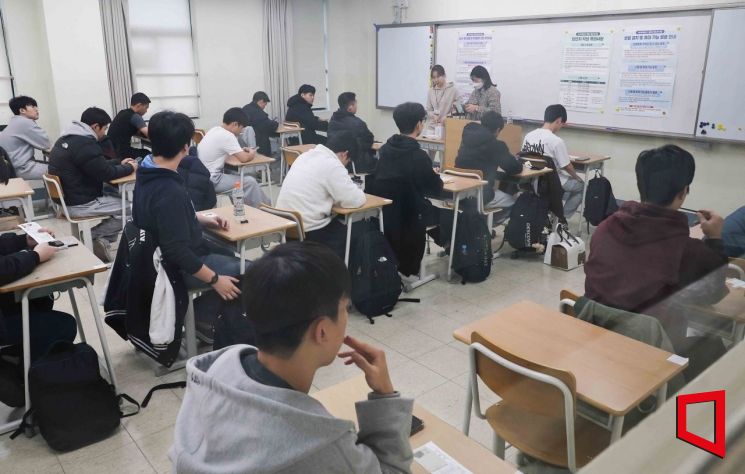 On the morning of the 13th, when the 2026 College Scholastic Ability Test was held, examinees were preparing for the exam at Yongsan High School in Yongsan-gu, Seoul. Photo by Joint Press Corps
According to an analysis by Jongro Academy of data from the School Information Disclosure System, as of the 2025 academic year, the four-year university enrollment rate for general high schools in Seoul stood at 46.2%, the lowest among the 17 cities and provinces nationwide. In contrast, North Gyeongsang Province recorded the highest rate at 80.2%, resulting in a gap of about 30 percentage points between the capital region and non-capital regions. The four-year university enrollment rates in Incheon and Gyeonggi, both part of the capital region, were 54.5% and 55.7% respectively-higher than Seoul, but still below the national average of 63.5%. This gap is attributed to the difficulty capital region students face in choosing to attend universities in other regions, as well as the intense competition focused on universities located in Seoul.
In fact, students in Seoul tend to invest more time in taking gap years or retaking the college entrance exam, rather than enrolling in universities outside the capital region, where tuition and living costs are higher. The rate of enrollment in junior colleges is also higher in the capital region, with Incheon at 24.8% and Seoul at 18.0%, making junior colleges a practical option for many students in these areas.
By district, Seongdong-gu in Seoul had the lowest four-year university enrollment rate nationwide at 40.1%, followed by Gangbuk-gu at 41.0%, Seocho-gu at 41.9%, Songpa-gu at 43.4%, and Dongjak-gu at 43.5%. The data shows that university enrollment outcomes for Seoul students vary significantly depending on housing costs and the structure of private education.
On the other hand, in some non-capital regions such as Jeju, the rate of enrollment in junior colleges is high, and students tend to make quick career decisions by choosing universities with lower financial burdens. Jongro Academy commented, "The current university enrollment rate reflects the economic structure of students' places of residence, rather than their academic performance," and added, "For students in the capital region, the costs associated with attending universities in other regions have led to a fixed trend of choosing gap years or junior colleges."
The overall university (four-year + junior college) enrollment rate for general high school students nationwide was 64.2% in Seoul, 75.7% in the greater capital area, and 85.7% in non-capital regions. While four out of ten students in the capital region do not enter university immediately and instead choose gap years or other alternatives, the non-capital region saw a non-enrollment rate of only about 20%, highlighting a clear regional disparity.
© The Asia Business Daily(www.asiae.co.kr). All rights reserved.
![Clutching a Stolen Dior Bag, Saying "I Hate Being Poor but Real"... The Grotesque Con of a "Human Knockoff" [Slate]](https://cwcontent.asiae.co.kr/asiaresize/183/2026021902243444107_1771435474.jpg)















