On Nanjing Massacre Memorial Day, China Targets Japan
"Must Never Allow the Resurgence of Militarism," Strong Criticism
The Chinese military released a poster strongly criticizing Japan on the occasion of the Nanjing Massacre Memorial Day.
On the 13th, the Eastern Theater Command of the People's Liberation Army posted a poster titled "Dadaoji" (Great Knife Ritual) on its official WeChat account. The poster depicts a large knife decapitating a skull wearing a Japanese military cap.
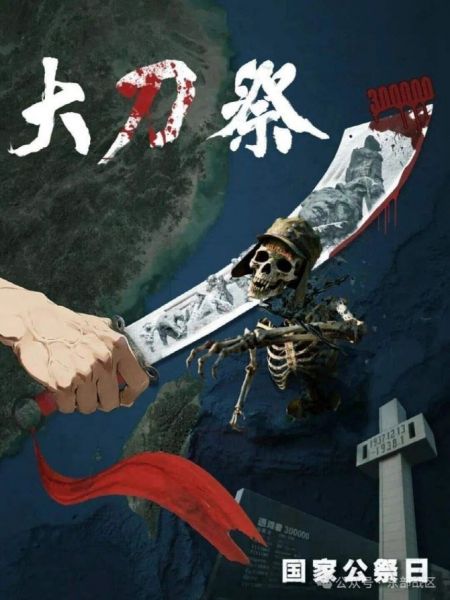 The Chinese military released a poster strongly criticizing Japan on the occasion of the Nanjing Massacre Memorial Day. Screenshot from WeChat
The Nanjing Massacre refers to the large-scale killing of Chinese soldiers and Nanjing citizens by the Japanese military over approximately six weeks after occupying Nanjing, the capital of the Republic of China, during the Second Sino-Japanese War in 1937, under the pretext of searching for straggling Chinese troops. The poster is a strong condemnation of the Nanjing Massacre, and at the bottom of the poster, there is an image of the memorial stone in the square of the Nanjing Massacre Memorial Hall, inscribed with the fact that 300,000 people were killed between December 13, 1937, and January of the following year.
The Eastern Theater Command stated, "Eighty-eight years have passed, but the blood of the souls has not yet dried, and the specter of militarism is rearing its head once again." It continued, "We must always raise the blood-soaked great knife high and resolutely sever the filthy and ugly head, never allowing the resurgence of militarism," adding a harsh warning apparently aimed at Japan's rightward shift.
China pointed out that Japan's involvement in the Taiwan issue is logically equivalent to its past aggression in Asia, and therefore Japan must take concrete measures to expel right-wing forces. There are also claims that Japanese Prime Minister Sanae Takaichi's refusal to retract her statement about "intervening in the event of a Taiwan contingency" is tantamount to showing no remorse for the Nanjing Massacre.
The Eastern Theater Command also expressed in a seven-character quatrain titled "Dadaoji" that "it has been 1,000 years since the Eastern Dwarf caused disaster." "Eastern Dwarf" is a derogatory term for Japan, meaning "the dwarf in the east." Chinese state media interpreted the poster as "a warning to commemorate the victims of the Nanjing Massacre and oppose militarism."
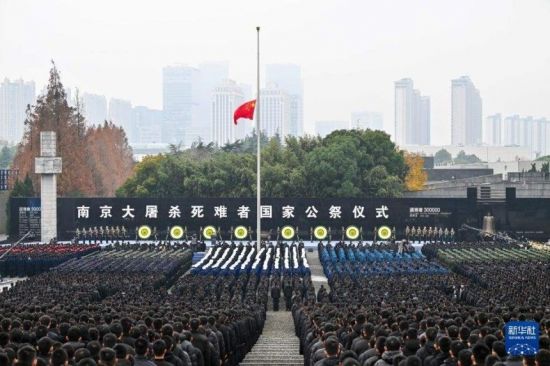 On the 13th, a memorial ceremony for the victims of the Nanjing Massacre was held at the Memorial Hall for the Victims of the Nanjing Massacre in Nanjing City, Jiangsu Province, China. Photo by Xinhua News Agency
Since 2014, China has designated the National Memorial Day for the Victims of the Nanjing Massacre as a national-level event and has held official ceremonies. On this day, thousands of people, including party and government officials, soldiers, and citizens, attended the national memorial ceremony at the square of the Memorial Hall for the Victims of the Nanjing Massacre in Nanjing, Jiangsu Province.
Amid escalating tensions between China and Japan, there was speculation that China's top leadership might attend the event. However, President Xi Jinping and other top officials did not participate. The last time a top leader attended and delivered a memorial address was in 2017, on the 80th anniversary, by President Xi, and in 2022, by Cai Qi, member of the Standing Committee of the Political Bureau of the Communist Party of China.
© The Asia Business Daily(www.asiae.co.kr). All rights reserved.
![Clutching a Stolen Dior Bag, Saying "I Hate Being Poor but Real"... The Grotesque Con of a "Human Knockoff" [Slate]](https://cwcontent.asiae.co.kr/asiaresize/183/2026021902243444107_1771435474.jpg)
















