Low Wages and Unstable Employment Hinder First Job Retention
Dissatisfaction with Location, Pay, and Job Type Drives Youth to Leave or Wait
An analysis has found that a first job is no longer serving as a stable stepping stone for young people entering society. Low wages, unstable working conditions, and job mismatches are converging, causing instability at the very entry point of the youth labor market.
The report "Analysis of First Jobs and Job Mismatch Among Young People," released on December 13 by the Korea Employment Information Service, quantifies the labor realities faced by the younger generation.
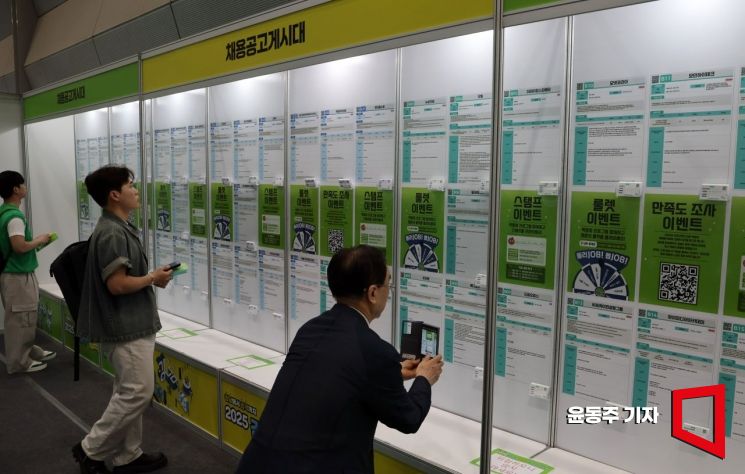 Job seekers visiting the Gangnam-gu Job Fair held last June at COEX in Gangnam-gu, Seoul, are checking the job posting board.
According to the report, 68% of young people (aged 15-29) earned less than 2 million won per month in their first job last year. While their working hours were 94.9% of the all-age average-showing little difference-their total wages amounted to just 69.6% of the average, indicating a significant gap in actual compensation. In this situation, young people are being asked to "adapt to the labor market," even though their first job is insufficient for basic living expenses.
Employment types are also becoming increasingly unstable. The proportion of contract workers among young people's first jobs rose from 33.0% in 2020 to 37.5% last year. Part-time positions also increased from 21.0% to 25.0%. This suggests that first jobs are turning into "temporary stops" rather than stable workplaces. In fact, 46.4% of young people who left their first job last year cited dissatisfaction with working conditions (such as pay and working hours) as the reason, followed by contract expiration at 15.5%.
There is also a clear mismatch between jobs and desired conditions. Last year, 14.9% of respondents said that none of the three main conditions-location, pay, and job type-were satisfied, up from 11.4% in 2022 and 13.2% in 2023. The percentage who said all three conditions were met dropped to 7.9%. Many young people are working in unsuitable positions from the start, and this mismatch is accumulating over time.
The mismatch rate was especially higher among young men than women. Although actual wages for men were higher, their desired wages were also higher, leading to a greater gap between expectations and reality, which the report noted could result in higher rates of early resignation.
Unstable first jobs are pushing young people out of the labor market altogether. As of October this year, among 116,000 unemployed men aged 15-29, 23,000 had no work experience, an increase of 9,000 from a year earlier. Of these, 32.3% chose to prepare for exams such as civil service tests, and among those aged 25-29, the figure was 41.8%.
© The Asia Business Daily(www.asiae.co.kr). All rights reserved.
![Clutching a Stolen Dior Bag, Saying "I Hate Being Poor but Real"... The Grotesque Con of a "Human Knockoff" [Slate]](https://cwcontent.asiae.co.kr/asiaresize/183/2026021902243444107_1771435474.jpg)















