Ministry of Land, Infrastructure and Transport Reports to President Lee on December 12
The government has announced plans to unveil a comprehensive policy package in the first half of next year aimed at improving the nation’s right to housing. The measures are expected to include increasing the supply of public rental housing by about 50% compared to previous years and providing more spacious public rentals with better access to city centers. The government will also relax income and asset requirements to allow a wider range of people to qualify for public rental housing and introduce tailored support measures targeting specific demand groups.
On December 12, the Ministry of Land, Infrastructure and Transport reported its main work plans for next year to President Lee Jae-myung. The ministry categorized its report into five key areas-regional revitalization, economic growth, real estate stability, a fair society, and public convenience-highlighting ten major projects.
Comprehensive Housing Welfare Measures to Be Announced in the First Half of 2026
The ministry reported its plan to supply at least 1.1 million units of public housing over the next five years, aiming to raise the long-term public rental stock rate to 10%. Over the past three years, the annual supply of public rental units was about 102,000, but next year at least 152,000 units will be provided. Of these, 140,000 will be public rentals, including 65,000 purchased units, and 12,000 will be public-supported sensitive rentals. The long-term public rental stock rate, which stood at about 8% as of 2023, will be gradually increased.
In response to criticism that public rentals have been cramped and inconvenient, the proportion of units with a dedicated area of 60-85 square meters will be increased, and more efforts will be made to secure units in city centers and near workplaces. Aging public rentals will undergo active performance improvements through reconstruction or remodeling. Starting in 2027, income and asset conversion rates will be introduced, taking into account that young people with low assets but high income and seniors with high assets but low income have difficulty qualifying for public rentals.
For young people, public rentals near subway stations and “Happy Dormitories” near universities will be supplied, and the scope of youth monthly rent support will be expanded. Ten child-friendly public housing complexes near elementary schools will be selected next year. Pilot projects for intergenerational housing will begin in 2027. For seniors, a master plan will be developed in the second half of next year to create retirement villages, and 3,000 senior-friendly rental units will be supplied next year. The scope of housing benefits will be expanded, and projects to improve living conditions for residents of semi-basement and small room accommodations will also be implemented.
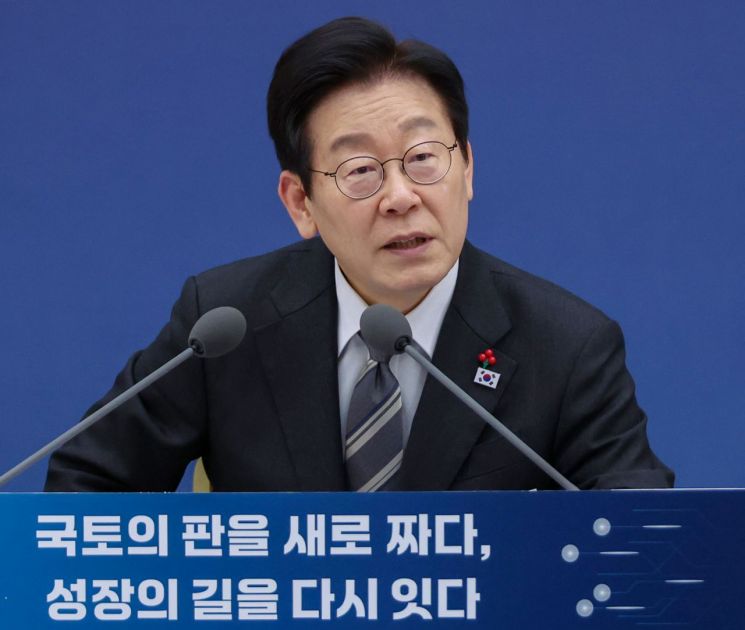 President Lee Jae-myung is speaking at the Ministry of Land, Infrastructure and Transport briefing held on the 12th at the Sejong Government Sejong Convention Center. Photo by Yonhap News
Next year, about 50,000 public housing units in the Seoul metropolitan area are scheduled to break ground, with about 29,000 units to be sold. Efforts will be made to accelerate the supply of third-phase new towns such as Incheon Gyeyang, and to expedite the approval process for new sites such as Seoripul (January next year) and Goyang Daegok (June). The Korea Land and Housing Corporation (LH) reform plan, with input from private experts, will be finalized by the first half of next year. Although the plan was originally scheduled for completion this year, the timeline was extended due to the complexity of the issues involved.
To increase urban housing supply, a special law will be enacted next year to facilitate mixed-use development of aging government buildings, school sites, and similar properties. Urban mixed-use projects will be promoted through relaxed floor area ratios and new project solicitations, and a 600 billion won Future City Fund will be established next year to accelerate the redevelopment of first-phase new towns. Over the next two years, 70,000 newly built and purchased homes will be supplied in the metropolitan area, and a special law will be enacted next year to promote modular housing.
Regional Hub Cities and Advanced Industrial Complexes... Second Phase Relocation of 350 Public Institutions Under Review
To promote balanced regional growth, the government will pursue the development of advanced corporate cities that combine regional hub cities with high-tech industrial complexes, urban convergence zones, and new towns. Fifteen advanced national industrial complexes will be established, and local strategic industries will be fostered by attracting AI data centers and converting to RE100. Urban convergence zones will be expanded to major cities, with candidate sites to be selected next year.
The pace of metropolitan and urban railway projects in regional areas will be accelerated. The Chungcheong region’s metropolitan express railway (CTX), connecting Daejeon, Sejong, and South Chungcheong, will begin construction in the second half of 2028, while the Busan-Yangsan-Ulsan metropolitan railway aims to announce its master plan in 2027. To boost regional investment, specific social overhead capital (SOC) projects will be selected for intensive investment. A special law will be proposed next year to provide regulatory, financial, and tax incentives at the pan-government level. The fifth National Territorial Comprehensive Plan, the highest-level spatial plan, will be revised in the first half of next year, and customized ultra-wide area plans for each region will also be developed.
The designation process for investment-leading districts will be expedited by about one year, and station area development projects will be launched in Osong (groundbreaking in 2027) and Chuncheon (district designation in 2028). Two new economic base-type urban regeneration projects, supporting business support centers and public housing, will be designated next year. Starting in 2027, landmark projects utilizing local natural and cultural heritage will be promoted in five selected local governments.
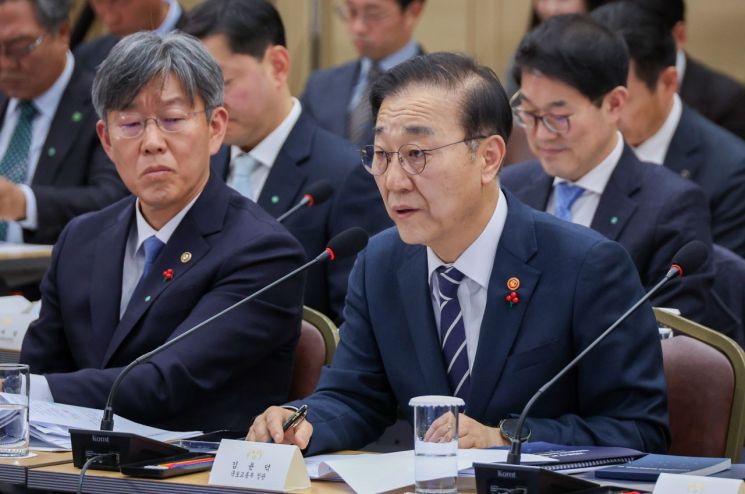 Kim Yoonduk, Minister of Land, Infrastructure and Transport, is reporting to President Lee Jae-myung at the Sejong Government Sejong Convention Center on the 12th. Photo by Yonhap News
The second phase relocation of public institutions will review the needs and relevant laws for about 350 organizations before finalizing the plan. As early as 2027, leading institutions could relocate first using a leasing method. The Presidential Sejong Office, to be built in the administrative capital, is scheduled for completion in 2030, and groundbreaking for the National Assembly Sejong Assembly Hall is targeted for 2029. On this day, the Saemangeum Development Authority announced plans to raise its renewable energy target from the current 7 GW to 10 GW by 2030.
To increase the high-speed rail service area from the current 41% to 53% by 2030, construction of the Southern Inland Railway and the Chungbuk Line high-speed upgrade will begin next year and the following year. Construction of the Sejong-Cheongju and Jecheon-Yeongwon expressways will commence next year. For new expressway projects, the proportion in regional areas will be raised to over 90%, as reflected in the Second National Road Network Revision Plan and similar statutory plans. New regional airports in locations such as Gadeokdo, Daegu-Gyeongbuk, and Saemangeum will proceed with design or groundbreaking next year, as part of ongoing efforts to revitalize local airports.
The regional SOC New Deal project will be supported by a special law to be enacted next year, enabling focused investment over the next ten years. Local public corporations will be given preferential treatment, such as increased points for local contractors. A special law will be enacted next year for the renovation of vacant buildings, and a nationwide survey will be conducted the following year. Integrated underground railway development in Busan, Daejeon, and Ansan will undergo feasibility studies next year.
1,000 Autonomous Vehicles and 1,200 km/h Train Demonstrations by 2030
In Gwangju, the autonomous driving demonstration city project will begin next year with about 200 vehicles, expanding to other local governments in 2027. By 2030, more than 1,000 vehicles are planned for demonstration. Level 4 autonomous BRT (Bus Rapid Transit) will be introduced in the Chungcheong region in 2027. The government will focus on securing technology for high-demand drone applications in fields such as firefighting and aviation, and will promote the commercialization of domestically developed AI drones. A roadmap for establishing AI cities that automate urban transportation and safety will be developed next year, and a special law will be enacted to promote smart-plus buildings with enhanced AI mobility connectivity.
The government aims to develop hyper-tube technology capable of speeds of 1,200 km/h by 2028 and to establish a demonstration test site in Saemangeum starting the following year. The Hydrogen Railway Act will be enacted to enable the commercialization of hydrogen trains on lines such as the Gyoe Line from 2027. In 2027, mandatory performance evaluations for used battery management will also be implemented.
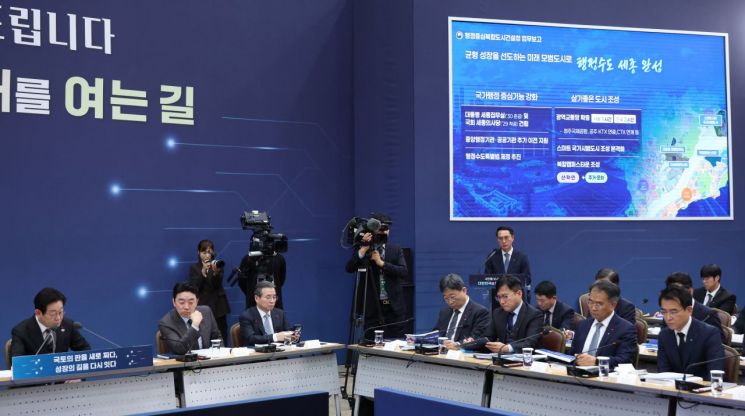 President Lee Jae-myung is listening to a report from Kang Juyeop, Administrator of the Administrative City Construction Agency, regarding the Presidential Sejong Office and the construction of the National Assembly Sejong Hall during the Ministry of Land, Infrastructure and Transport briefing held at the Government Sejong Convention Center in Sejong City on the 12th. Photo by Yonhap News
Key initiatives for next year include enacting the Construction Safety Special Act to strengthen safety management responsibilities at construction sites, advancing enforcement systems using AI technology, and reintroducing the safe freight rate system to protect truck drivers. The government will also provide ground subsidence information through navigation systems and enhance integrated underground mapping starting next year. A pilot project for black ice risk indicators to improve winter road safety will be launched next year.
Additional measures include establishing the legal basis for mobility rights by enacting the Basic Transportation Act and setting minimum transportation service standards. The government will also work to guarantee mobility rights for transportation-vulnerable groups without discrimination and address transportation service gaps in underserved areas. To improve the quality of service at expressway rest areas, a dedicated professional public management company will be established starting next year.
© The Asia Business Daily(www.asiae.co.kr). All rights reserved.
![Clutching a Stolen Dior Bag, Saying "I Hate Being Poor but Real"... The Grotesque Con of a "Human Knockoff" [Slate]](https://cwcontent.asiae.co.kr/asiaresize/183/2026021902243444107_1771435474.jpg)

















