"Worries Over Launch Gap from 2027 to 2031... Government Will Take Responsibility if Private Demand Is Lacking"
Criticism Over Lunar Lander Delay and Space Agency Location... President Jokes About G-Dragon's Ambassador Appointment: "Are You Trying to Lure Me?"
On December 12, President Lee Jae-myung expressed his strong commitment to actively support the annual launch of the Nuri rocket during a joint work report session held in Sejong by the Ministry of Science and ICT, the Korea Aerospace Administration, the Korea Communications Commission, and the Personal Information Protection Commission.
President Lee stated, "There are no launch plans from 2027 to 2031, so we need to increase the launch vehicle's success rate during that period to enable commercialization. We should be able to launch at least one rocket per year, and if there is no demand from the private sector, shouldn't the government cover the shortfall financially?"
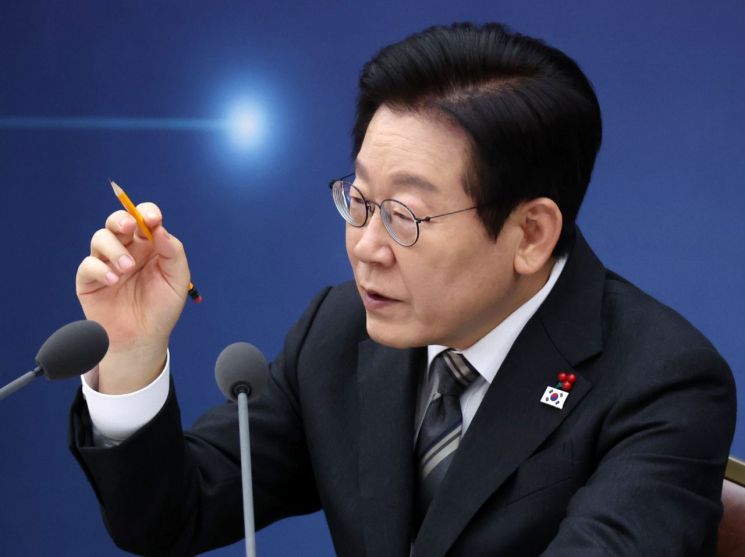 President Lee Jae-myung is speaking at the Ministry of Science and ICT and Space Agency briefing held on the 12th at the Sejong Government Sejong Convention Center. Photo by Yonhap News
This can be seen as a government pledge to fill the so-called "launch gap" that may occur between the development of the Korean launch vehicle Nuri (KSLV-II) and the next-generation launch vehicle (2029-2032). President Lee added, "To ensure predictability from now on, let's decide as soon as possible to proceed with annual launches. Please tell them to prepare for investment, assuming that additional launches will definitely take place."
President Lee repeatedly emphasized the importance of "predictability" in maintaining the launch vehicle industry ecosystem. When Ha Jeongwoo, Senior Secretary for AI Future Planning at the Presidential Office, suggested, "If we launch a rocket once a year, materials, parts, and equipment companies will invest and generate revenue, thereby sustaining the ecosystem," President Lee agreed, responding, "It's important to say that, in the worst-case scenario, the government will take responsibility for any losses, so let's be prepared."
The necessity of repeated launches to ensure the reliability of the Nuri rocket was also discussed. Yoon Youngbin, Administrator of the Korea Aerospace Administration, reported, "The current success rate of Nuri is 75% (3 successes out of 4 launches), but to enable exports, we need reliability of over 90%." In response, President Lee said, "If we launch five times and succeed four times, that is an 80% success rate. We need to launch every year to increase the success rate. The launch cost, which is about 120 billion won per launch, is not a significant amount from the perspective of industrial development."
"Sending a lunar lander in 2032 is too late"... Space Agency's location efficiency also questioned
During the work report, President Lee also sharply criticized the Korea Aerospace Administration's lunar exploration roadmap and its site selection.
The Korea Aerospace Administration reported its plan to first send a lunar communication orbiter using the Nuri rocket and an orbital transfer vehicle in 2029, and then send a lunar lander with a next-generation launch vehicle in 2032. President Lee commented, "Other countries are already sending people to the Moon, so isn't sending a lunar lander only in 2032 too late?"
Administrator Yoon responded, "It may be late, but the significance lies in sending the lander using our own launch vehicle and complete domestic technology." Regarding the orbiter to be launched in 2029, he added, "It is an essential satellite that will serve as a relay to ensure uninterrupted communication with Earth when the lander reaches the far side or polar regions of the Moon."
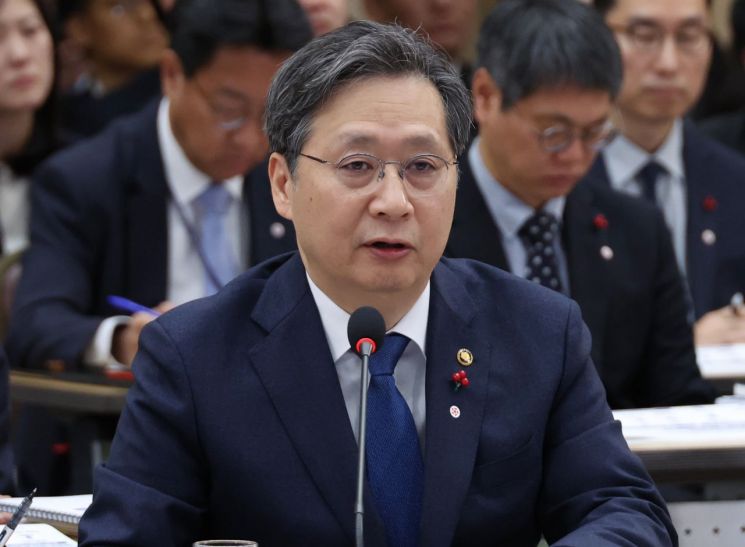 Yoon Youngbin, Administrator of the Space Agency, is giving a briefing at the Ministry of Science and ICT and Space Agency work report held at the Government Sejong Convention Center in Sejong City on the 12th. Photo by Yonhap News
There was also criticism regarding the geographical location of the Korea Aerospace Administration. President Lee pointed out, "The main office of the Korea Aerospace Administration is in Sacheon, Gyeongnam, but key research institutes such as the Korea Aerospace Research Institute and the Korea Astronomy and Space Science Institute remain in Daejeon. If only administrative staff go to Sacheon, what will they do there? Isn't this inefficient?" Administrator Yoon explained, "The Sacheon headquarters mainly consists of personnel for policy-making and industry development, while research staff in Daejeon focus on R&D."
G-Dragon appointed as promotional ambassador... Space Agency's budget to reach 1 trillion won next year
Meanwhile, the appointment of singer G-Dragon as a promotional ambassador for the Korea Aerospace Administration was announced during the session, creating a cheerful atmosphere.
No Kyungwon, Deputy Administrator of the Korea Aerospace Administration, said, "G-Dragon has agreed to serve as our promotional ambassador. If the President visits the Naro Space Center and personally presents the letter of appointment, it would be a great encouragement." President Lee joked, "Are you trying to lure me by promising that I can meet G-Dragon?" and then added, "I should go," drawing laughter from the attendees.
Starting with this work report, the Korea Aerospace Administration plans to enter the era of a 1 trillion won budget in 2026. The agency will actively pursue key projects to become one of the world's top five aerospace powers, including the fifth Nuri launch and demonstration of multi-satellite deployment of ultra-small cluster satellites, preliminary design of the next-generation launch vehicle, and securing reusable launch vehicle technology.
© The Asia Business Daily(www.asiae.co.kr). All rights reserved.
![Clutching a Stolen Dior Bag, Saying "I Hate Being Poor but Real"... The Grotesque Con of a "Human Knockoff" [Slate]](https://cwcontent.asiae.co.kr/asiaresize/183/2026021902243444107_1771435474.jpg)
















