Plans for Introducing a Unified Membership System
Step-by-Step Implementation Roadmap Requested
Amid Opposition from the SR Labor Union
Korea Railroad Corporation (KORAIL) has decided to revamp its 'KTX Mileage Program.' While the move appears to be an external consulting project aimed at improving existing customer satisfaction, KORAIL has requested proposals that include plans for introducing a unified membership system in line with the integration of KORAIL and SR, as well as a step-by-step implementation roadmap for each scenario. The government has only announced its policy to integrate the KTX and SRT operating systems, and there is strong opposition from the SR labor union and others, leading to criticism that KORAIL's actions are premature.
According to the proposal for the 'Customer-Centric Railway Service Improvement and Membership System Reform Consulting Project,' for which KORAIL began accepting submissions on December 12, the direction of the reform is to introduce membership tiers. KORAIL stated, "We will set appropriate multidimensional criteria for membership levels by comprehensively considering usage frequency, spending, and contribution, and will develop effective differentiated benefits for each tier." The company has required that the consulting results include a redesign of the customer relationship management (CRM)-based membership tier system.
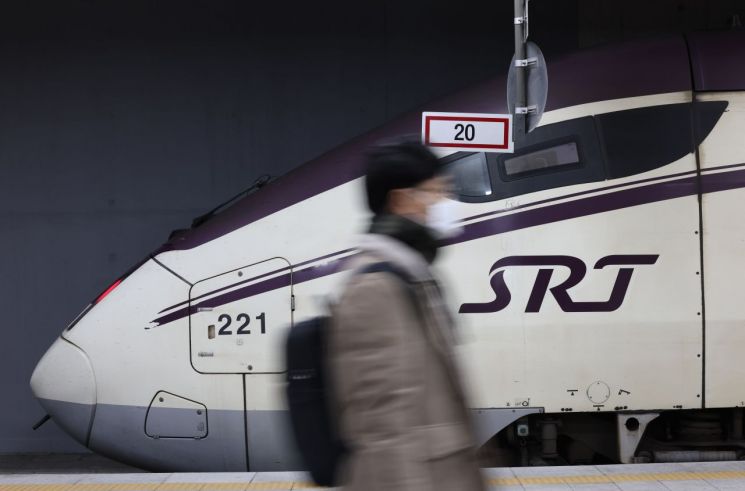
In addition, KORAIL has requested that the consulting project present plans for introducing a unified membership system and a step-by-step implementation roadmap for each scenario. The scope also includes proposals for improving mileage program operations and designing a system to manage joint members.
KORAIL explained that the background for commissioning this consulting project is "to respond to changes in the high-speed rail transport environment and to enhance customer loyalty." The company also plans to compare how membership systems are operated by domestic and international transportation providers, such as airlines, and to adopt relevant best practices where appropriate.
However, there are criticisms that this move is far ahead of the government's timeline, as the government has only just released a high-speed rail integration roadmap. The Ministry of Land, Infrastructure and Transport, the main government body in charge, announced the roadmap on December 8, which includes President Lee Jaemyung's campaign pledge of 'operation first, integration of organizations later.' Industry insiders and outsiders alike have consistently raised concerns that the integration is being pursued prematurely, without concrete grounds for unification in place.
In particular, SR, which is subject to the integration, does not currently have a mileage program. There is also no established fare structure that could be linked to a mileage program. The Ministry of Land, Infrastructure and Transport plans to conduct further research to determine the extent of seat increases that could result from the integration, including the fare system. However, this research project has not yet been commissioned.
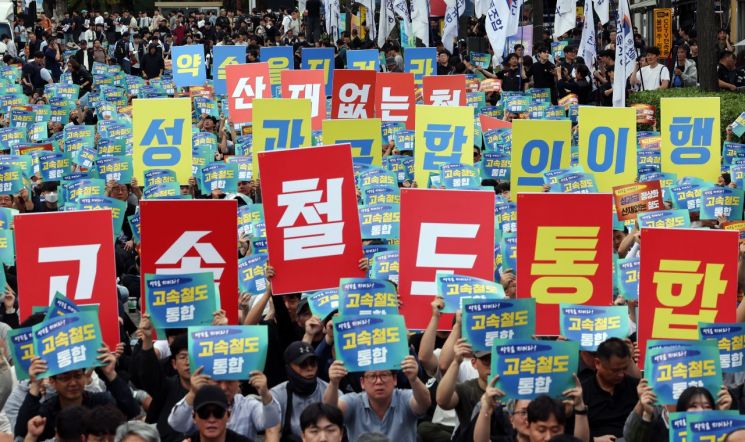 At the railway workers' solidarity rally held near Samgak Station in Yongsan-gu, Seoul, last October, participants are holding placards urging the integration of high-speed rail. Photo by Yonhap News
There are concerns both inside and outside the ministry about KORAIL's premature integration efforts. The main issues are KORAIL's claims regarding seat increases and the potential for fare reductions resulting from the integration. KORAIL has asserted that integrated operation of KTX and SRT could increase the number of seats by 10,127 on the Gyeongbu Line and 4,684 on the Honam Line, for a total of 16,690 additional seats. However, the Ministry of Land, Infrastructure and Transport explained that these figures are a simple sum that does not take into account factors such as increased operating distance and the need for safety inspections, and that a pilot operation of actual trains would be necessary to examine these claims in detail.
KORAIL's claim that 'reducing redundant costs could allow for a 10% fare reduction' is also lacking in evidence. In the past, KORAIL has argued that fares would need to be increased by about 17% to cover the costs of replacing aging trains. Since its establishment as a public corporation, KORAIL has recorded net losses in most years, with cumulative debt exceeding 21 trillion won. The Ministry of Land, Infrastructure and Transport has also not provided any basis for a fare reduction.
© The Asia Business Daily(www.asiae.co.kr). All rights reserved.
![Clutching a Stolen Dior Bag, Saying "I Hate Being Poor but Real"... The Grotesque Con of a "Human Knockoff" [Slate]](https://cwcontent.asiae.co.kr/asiaresize/183/2026021902243444107_1771435474.jpg)
















