Zelensky Rejects Donbas Withdrawal Demands
"Territorial Issues Must Be Settled Only by Referendum or Election"
Calls in Europe Grow for Increased Defense Spending and Self-Reliance
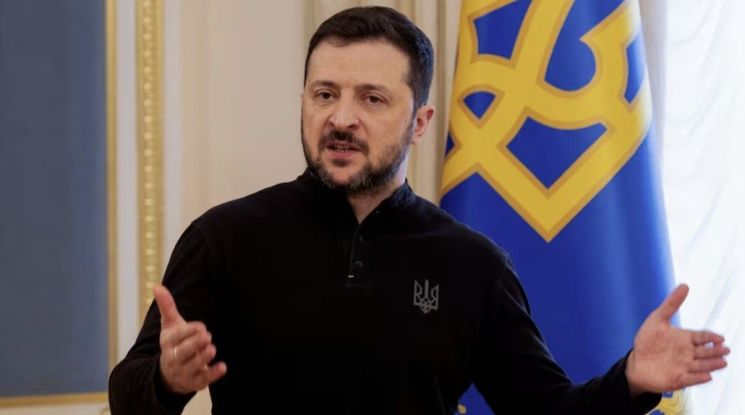
On the 11th (local time), President Volodymyr Zelensky of Ukraine stated that while Ukraine is being pressured to withdraw from the Donbas region in the east, any territorial issues can only be decided through a national referendum or election. He reaffirmed that the new U.S. compromise proposal to designate parts of Donbas as a "free economic zone" cannot be accepted until the territorial issue is resolved.
"Territorial Issues Must Be Decided by the Ukrainian People"
According to AFP, Bloomberg, and AP, President Zelensky told reporters that "Russia wants the entire Donbas, and we cannot accept this," adding, "The Ukrainian people will answer this question. Whether through elections or a referendum, it must be decided by the Ukrainian people."
Russia is demanding that Ukraine withdraw from the entire Donbas, which combines Donetsk-about three-quarters of which is occupied by Russia-and Luhansk, most of which is also under Russian control. This issue is a core point of contention in the ceasefire negotiations mediated by U.S. President Donald Trump, alongside postwar security guarantees.
President Zelensky explained that the United States had proposed designating the eastern regions from which Ukraine would withdraw as a "free economic zone." He described the compromise as "the Ukrainian military withdrawing from Donetsk, and Russian forces not entering the area."
President Zelensky, who has repeatedly emphasized that the Ukrainian constitution does not grant him the authority to cede territory, reiterated that maintaining the current front lines would be the "fair outcome."
According to the U.S. proposal, Russia would have to relinquish control over the areas it currently occupies in Kharkiv, Sumy, and Dnipropetrovsk. Unlike Donetsk, Kherson, Luhansk, and Zaporizhzhia, Russia has not officially declared the annexation of these regions.
The New York Times noted, "President Zelensky rejected the revised U.S. peace plan, which also demands Ukraine’s withdrawal from Donbas, making it clear that the unresolved territorial issue remains a central point of contention."
President Zelensky also said that the U.S. side had proposed a plan for joint management of the Zaporizhzhia nuclear power plant, and that the negotiating teams are currently discussing the details of this arrangement.
Growing Trump Fatigue: "Frustration on Both Sides"
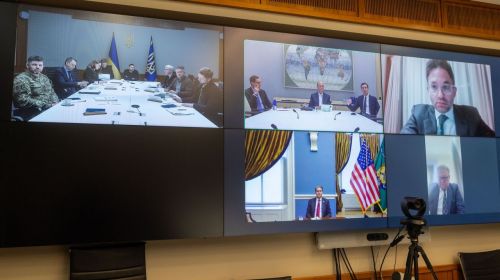 President Zelensky posted on X (formerly Twitter) on the 11th that he discussed security guarantees with the United States and attached a photo of the ongoing video conference. Zelensky X
The Trump administration has been drafting a ceasefire proposal since last month, meeting alternately with Ukrainian and Russian delegations to mediate the negotiations.
However, as a conclusion remains elusive, President Trump's fatigue has reportedly grown. According to CNN, White House spokesperson Karoline Leavitt conveyed that "President Trump is extremely frustrated with both sides and is tired of meetings for the sake of meetings."
After appealing for support and holding consultations with major European countries, President Zelensky revised Ukraine’s negotiation proposal and sent it to the Trump administration the previous day. He explained that the document sent to the U.S. consisted of 20 items, and that each item may have included supplementary documents detailing specific conditions. He said, "We appreciate the United States' efforts to cooperate with us and to take a balanced approach," but added, "Nevertheless, it is still difficult to say what the final document will look like at this point."
President Zelensky also announced via X (formerly Twitter) that he had discussed security guarantees with the U.S. side. The U.S. delegation included Secretary of State Marco Rubio, Secretary of Defense Pete Hegseth, and President Trump’s special envoy Steve Witkoff. He wrote, "We had a constructive and in-depth discussion on security guarantees, which is one of the three documents we are working on," and added, "We greatly value the United States’ active participation not only in ceasefire efforts but also in ensuring Ukraine’s security and preventing further Russian aggression."
In a statement, he also referenced the "negative experience" of the 1994 Budapest Memorandum, which led to Ukraine’s renunciation of nuclear weapons. He stressed that "it is essential for this document on security guarantees to provide a concrete answer to the Ukrainian people’s greatest concern: what actions our partners will take if Russia launches another invasion."
Heightened Tensions in Europe: Calls to Rapidly Increase Defense Spending
European countries have also moved quickly. On this day, under the leadership of the United Kingdom and France, about 30 countries held a virtual meeting of the "Coalition of Willing," discussing postwar security guarantees for Ukraine. This consultative body, centered on Europe, serves as a channel for coordinating a unified position for Ukraine and discussing it with the United States.
German Chancellor Friedrich Merz, after meeting with NATO Secretary General Mark Rutte in Berlin earlier in the day, said, "Above all, the issue of territorial concessions, which Ukraine seeks to decide, is a matter for the Ukrainian president and people to answer," adding, "We have made this clear to President Trump."
Secretary General Rutte, speaking at the Munich Security Conference held in Berlin, argued that European countries "could be Russia’s next target" and called for a rapid increase in defense spending. He emphasized, "War is at our doorstep," and added, "Russia has brought war back to Europe, and we must prepare for the kind of conflict our grandparents and great-grandparents endured."
© The Asia Business Daily(www.asiae.co.kr). All rights reserved.
![Clutching a Stolen Dior Bag, Saying "I Hate Being Poor but Real"... The Grotesque Con of a "Human Knockoff" [Slate]](https://cwcontent.asiae.co.kr/asiaresize/183/2026021902243444107_1771435474.jpg)
















