236,000 New Claims Reflect Increased Volatility from Holiday and Seasonal Factors
Continuing Claims Fall to 1,838,000, Below Market Expectations
Last week, the number of new unemployment benefit claims in the United States unexpectedly surged, marking the largest weekly increase in five years and nine months.
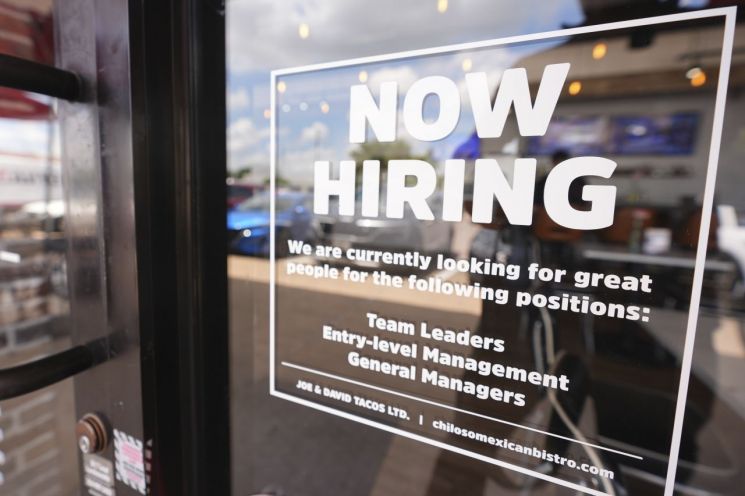 A job posting is displayed at a restaurant in Richardson, Texas, USA. Photo by AP Yonhap News Agency
According to the U.S. Department of Labor on December 11 (local time), the number of new unemployment benefit claims for the week of November 30 to December 6 reached 236,000, an increase of 44,000 from the previous week's 192,000. This figure not only far exceeded market expectations of 220,000, but also represented the largest increase since March 2020, at the onset of the COVID-19 pandemic.
New unemployment benefit claims had plunged to a three-year low during the week that included Thanksgiving (November 27), but then rebounded the following week with the largest increase in five years, reflecting extreme volatility in recent weeks. Analysts suggest that seasonal factors during the holiday period are having a significant impact, and this trend could continue through the end of the year.
The number of continuing unemployment benefit claims-those filed by people receiving benefits for two weeks or more-stood at 1,838,000 for the week of November 23 to 29. This was lower than both the previous week's 1,937,000 and the market forecast of 1,950,000.
The sharp increase in new unemployment benefit claims is drawing attention amid growing concerns about a slowdown in employment. Major companies such as PepsiCo and Hewlett-Packard (HP) have recently announced plans for workforce reductions. According to the U.S. Department of Labor's Job Openings and Labor Turnover Survey (JOLTs), layoffs in October also rose to 1,854,000 (a layoff rate of 1.2%), up from 1,781,000 (1.1%) the previous month, reaching the highest level since early 2023.
The U.S. Federal Reserve also expressed caution regarding downside risks in the labor market the previous day, lowering the benchmark interest rate by 0.25 percentage points to a range of 3.5% to 3.75%, marking its third consecutive rate cut.
However, some point out that weekly unemployment benefit claims are highly volatile and have limitations as an indicator of the overall strength of the labor market. Even in the longer term, the numbers remain at relatively low levels.
Heather Long, Chief Economist at Navy Federal Credit Union, said, "There is no need to read too much into the sharp increase in unemployment benefit claims," adding, "Considering the average, the weekly figure remains in the range of 215,000 to 220,000, which is not a cause for concern."
© The Asia Business Daily(www.asiae.co.kr). All rights reserved.
![Clutching a Stolen Dior Bag, Saying "I Hate Being Poor but Real"... The Grotesque Con of a "Human Knockoff" [Slate]](https://cwcontent.asiae.co.kr/asiaresize/183/2026021902243444107_1771435474.jpg)















