Generative AI Drives Employment Growth in the Service Sector
Leads to Higher Wages for Highly Skilled Workers
New Roles Emerging, Such as "AI Operator"
Research has found that the spread of artificial intelligence (AI) increases wages for highly skilled workers and raises employment rates, particularly in the service sector. It has also been evaluated as contributing to the creation of new types of work. However, Korea's adoption rate of AI remains lower than that of other countries, with significant disparities depending on company size, which has been identified as a challenge. Experts have assessed that to maximize the positive effects of AI adoption, measures such as job redesign and education and training are necessary.
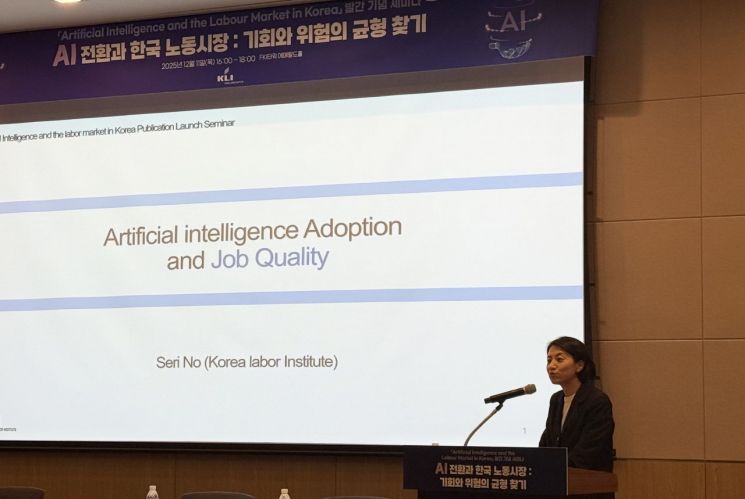 Noseri, a research fellow at the Korea Labor Institute (KLI), is presenting at the seminar commemorating the publication of the joint report by the Organisation for Economic Co-operation and Development (OECD) and KLI titled 'Artificial Intelligence and the Labour Market in Korea,' held on the 11th at the FKI Tower in Yeouido, Seoul. Photo by Kim Pyeonghwa
The Korea Labor Institute (KLI) held a seminar on December 11 at the FKI Tower in Yeouido, Seoul, to commemorate the publication of the joint report "Artificial Intelligence and the Labour Market in Korea" by the Organisation for Economic Co-operation and Development (OECD) and KLI. The seminar, under the theme "AI Transformation and the Korean Labor Market: Striking a Balance Between Opportunities and Risks," was organized to examine the impact of AI on employment and labor and to discuss policy directions for building a sustainable work environment.
Bang Hyungjun, a research fellow at KLI, gave a presentation titled "AI and the Korean Labor Market: Focusing on Empirical Analysis." Bang explained that while traditional AI has shown to reduce employment in certain occupations, generative AI contributes to wage growth. He noted that by increasing the value of certain jobs, the compensation system is changing, with wage increases centered on highly skilled workers.
However, the impact may vary depending on age, skill level, industry, and gender. Bang explained that highly skilled workers, women, and service sector occupations are the main beneficiaries. He pointed out, "Traditional AI is reducing employment in manufacturing, while generative AI is increasing employment growth in the service sector." He also argued that, as AI triggers job restructuring and changes in skill structures, the effects can be diverse, making it necessary to develop differentiated responses in the labor market.
Noseri, a research fellow at KLI, presented on "Changes in Work Experience in the AI Era," explaining that AI replaces 8.4% of jobs entirely, partially replaces 56.6% of tasks, and creates 35.1% new types of work that did not previously exist. Noseri stated, "With the introduction of AI, companies are creating new roles such as AI operators." He explained that as AI functions as a complementary technology that enhances productivity and precision, job redesign is required.
Noseri also emphasized the need to develop collaborative models between humans and AI to improve performance and overall work experience through AI adoption. At the organizational level, he suggested identifying new sources of work-related stress and burdens arising from AI integration and considering support systems for workers. Noseri remarked, "It would be ideal if AI technology could be designed to reduce stress and fatigue for workers."
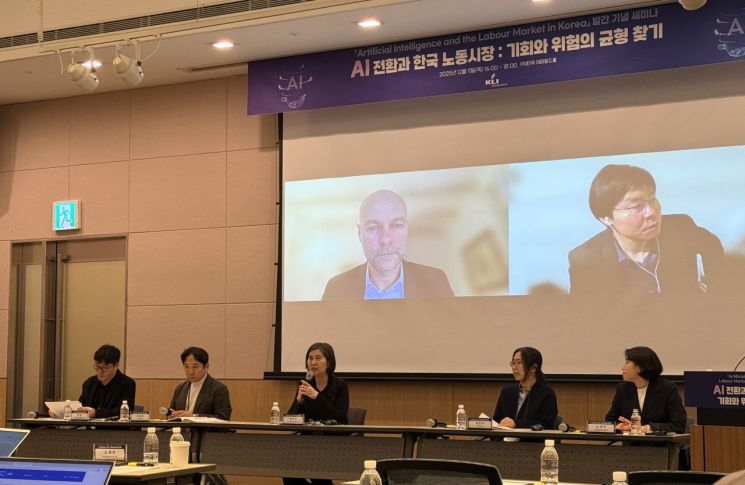 A panel discussion is taking place at the seminar commemorating the publication of the joint report by the Organisation for Economic Co-operation and Development (OECD) and the Korea Labor Institute (KLI) titled 'Artificial Intelligence and the Labour Market in Korea,' held on the 11th at the FKI Tower in Yeouido, Seoul. Photo by Kim Pyeonghwa
The final presenter, Stein Br?ck, Senior Economist at the OECD, spoke on "Managing Opportunities and Risks from AI: Exploring Policy Alternatives," calling for prerequisites to ensure the successful adoption of AI. He pointed out that, despite Korea's urgent need to address population aging and boost productivity, its AI adoption rate remains low, with particularly wide gaps between companies of different sizes, making it especially difficult for small and medium-sized enterprises (SMEs).
He explained, "In Korea, SMEs account for over 80% of employment, which is higher than the OECD average. However, SME productivity is only about one-third that of large enterprises, whereas the OECD average is about half." He added, "SMEs face low productivity issues and are also less likely to adopt AI compared to large companies. Therefore, it is necessary to provide support, such as funding, to facilitate AI adoption."
Br?ck identified a lack of skills as the biggest barrier to AI proliferation. He also expressed concern that the rate of labor-management consultation during the AI adoption process is extremely low in Korea, which could lead to social conflict during the transition. To address this, he recommended increasing investment in workforce development through education, training, and upskilling, as well as expanding social dialogue. Establishing reliable AI standards was also cited as a key challenge.
© The Asia Business Daily(www.asiae.co.kr). All rights reserved.
![Clutching a Stolen Dior Bag, Saying "I Hate Being Poor but Real"... The Grotesque Con of a "Human Knockoff" [Slate]](https://cwcontent.asiae.co.kr/asiaresize/183/2026021902243444107_1771435474.jpg)
















