Low Utilization of Mileage by Central Agencies and Local Governments
Lack of Public Donations... Risk of Personal Misuse
Seoul City Provides 18 Million KRW Worth of Aid to Vulnerable Groups
Integrated Management Stalled as Airlines Cite "Ma
The "official air mileage" accumulated by public officials after using aircraft continues to be left in a management blind spot. Since this mileage is also funded by taxpayers, the government has recommended that central administrative agencies and local governments use it for public purposes, but the implementation rate remains low. Although the integrated management of mileage has been under discussion for several years, airlines have not been cooperating.
According to government ministries on December 11, the deadline for establishing and implementing plans to utilize official air mileage, which the National Rights Commission recommended last year to 49 central administrative agencies and 243 local governments nationwide, is set for the end of this month.
 Public officials' "official air mileage" earned after using aircraft is still left neglected in a management blind spot. Photo by Pixabay
Previously, the National Rights Commission conducted a full survey of these agencies last year and revealed that a total of 130 million miles expired over the past five years due to the expiration of their validity period. This is equivalent to between 1.3 billion and 2.6 billion KRW in cash. Notably, in 2023 alone, 35 million miles expired due to the end of their validity period. Additionally, about 39 million miles went unused as public officials who held them retired. Given that the value of one mile is approximately 20 KRW, this means that roughly 1.48 billion KRW in taxpayer funds have disappeared.
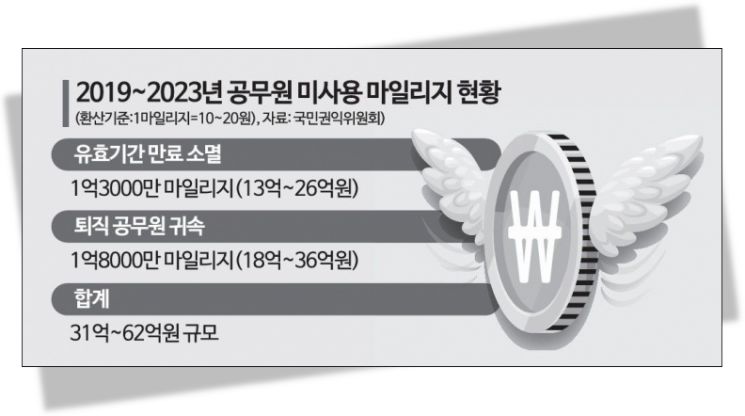 2019-2023 Unused Mileage Status of Public Officials (Conversion Standard: 1 Mileage = 10-20 KRW). National Rights Commission
In response, the National Rights Commission requested that the Ministry of Personnel Management issue work guidelines related to travel expenses for public officials, and that local governments take measures such as amending relevant ordinances to expand the use of official air mileage by the end of this month.
Upon review, the Ministry of Personnel Management created and distributed relevant guidelines to central administrative agencies. In contrast, the response from local governments has been insufficient. Of the 243 local governments targeted by the National Rights Commission, only five have reported preparing and implementing measures such as ordinance amendments.
Seoul City, which the National Rights Commission cites as a model case, encourages officials who are about to retire or whose mileage is about to expire to participate in donations, using the mileage in various ways, such as donating daily necessities. Over the past year, donation campaigns have provided daily necessities worth about 18 million KRW to vulnerable groups. Seoul City has also designated this month as a "mileage use intensive participation period" and plans to provide additional support.
The problem lies in the implementation rate among public officials. Because the mileage is credited to individuals and there is no legal basis for forced recovery, there is a high possibility of personal misuse. During the recent parliamentary audit, it was revealed that from 2021 to September this year, 662 retired officials from the Ministry of Foreign Affairs collectively held 23.28 million miles. Another survey found that among approximately 4,000 public officials under the National Assembly's Strategy and Finance Committee who hold official air mileage scheduled to expire, only 10% expressed willingness to donate.
Airlines' lack of cooperation in integrated mileage management is also a problem. The government has been discussing with some airlines for years about ways to attribute mileage to institutions rather than individuals, but airlines have expressed reluctance, citing "management limitations."
The National Rights Commission is also known to have proposed other measures, such as a donation system linked to mileage and the sale of discounted air tickets that reflect mileage in advance. A representative from the National Rights Commission stated, "We have recently held discussions, but the airlines cited difficulties in budget and system development." An airline official explained, "There are inevitably limitations in integrated management because the amount of mileage accumulated varies greatly by individual and institution," adding, "There are also concerns about side effects in managing personal information and official air tickets."
However, some point out that this structure only benefits the airlines. Although public officials are allowed to use mileage for purchasing tickets or upgrading seats for official travel under the "Regulations on Official Travel Expenses for Public Officials," the amount they hold often falls short of the threshold needed to redeem bonus tickets. A local government official commented, "Mileage is essentially the same as taxpayer money, so if it expires unused, only the airlines profit," adding, "If there are management limitations, we need to consider alternative uses that take the airlines' position into account."
© The Asia Business Daily(www.asiae.co.kr). All rights reserved.
![Clutching a Stolen Dior Bag, Saying "I Hate Being Poor but Real"... The Grotesque Con of a "Human Knockoff" [Slate]](https://cwcontent.asiae.co.kr/asiaresize/183/2026021902243444107_1771435474.jpg)
















