"Slower Job Growth... Unemployment Rate Rises Through September"
Three Dissenting Votes: Schmidt and Goolsbee for 'Hold', Miran for 'Big Cut'
One Rate Cut Projected in 2026, One in 2027
Pace of Monetary Easing Expected to Slow Next Year
The United States Federal Reserve (Fed) has implemented its third consecutive interest rate cut, lowering rates by 0.25 percentage points as expected. In its new dot plot outlining future rate projections, the Fed signaled that it anticipates only one rate cut each in the next two years, indicating that the pace of monetary easing may become more gradual. The Fed also confirmed its plan to end quantitative tightening (QT) starting this month and to resume purchases of short-term government bonds.
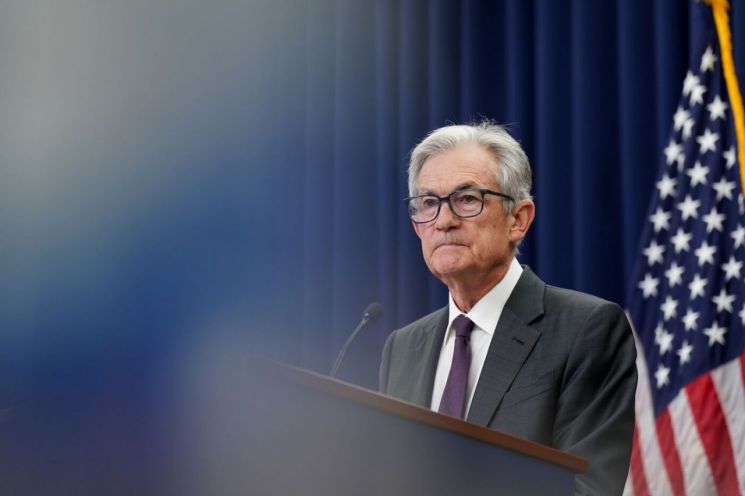
On December 10 (local time), following its regular Federal Open Market Committee (FOMC) meeting, the Fed announced in its policy statement that it had decided to lower the federal funds rate by 0.25 percentage points to a range of 3.5% to 3.75% per annum. This marks the third consecutive rate cut, following those in September and October. As a result, the gap between the benchmark interest rates of South Korea and the United States has narrowed from the previous 1.5 percentage points to 1.25 percentage points at the upper end.
The Fed cited a slowdown in employment as the reason for this rate cut. In its policy statement, the Fed noted, "Since the beginning of this year, the pace of job growth has slowed, and the unemployment rate has risen slightly through September." It added, "Recent indicators also support this trend." Regarding inflation, the Fed assessed that "it has risen compared to the beginning of the year and remains at a somewhat elevated level."
However, there were internal disagreements over the direction of monetary policy, as three out of the twelve voting FOMC members cast dissenting votes on this rate decision. This is the first time since September 2019 that three dissenting votes have been recorded in an FOMC rate decision. The simultaneous appearance of employment slowdown signals and high inflation suggests that committee members are sharply divided over policy priorities. Among the three dissenting members, Jeffrey Schmidt, President of the Federal Reserve Bank of Kansas City, and Austan Goolsbee, President of the Federal Reserve Bank of Chicago, advocated for holding rates steady. In contrast, Fed Governor Stephen Miran, known as President Donald Trump's "economic advisor," once again called for a 0.5 percentage point cut-a so-called "big cut"-as he did in the September and October meetings, and voted against the decision.
Regarding the future path of interest rates, Fed officials projected one rate cut each in 2026 and 2027. According to the dot plot released that day, the median projection for the Fed’s policy rate at the end of 2026 is 3.4%, and for 2027, it is 3.1%, both unchanged from the numbers presented in September. With strong arguments within the FOMC for both additional cuts and holding rates steady, this suggests that the pace of monetary easing may slow from next year. The projection for the end of 2028 is 3.1%, indicating no further rate cuts are expected that year.
In the Summary of Economic Projections (SEP) released alongside the rate decision, the Fed raised its forecast for this year's gross domestic product (GDP) growth rate from 1.6% to 1.7%. The year-end unemployment rate is projected at 4.5%, and the core personal consumption expenditures (PCE) inflation rate at 3.0%. For 2026, the Fed increased its growth forecast from 1.8% to 2.3%, with a year-end unemployment rate of 4.4% and a core PCE inflation rate of 2.5%.
Additionally, the Fed confirmed its plan, first announced in October, to end quantitative tightening (QT) starting in December, and on this day, it also confirmed the resumption of short-term government bond purchases. The Fed will initially purchase 40 billion dollars’ worth of short-term government bonds and maintain a high level of purchases for the next several months before gradually reducing the scale.
© The Asia Business Daily(www.asiae.co.kr). All rights reserved.
![Clutching a Stolen Dior Bag, Saying "I Hate Being Poor but Real"... The Grotesque Con of a "Human Knockoff" [Slate]](https://cwcontent.asiae.co.kr/asiaresize/183/2026021902243444107_1771435474.jpg)















