'Economic Strategist of the Civilian Government' Jae-Yoon Park
Proposes Tasks and Solutions for Advancing to an Advanced Nation
Proposes Four-Year Presidential Term with Re-Election and Introduction of Vice Presidency
"Governance Reform Is Essential for Driving Joint Growth"
"If we fail to become an advanced nation by 2031, we too will fall into the middle-income trap. To avoid this, we must raise our per capita income to $41,200 and achieve an average growth rate of 3.0% over the next six years."
Jae-Yoon Park, Professor Emeritus of Economics at Seoul National University, made this statement at the 124th Win-Win Growth Forum held on the 10th at the Samsung Convention Center in the Hoam Faculty House of Seoul National University. The Win-Win Growth Forum is an event organized by the Win-Win Growth Research Institute (Director: former Prime Minister Chung Unchan), a private research institution. This forum was held under the theme "The Great Transformation of the Korean Economy: 11 Key Innovations for Advancing to an Advanced Nation."
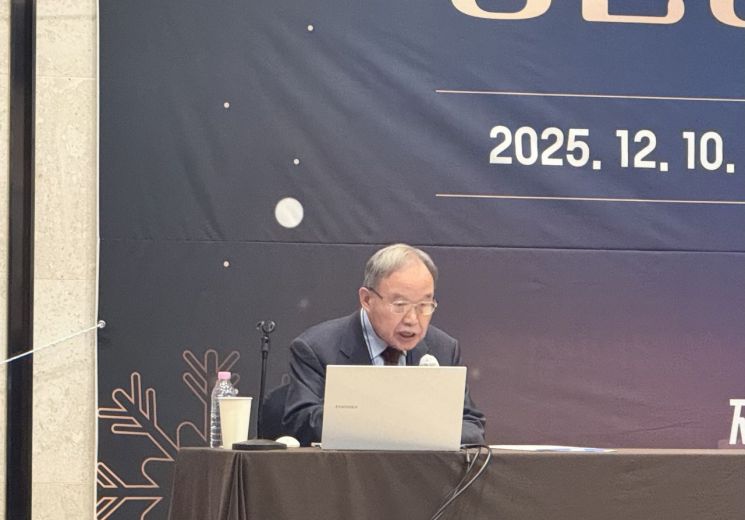 Professor Jae Yoon Park, Professor Emeritus of the Department of Economics at Seoul National University, is presenting at the 124th Win-Win Growth Forum held on the 10th at the Samsung Convention Center in the Hoam Faculty House of Seoul National University. Photo by Kim Pyeonghwa
On this day, Professor Park presented detailed tasks and sought alternatives for Korea to advance to the status of an advanced nation. He said, "There is a widespread perception that Korea has already become an advanced nation, but this is completely mistaken. We are not yet an advanced nation." He further explained, "Among 21 advanced nations (excluding Japan), the per capita income is at least $38,000, but we have not yet reached that level."
Professor Park stated, "Of course, we have achieved success through industrialization and democratization," but added, "However, since we have not yet become an advanced nation, our success remains incomplete." He continued, "There is a theory that if a country fails to become an advanced nation within half a century, or 50 years, after entering the middle-income tier, it will either remain a middle-income country or fall back to being a developing country. Without special efforts, we too will fall into this trap."
Professor Park identified "2031" as the deadline. He emphasized, "By 2031, it will be exactly half a century since we entered the middle-income tier in 1981. The Korean economy now stands at a crossroads: will we advance to an advanced nation, or will we remain stuck in the middle-income trap?"
According to Professor Park, to achieve this, per capita national income must rise from $34,134 (the average from 2015 to 2024) to $41,200 (the average from 2025 to 2031), and the economic growth rate must increase from 2.1% (the average from 2022 to 2024) to 3.0% (the average from 2025 to 2031). He pointed out, "This is an extremely difficult situation that cannot be achieved without special policies and efforts."
Professor Park argued that a vision for national governance must be established to achieve advanced nation status. He proposed setting the advancement to an advanced nation as a national mission (goal), upholding integrity, consistency, and determination as values (principles), and preparing 11 innovation strategies (measures) along with the "Six-Year Plan for Korea's Advancement." The 11 innovation strategies include reforms in national governance, regional decentralization, political and economic structure, science and technology, and demographic structure.
Professor Park stated, "For governance reform, a four-year presidential term with the possibility of re-election and the introduction of a vice presidency are necessary," adding, "A prepared president must emerge." He also said, "If governance is reformed, it will drive the joint growth of the nation and its people." He emphasized the need to create a system where cooperation is followed by competition in politics and economics, saying, "We need to change the structure so that we make the pie bigger before dividing it." He also called for an increase in the actual number of working days.
Professor Park began his public service as Senior Presidential Secretary for Economic Affairs during the Civilian Government (President Kim Youngsam), later serving as Minister of Finance and Economy (now the Ministry of Economy and Finance) and Minister of Trade and Industry (now the Ministry of Trade, Industry and Energy). He was the founding president of both the Korea Money & Finance Association and the Korea Institute of Finance. After serving as president of Pusan National University and Ajou University, he is currently Professor Emeritus of Economics at Seoul National University and also serves as the head of the Knowledge Society Forum.
© The Asia Business Daily(www.asiae.co.kr). All rights reserved.
![Clutching a Stolen Dior Bag, Saying "I Hate Being Poor but Real"... The Grotesque Con of a "Human Knockoff" [Slate]](https://cwcontent.asiae.co.kr/asiaresize/183/2026021902243444107_1771435474.jpg)















