Presided Over the "K-Semiconductor Vision and Development Strategy Briefing"
"Growth Benefits Should Be Shared Equitably... Companies Must Contribute to Balanced Regional Development"
"Plans to Introduce Groundbreaking Measures in Taxation and Regulation"
"Institutional Reforms That Do Not Undermine the Separation of Banking and Commerce to Be Finalized Soon"
Kim Jeonggwan: "We Will Scale Up the Fabless Sector Tenfold"
On December 10, President Lee Jaemyung emphasized that the semiconductor industry is the key to Korea's industrial and economic leap forward, highlighting the importance of strengthening the domestic semiconductor ecosystem-including materials, components, and equipment-and the contribution of companies to balanced regional development. In particular, President Lee announced plans to soon complete institutional reforms, such as easing the separation of banking and commerce regulations, to facilitate large-scale investments in advanced technology industries such as artificial intelligence (AI) and semiconductors.
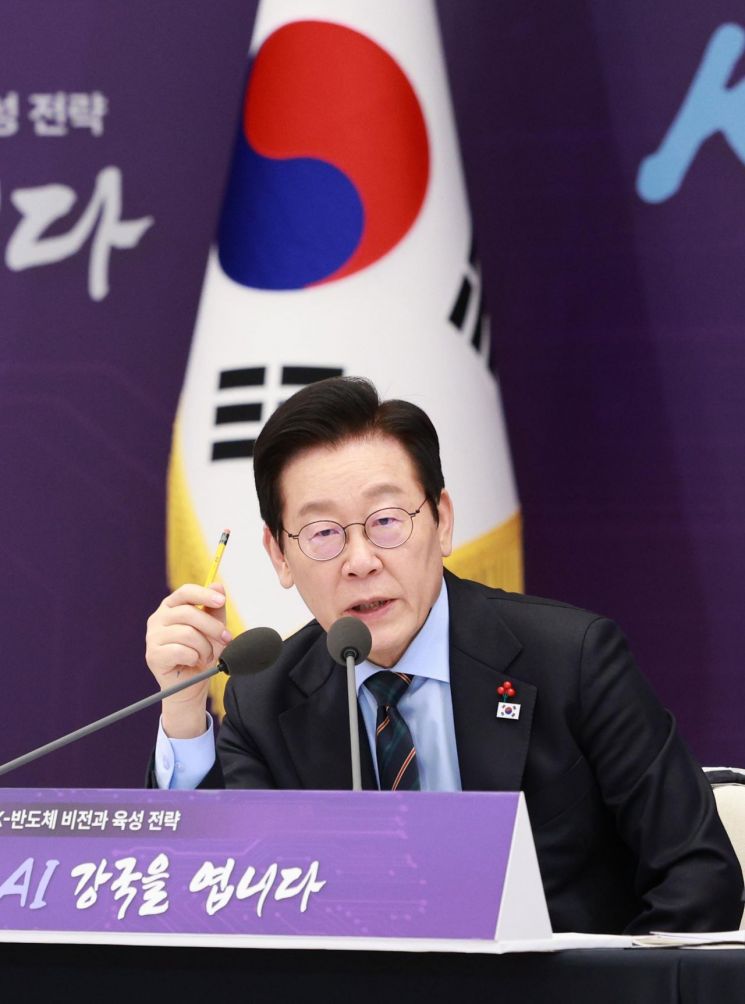
At the "K-Semiconductor Vision and Development Strategy Briefing" held at the presidential office in Yongsan, Seoul, that afternoon, President Lee stated, "With the sudden arrival of the artificial intelligence (AI) era, the world seems to be changing at a dizzying pace. Korea must move beyond this brief period of confusion and take a new leap forward. Industrial and economic development is at the core of this, and among these, the semiconductor sector is a promising area where we have significant competitiveness."
Regarding the approach to growth, President Lee said, "It is very important to increase the overall size of the pie. Secondly, I hope that the pie can be diversified so that more people can benefit." He continued, "When digging a well, if you dig narrowly and small, you may finish quickly, but it will be difficult to dig deeper. I hope we can take the path of digging more broadly, even if it takes more time, so that we can go deeper. That is my wish as the chief policymaker."
On the topic of the semiconductor supply chain, President Lee identified the strengthening of the ecosystem-including upstream and downstream industries such as materials, components, and equipment-as a key task. He said, "I believe it would be beneficial to properly establish the domestic industrial ecosystem. There are concerns that the so-called materials, components, and equipment sectors, which are being discussed, are highly dependent on foreign sources. I hope that attention will also be paid to these areas." He added, "The ecosystem must be robust for sustainable and long-term growth and development."
President Lee also stressed the connection with balanced regional development. He said, "I hope companies will contribute to balanced development. Given that companies operate based on capital logic, there are limits to relying solely on goodwill." He explained, "We are systematically preparing measures such as tax policies, regulatory improvements, infrastructure development, and securing living conditions to supply talent, so that these can be beneficial for companies, not just acts of goodwill."
He further requested, "For balanced development, please turn your attention to the southern regions, which are rich in renewable energy, and take an interest in building new industrial ecosystems there." He added, "The government is preparing to introduce truly groundbreaking measures as part of its policy."
In the subsequent discussion, it was revealed that practical measures are being prepared to encourage large-scale investment in advanced industries, within the scope of not undermining the separation of banking and commerce regulations. When Kwak Nojeong, CEO of SK Hynix, remarked, "It is difficult to carry out ultra-large-scale investments alone. If regulations are improved, proactive and simultaneous investments will become possible," President Lee responded, "The rationale for restricting financial procurement under the principle of separation of banking and commerce is to prevent the harms of monopoly, but for advanced industries, that issue has already passed. Since it is now a hindrance to industrial development, we are already preparing institutional changes."
Currently, the Fair Trade Act prohibits general holding companies from owning financial companies, and requires a holding company's second-tier subsidiaries to own 100% of their third-tier subsidiaries. As a result, when establishing a third-tier subsidiary to invest in AI or semiconductors, it was impossible to attract external investment, increasing the initial investment burden. To alleviate this, the government is considering measures such as lowering the mandatory shareholding ratio for a holding company's third-tier subsidiaries in advanced industries from 100% to 50%.
Earlier, Kim Jeonggwan, Minister of Trade, Industry and Energy, who announced the semiconductor industry policy, compared the global semiconductor competition to a war and stated that Korea would maintain its overwhelming lead in the memory semiconductor sector. He also pledged to scale up the fabless sector, which is Korea's weakness, by a factor of ten to become the world's second-largest. Minister Kim emphasized, "On the western front, China operates a fund of about 100 billion dollars, while on the eastern front, the United States provides 53 billion dollars in subsidies. Korea currently invests only about 2 billion dollars (about 2 trillion won) in semiconductors."
The briefing was attended by Jun Younghyun, Vice Chairman of Samsung Electronics; Kwak Nojeong, CEO of SK Hynix; representatives from semiconductor equipment, materials, fabless, and AI semiconductor companies; as well as academic and research experts. On the government side, Deputy Prime Minister and Minister of Economy and Finance Koo Yooncheol; Deputy Prime Minister and Minister of Science and ICT Bae Kyunghoon; Minister of Education Choi Gyojin; Minister of Trade, Industry and Energy Kim Jeonggwan; Chairman of the Fair Trade Commission Joo Byungki; Chairman of the Financial Services Commission Lee Eogwon; and Vice Chairman of the National AI Committee Im Munyoung were present.
Meanwhile, on the same day, the National Assembly’s Legislation and Judiciary Committee held a plenary session and passed the "Special Act on Strengthening and Supporting Semiconductor Industry Competitiveness" by bipartisan agreement. This bill includes the establishment of a "Special Committee for Strengthening Semiconductor Industry Competitiveness" under the President, the designation of "semiconductor clusters," and the creation and support of related infrastructure.
© The Asia Business Daily(www.asiae.co.kr). All rights reserved.
![Clutching a Stolen Dior Bag, Saying "I Hate Being Poor but Real"... The Grotesque Con of a "Human Knockoff" [Slate]](https://cwcontent.asiae.co.kr/asiaresize/183/2026021902243444107_1771435474.jpg)















