Concerns Over Constitutionality, Including Violation of Judicial Independence
Aiming for Passage Within the Year After Additional Revisions
The Democratic Party of Korea has begun additional revisions to its judicial reform bills related to settling insurrection cases, including the bill to establish a dedicated insurrection tribunal and the amendment to the Constitutional Court Act. This move comes as not only the legal community and opposition parties, but also progressive civic groups and even members within the ruling party, have raised concerns about the bills’ constitutionality. The party is now refining the legal texts and taking a step back to reduce internal opposition.
Kim Hyunjung, the Democratic Party’s floor spokesperson, met with reporters after the party’s floor countermeasures meeting at the National Assembly on the morning of December 9, stating, “We will gather opinions from experts and various sectors of the legal community and make a decision through a general assembly of lawmakers,” and added, “Regarding the insurrection tribunal, we will proceed in a way that minimizes any issues of unconstitutionality.”
Initially, the Democratic Party had planned to introduce the bill to establish a dedicated insurrection tribunal at the plenary session on this day. However, after a significant number of lawmakers voiced concerns about its constitutionality during a closed-door caucus the previous day, the party decided to postpone its submission. The party also delayed the handling of the amendment to the Constitutional Court Act in the Legislation and Judiciary Committee, which would prevent trials for insurrection and treason cases from being suspended even if a request for a constitutional review is made.
The bill to establish a dedicated insurrection tribunal, which passed the Legislation and Judiciary Committee under the Democratic Party’s leadership, stipulates that at least two dedicated tribunals should be established at both the first and appellate trial levels, and that judges appointed by a nomination committee will comprise these tribunals. The nomination committee is to be formed by the Chief Justice of the Constitutional Court, the Minister of Justice, and nominees from the judges’ council. Lawmakers who expressed opposition or requested postponement the previous day argued that the bill violates the principle of random assignment of judges for fair trials, and that the Minister of Justice’s nomination authority and the transfer of cases to the dedicated tribunal after the first trial are contrary to the principle of judicial independence, raising constitutional concerns.
Particular consideration was given to the fact that concerns were raised not only by organizations such as the People’s Solidarity for Participatory Democracy, the Lawyers for a Democratic Society (Minbyun), the Korean Bar Association, the Court Administration Office, and the meeting of court presidents, but also by parties such as the Cho Kuk Innovation Party.
There are also concerns that if the ruling Democratic Party is seen as pressuring the judiciary, it could face a backlash in the local elections six months from now. One Democratic Party lawmaker said, “If there were no local elections next year, it might be different, but there could be a public backlash from centrist voters.”
Nevertheless, the Democratic Party leadership maintains its stance to process the bills within this year. They explained that after reviewing external law firm consultations and the contents of a public hearing at the Court Administration Office attended by former Acting Chief Justice Moon Hyungbae, they will hold another general assembly of lawmakers and propose a revised bill. Kim, the floor spokesperson, said, “Our goal is to review and deliberate within the principle of passing the bills by the end of this year, and to complete the process within this year.”
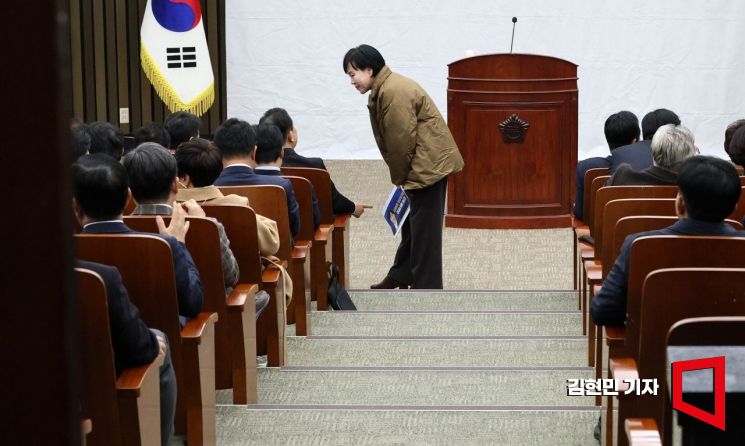 Hyunhee Jeon, Task Force Leader for Overcoming Judicial Distrust and Normalizing Judicial Administration of the Democratic Party of Korea, is seen showing the key contents of the three major bills for normalizing judicial administration to Kim Byunggi, the floor leader, while conversing before the party members' meeting held at the National Assembly on December 8, 2025. Photo by Hyunmin Kim
© The Asia Business Daily(www.asiae.co.kr). All rights reserved.
![Clutching a Stolen Dior Bag, Saying "I Hate Being Poor but Real"... The Grotesque Con of a "Human Knockoff" [Slate]](https://cwcontent.asiae.co.kr/asiaresize/183/2026021902243444107_1771435474.jpg)















