Prime Minister Kim Minseok met with Bank of Korea Governor Lee Changyong on December 9 and emphasized, "Cooperation between the Bank of Korea and the government is crucial for stabilizing the market, including the exchange rate and prices." As the won-dollar exchange rate has recently hovered above 1,470 won and concerns over high inflation have intensified in the market, the Prime Minister and the Bank of Korea Governor held this meeting.
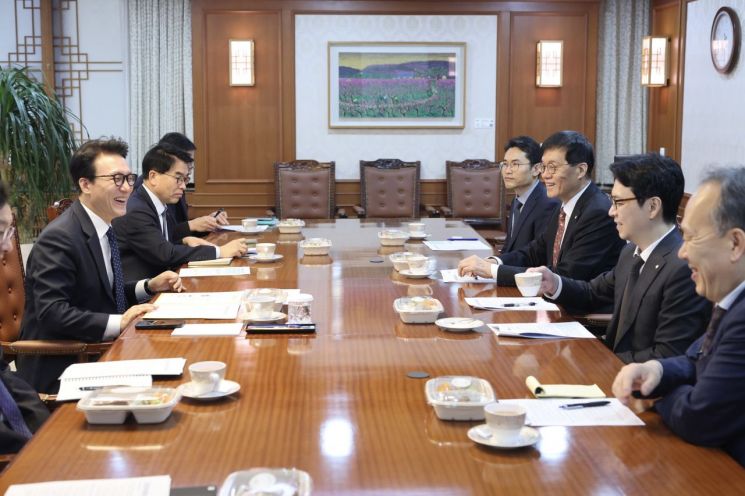 Prime Minister Kim Minseok (first from the left) and Bank of Korea Governor Lee Changyong (third from the right) are holding a meeting at the Prime Minister's office in the Government Seoul Building on the morning of the 9th. Office for Government Policy Coordination
Prime Minister Kim held a meeting with Governor Lee at his office in the Government Seoul Building for about an hour starting at 7:30 a.m. that day, exchanging views on the current economic and financial situation. According to the Office for Government Policy Coordination, Governor Lee responded, "The Bank of Korea will continue research on structural reforms not only for short-term economic stability but also to enhance medium- and long-term growth potential, and will further strengthen communication and cooperation with the government."
It is rare for a sitting Prime Minister to publicly announce and then meet with the Governor of the Bank of Korea. The Bank of Korea, by law, is an institution whose political neutrality and independence must be respected. This meeting was reportedly initiated at the suggestion of Prime Minister Kim.
On June 4, the inauguration day of the Lee Jaemyung administration, the won-dollar exchange rate closed at 1,363.50 won, but has since risen sharply, reaching 1,471.00 won as of 9:40 a.m. on December 9. Rising prices of various raw materials and oil have directly driven up import prices, which in turn has led to higher consumer prices. According to the 'November Consumer Price Trends' announced by the National Data Office on December 2, this month's consumer price index stood at 117.20 (2020=100), up 2.4% compared to the same month last year. Typically, a price increase rate in the 1% range is considered stable, but for three consecutive months since September, the rate has remained in the 2% range.
On December 3, President Lee Jaemyung addressed questions about inflation measures during a special national statement marking one year since the declaration of martial law, saying, "Prices are currently fairly stable." While President Lee expressed confidence in price stability, market unease has persisted. He added, "Perceived inflation may be high and could cause significant hardship for our people, so we will respond thoroughly and carefully."
Despite the high exchange rate and inflation, the Office for Government Policy Coordination assessed that since the launch of the new administration, consumer sentiment has improved and semiconductor exports have been robust, indicating a clear economic recovery. The government believes that if next year's policy plans are implemented smoothly, stable management will be possible. Prime Minister Kim stated, "The government will do its utmost to ensure the momentum of economic recovery takes hold and spreads to stabilize people's livelihoods."
An official from the Office for Government Policy Coordination stated, "Going forward, we plan to continue sharing perspectives on major economic and financial issues with the Bank of Korea and maintain close communication."
© The Asia Business Daily(www.asiae.co.kr). All rights reserved.
![Clutching a Stolen Dior Bag, Saying "I Hate Being Poor but Real"... The Grotesque Con of a "Human Knockoff" [Slate]](https://cwcontent.asiae.co.kr/asiaresize/183/2026021902243444107_1771435474.jpg)















