200,000 Humanities Applicants vs. 9,300 Admissions: 8.5% Increase in Unsuccessful Candidates
Natural Sciences See Fewer Early Admission Failures... Top Science Scores Drop by 25%
Expert: "Humanities Regular Admissions Competition Exploding... Surge in Repeat Test-Takers Likely"
It has been analyzed that competition for regular admissions in the humanities track at the top 10 universities in Seoul for the 2026 academic year will be much more intense than in the natural sciences track. The number of students to be admitted through early admissions in the humanities track at the top 10 universities-Seoul National University, Korea University, Yonsei University, Sungkyunkwan University, Hanyang University, Sogang University, Chung-Ang University, Kyung Hee University, Hankuk University of Foreign Studies, and Ewha Womans University-has been tallied at 9,305, but the number of applicants is expected to reach 203,543, meaning that the number of unsuccessful applicants alone is projected to exceed 190,000.
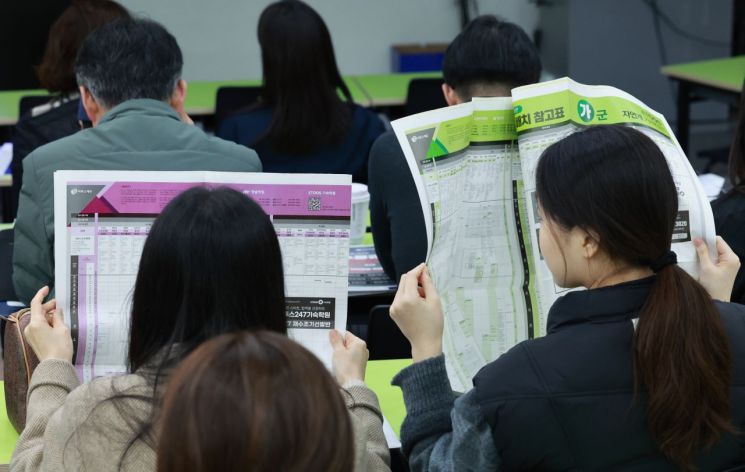 Students and parents attending the "2026 College Scholastic Ability Test Preliminary Scoring Briefing" hosted by Etoos Edu at the Gangnam Hyper Academy main branch in Seoul on the 15th are looking over the university placement reference chart. Photo by Yonhap News
This figure represents an 8.5% increase in unsuccessful applicants compared to the previous year, as the number of applicants is rising faster than the slight increase in early admission slots. In contrast, the number of unsuccessful applicants in the natural sciences track is expected to decrease. The number of students to be admitted through early admissions in the natural sciences track at the top 10 universities is 8,591, with 204,654 applicants, and the number of unsuccessful applicants is estimated to decrease by 3.4% compared to the previous year.
As students who fail to secure early admission shift to regular admissions, competition in the humanities track is expected to become even fiercer. In particular, the number of humanities track students who achieved a grade 2 or higher in the social studies section of the 2026 College Scholastic Ability Test is 79,611, a 30% increase compared to the previous year, which is expected to further intensify competition among top-tier applicants during the regular admissions period. Humanities track students must demonstrate competitiveness across a wide range of subjects-including Korean, English, mathematics, and social studies-to gain admission to their desired universities.
On the other hand, competition in the natural sciences track for regular admissions is likely to ease. The number of students in the natural sciences track who achieved a grade 2 or higher in the science section of the 2026 College Scholastic Ability Test is 37,308, a 25.3% decrease compared to the previous year, and the reduction in medical school admissions is also expected to limit the influx of repeat test-takers at the top level.
Lim Seongho, CEO of Jongno Academy, explained, "Humanities track students had an advantage in meeting the minimum CSAT requirements for early admissions, but the strategy for regular admissions has become more complex," adding, "In contrast, opportunities for university admission through regular admissions have actually expanded for natural sciences track students."
Lim also raised the possibility that intensified competition in the humanities track for regular admissions could result in a surge of repeat test-takers. This is because, starting with the 2028 academic year, the integrated CSAT will be implemented, eliminating the option to choose specific subjects in Korean, mathematics, and inquiry, making the 2027 academic year the last chance to apply under the current CSAT system. He added, "Humanities track students who are unsuccessful in early admissions are likely to become repeat test-takers and try again, as competition in regular admissions will be extremely fierce."
© The Asia Business Daily(www.asiae.co.kr). All rights reserved.
![Clutching a Stolen Dior Bag, Saying "I Hate Being Poor but Real"... The Grotesque Con of a "Human Knockoff" [Slate]](https://cwcontent.asiae.co.kr/asiaresize/183/2026021902243444107_1771435474.jpg)















