October Current Account Surplus at $6.81 Billion, Marking 30 Consecutive Months of Surplus
Surplus Narrows Due to Chuseok Holiday and Ship Export Adjustments
Record-High Overseas Securities Investment by Koreans, Led by Stocks
Semiconductor
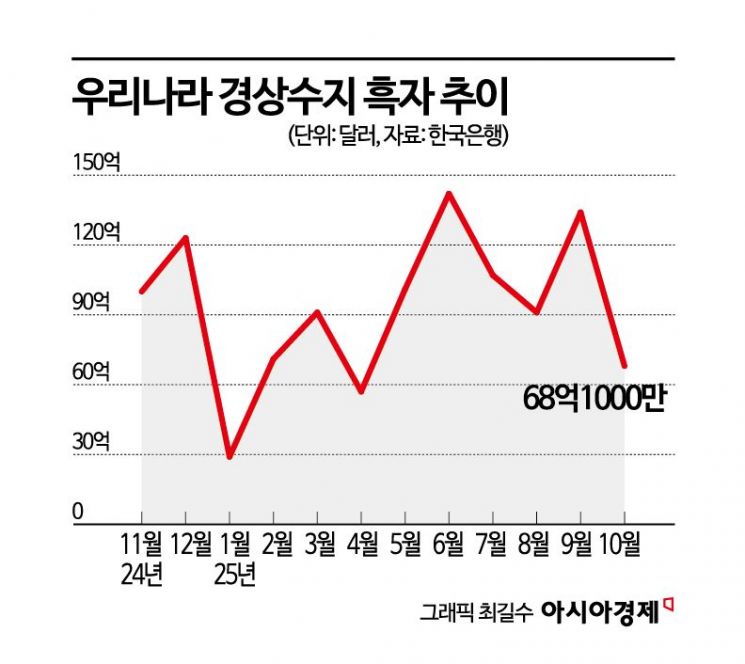
In October, South Korea recorded a current account surplus of 6.81 billion dollars. While this marked the 30th consecutive month of surplus, the size of the surplus shrank significantly due to a reduction in business days during the Chuseok holiday period.
Although there was a temporary slowdown in October, the country is on track to achieve a record annual current account surplus. The cumulative current account surplus from January to October reached an all-time high for the same period, and from November onward, monthly surpluses of over 10 billion dollars are expected, led by semiconductor exports.
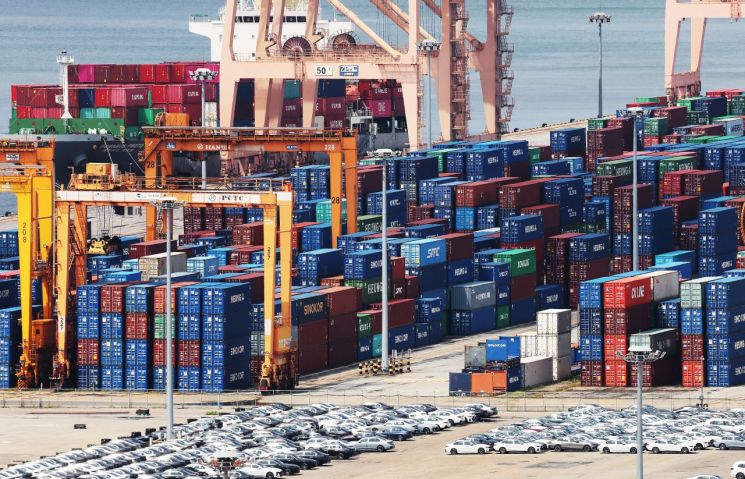
Temporary Factors: Ship Export Adjustment and Fewer Working Days... Exports Decline After Two Months of Growth
According to the "Preliminary Balance of Payments for October 2025" released by the Bank of Korea on the 5th, South Korea posted a current account surplus of 6.81 billion dollars in October. This marked the 30th consecutive month of surplus since May 2023, the second-longest streak since the 2000s. However, the surplus declined compared to both the same period last year (9.4 billion dollars) and the previous month (13.47 billion dollars).
The goods account, which makes up the largest portion of the current account, recorded a surplus of 7.82 billion dollars. However, the surplus narrowed compared to both October last year (8.07 billion dollars) and the previous month (14.24 billion dollars). The reduction was due to the Chuseok holiday effect and an adjustment in ship exports based on balance of payments standards.
Exports amounted to 55.88 billion dollars, a 4.7% decrease from the same period last year, marking the first decline in two months. IT items, especially semiconductors, continued to grow, but non-IT items were affected by a one-off adjustment in ship exports and fewer working days. In October, semiconductor exports reached 15.86 billion dollars, up 25.6% year-on-year, driving the 12.0% growth in IT exports. Computer peripherals also increased by 3.5%, while wireless communication devices fell by 8.7%. Among non-IT items, passenger car exports dropped by 12.6% to 5.25 billion dollars, and exports of steel products (-14.1%), chemical products (-13.1%), machinery and precision instruments (-12.3%), and others also declined, resulting in an overall 1.3% decrease.
Imports totaled 48.06 billion dollars, down 5.0% from the same period last year, also marking the first decline in two months. Despite a surge in gold imports (up 834.4%) and a 9.9% increase in consumer goods, imports turned downward after two months due to fewer working days and falling energy import prices, with raw materials imports declining by 6.4%. In October, raw material imports amounted to 23.59 billion dollars, down 6.4% year-on-year. Imports of gas (-37.2%), coal (-18.6%), petroleum products (-13.1%), and chemical products (-7.6%) all decreased, while crude oil imports rose by 6.8%. Capital goods imports slightly decreased by 0.6% to 19.76 billion dollars, mainly due to declines in information and communication equipment (-5.6%) and semiconductors (-1.6%). However, imports of transportation equipment (up 19.3%) and semiconductor manufacturing equipment (up 2.3%) increased. Consumer goods imports rose by 9.9% to 10.17 billion dollars, largely due to a sharp 834.4% increase in gold imports, which drove a 43.4% surge in durable consumer goods. In contrast, imports of non-durable consumer goods and direct consumer goods fell by 10.7% and 10.8%, respectively.
Wider Travel Account Deficit... Record-High Overseas Stock Investment by Koreans
The services account posted a deficit of 3.75 billion dollars, widening from the previous month's deficit of 3.32 billion dollars. The travel account deficit expanded from 910 million dollars in September to 1.36 billion dollars in October, as the number of outbound travelers increased during the extended Chuseok holiday. The surplus in telecommunications, computer, and information services narrowed to 150 million dollars as payments for computer services, such as software for semiconductor equipment, increased.
The primary income account posted a surplus of 2.94 billion dollars, mainly due to a 2.29 billion dollar surplus in dividend income. Although both direct and securities investment dividend income declined from the previous month, a base effect from the previous month's increase in securities investment dividend payments led to a decrease in payments, keeping the surplus at a similar level to September (2.96 billion dollars).
Net external assets in the financial account, calculated as assets minus liabilities, increased by 6.81 billion dollars, a smaller rise compared to the previous month's 12.9 billion dollars. In direct investment, overseas investment by Koreans increased by 1.88 billion dollars, while foreign investment in Korea rose by 150 million dollars.
Securities investment grew by 12.08 billion dollars. Overseas stock investment by Koreans reached a record high of 18.04 billion dollars, driven by strong investor sentiment toward the U.S. stock market, resulting in an all-time high for total overseas securities investment. Foreign investment in Korean securities increased by 5.2 billion dollars, mainly in stocks. Net assets in derivative financial products grew by 1.13 billion dollars. In other investments, assets decreased by 10.57 billion dollars, mainly due to a reduction in loans, while liabilities increased by 4.22 billion dollars, mainly due to increased borrowings. Reserve assets rose by 6.67 billion dollars.

Record Annual Current Account Surplus Expected... "Monthly Surplus to Exceed 10 Billion Dollars from November"
The overall annual trend remains strong. The cumulative current account surplus from January to October this year reached 89.58 billion dollars, the highest ever for the same period. Although the October surplus shrank due to temporary factors, a monthly surplus of over 10 billion dollars is expected to return from November, driven by robust semiconductor exports. In its November economic outlook, the Bank of Korea projected a record annual current account surplus of 115 billion dollars for this year. To meet this projection, a combined surplus of 25.42 billion dollars is needed for November and December.
Song Jaechang, Director of the Financial Statistics Department at the Economic Statistics Bureau of the Bank of Korea, stated, "Although the current account surplus in October was reduced compared to the previous month due to several temporary factors, from November onward, as the effects of the holidays dissipate and semiconductor exports reach record highs, we expect to see a substantial trade surplus and a recovery of the current account surplus to over 10 billion dollars."
© The Asia Business Daily(www.asiae.co.kr). All rights reserved.
![Clutching a Stolen Dior Bag, Saying "I Hate Being Poor but Real"... The Grotesque Con of a "Human Knockoff" [Slate]](https://cwcontent.asiae.co.kr/asiaresize/183/2026021902243444107_1771435474.jpg)

















