Survey Conducted Among Nearly 10,000 People in 9 European Countries
Strong Aversion to Trump Centered in Belgium and France
Military Threat From Russia Also Stands Out
A recent survey has revealed that half of Europeans consider Donald Trump, the President of the United States, to be the "enemy of Europe." On December 4 (local time), Yonhap News, citing the British daily The Guardian and AFP, reported that the French international affairs magazine Le Grand Continent commissioned the polling agency Cluster 17 to conduct a survey of 9,553 citizens across nine European countries at the end of last month. According to the results, 48% of respondents regarded President Trump as an enemy. The countries included in the survey were France, Italy, Spain, Germany, Poland, Portugal, Croatia, Belgium, and the Netherlands.
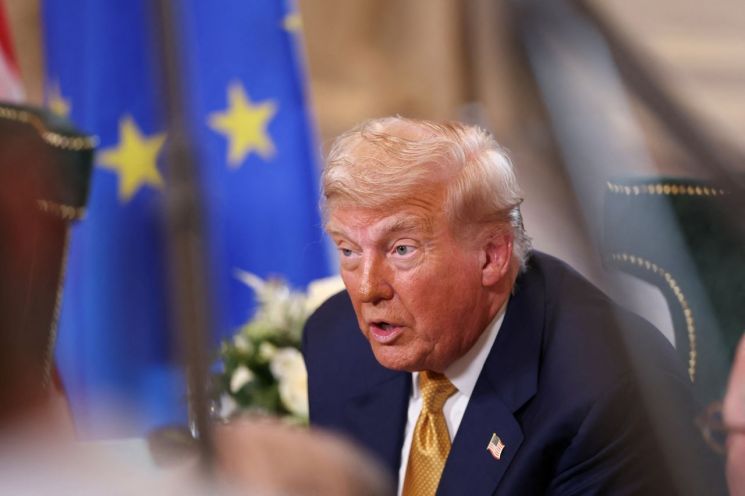 A poll revealed that half of Europeans consider Donald Trump, the President of the United States, as the "enemy of Europe." President Trump engaged in tariff negotiations with the European Union last July. Photo by Reuters Yonhap News
Strong Aversion to Trumpism, But... "Compromise With the U.S. Government Is Necessary"
By country, respondents in Belgium (62%) and France (57%) showed the highest levels of aversion toward President Trump, while Croatia (37%) and Poland (19%) were less hostile. However, when asked what stance the European Union should take toward the U.S. government, the most common answer was "compromise" (48%). This indicates that, separate from negative views of President Trump, many see the relationship with the United States as strategically important.
Jean-Yves Dormagen, a political scientist and founder of Cluster 17 who led the survey, commented, "Across the European continent, Trumpism is clearly regarded as a hostile force," adding, "Compared to previous surveys, the number of respondents who answered 'neither friend nor foe' has decreased, and hostile perceptions have solidified."
Majority of Respondents Perceive High Risk of War With Russia
As the war in Ukraine, sparked by Russia's invasion, approaches its fourth year, 51% of Europeans believe that the risk of war with Russia is "high" or "very high." In Poland, which borders Russia, 77% of respondents said the risk of war is high, while in Portugal (39%) and Italy (34%), which are relatively farther away, concerns about war were lower.
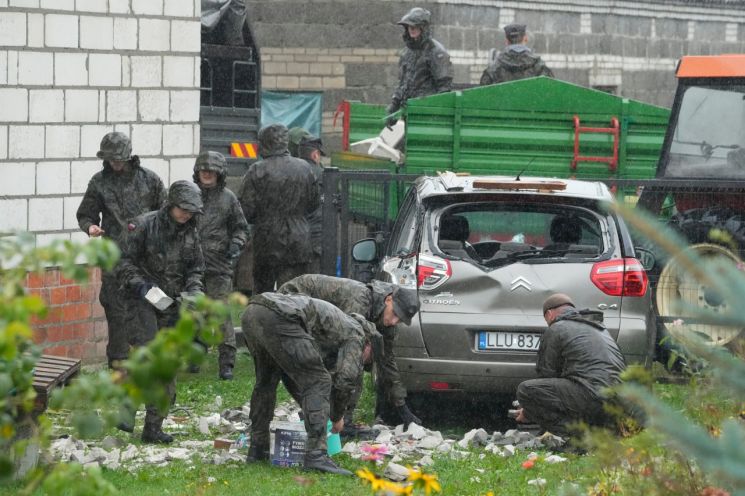 Last September, after a Russian drone violated Polish airspace, territorial defense personnel were seen clearing debris near a residential area in Lublin, Poland. Photo by AP Yonhap News
When asked whether their national military could defend against a Russian invasion, 69% of respondents expressed a negative view. In France, the only nuclear-armed country among those surveyed, 44% said they believed their country had the capacity to defend itself-the highest among all countries. In contrast, when asked about the likelihood of war with China, a geographically distant country, 81% said there was no possibility of such a conflict.
Meanwhile, five years after the United Kingdom's exit from the European Union (Brexit), 63% of respondents said it had a negative impact on the UK. Only 19% gave a positive assessment. Additionally, 74% of respondents said they wanted their own country to remain a member of the EU. The highest rates were in Portugal (90%) and Spain (89%), while Poland (68%) and France (61%) were lower.
Dormagen stated, "Europe is not only facing military threats, but is also experiencing changes in its historical, geopolitical, and political environment," adding, "The overall results of the survey depict a Europe that is anxious, acutely aware of its vulnerabilities, and finds it difficult to look positively toward the future."
© The Asia Business Daily(www.asiae.co.kr). All rights reserved.
![Clutching a Stolen Dior Bag, Saying "I Hate Being Poor but Real"... The Grotesque Con of a "Human Knockoff" [Slate]](https://cwcontent.asiae.co.kr/asiaresize/183/2026021902243444107_1771435474.jpg)
















