Myunghwan Kim, Head of the Next-Generation Secondary Battery Innovation Strategy Research Group
Shares Thoughts on Being Named Industrial Contributor on Trade Day
"Infrastructure and Budget at Government-Funded Institutes Are Severely Lacking, Systemic Reform Is Essential"
"I Will Work to Promote Active Exchange and Communication Between Companies and Government Institutes"
"Accumulating Data Is the Path to Technological Leadership... Failure Must Be Accepted"
The experience of continuing battery development amid internal opposition and market uncertainty laid the foundation for today's Korean battery industry. Myunghwan Kim, Head of the Next-Generation Secondary Battery Innovation Strategy Research Group at the Korea Research Institute of Chemical Technology, said in an interview with The Asia Business Daily on December 4, "The competition between Samsung and LG led to the expansion of the domestic materials and equipment ecosystem," adding, "Currently, as the head of the strategy research group, I am focusing on restoring the broken roles among academia, industry, and research institutes."
He was selected as an industrial contributor in the battery sector in celebration of the 62nd Trade Day. Kim commented, "Being recognized as an industrial contributor by the government is not a personal achievement, but rather like a coach meeting a good team," and added, "My desire to directly contribute to society through the battery industry has brought me this far."
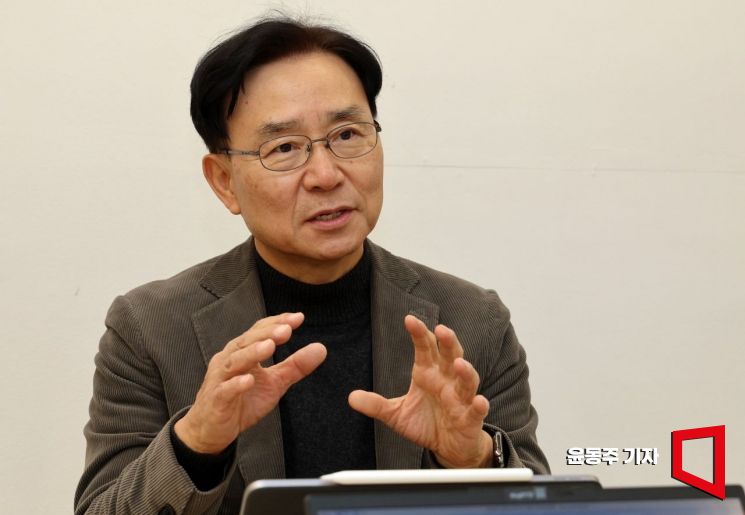 Myunghwan Kim, Head of the Next-Generation Secondary Battery Innovation Strategy Research Group, is being interviewed by The Asia Business Daily at an undisclosed location in Jongno-gu, Seoul. Photo by Dongju Yoon
After joining LG Chem, Kim served as the president of LG Energy Solution, leading the Korean battery industry from its early days to the present. In 1996, he began research at LG Chem under the late Chairman Koo Bon-moo's commitment to battery development, enduring more than a decade of trailing behind the Japanese-dominated market. Even during the period when LG Chem was criticized as the "main culprit" for its difficulties following the large-scale Apple laptop recall, he advocated for the business potential and future of batteries, pushing the business forward.
Kim recalled, "The fierce competition between Samsung and LG, each striving to outdo the other, was the driving force that allowed us to surpass Japan," adding, "This competition naturally led to the growth of domestic materials and equipment companies and the establishment of a diverse technological ecosystem."
Once the small battery division began turning a profit, Kim set his sights on the era of automotive batteries. In 2005, he established a research center for automotive batteries and began full-scale development, but the battery division continued to post losses. Internal opposition was also strong. However, he succeeded in securing contracts with General Motors and Volkswagen, boosting both internal and external confidence and laying the groundwork for Korean batteries to expand into the global market.
Kim explained, "For someone with a background in chemical engineering, the spread of secondary batteries was an inevitable trend," adding, "I was convinced that technology converting and storing sustainable resources like solar energy into electricity would ultimately change the future."
Kim emphasized materials and processes as the core of technological innovation. He said, "Once battery material differentiation had progressed to a certain point, I felt the need for process innovation," and "I devoted nearly four years to researching the establishment of smart factories." As the cost of data collection and analysis has decreased compared to the past, it is now possible to analyze more data quickly and accurately. Kim stated, "Standardization of equipment and software has become important for active data utilization," and "Our goal is to ensure that even employees unfamiliar with batteries can work in the factory without issues. After introducing smart factories, we maximized yields at our plants in the United States and Indonesia."
Envisioning a New Future as Head of the Next-Generation Secondary Battery Innovation Strategy Research Group: "Restoring the Broken Bridge Among Academia, Industry, and Research"
Since February, Kim has been leading the Next-Generation Secondary Battery Innovation Strategy Research Group and identified the collapse of roles among academia, industry, and research institutes as the biggest challenge facing the Korean battery industry today. Kim explained, "Technology readiness levels (TRL) are divided into nine stages, with schools originally responsible for stages 1 to 3, government research institutes for 4 to 6, and companies for 7 to 9," adding, "However, due to a lack of infrastructure, equipment, and budget, government research institutes are only able to conduct research at stages 2 to 4, creating a gap in the crucial stages 5 to 6 needed by industry."
He also pointed out that the equipment procurement process needs improvement. He said, "It can take several months to get approval to purchase duplicate research equipment," and "Because multiple pieces of equipment are needed simultaneously to extract data effectively, it is common to spend up to 10 months on equipment procurement even after a project begins." He added, "For Korea to become a technological powerhouse, the budget and infrastructure of government-funded research institutes must be strengthened."
To address these challenges, Kim is focusing on breaking down barriers between government-funded institutes and companies, and establishing a common language and infrastructure. In fact, the research group now includes numerous companies, including the three major battery manufacturers (LG Energy Solution, Samsung SDI, and SK On), which have begun active exchanges and communication.
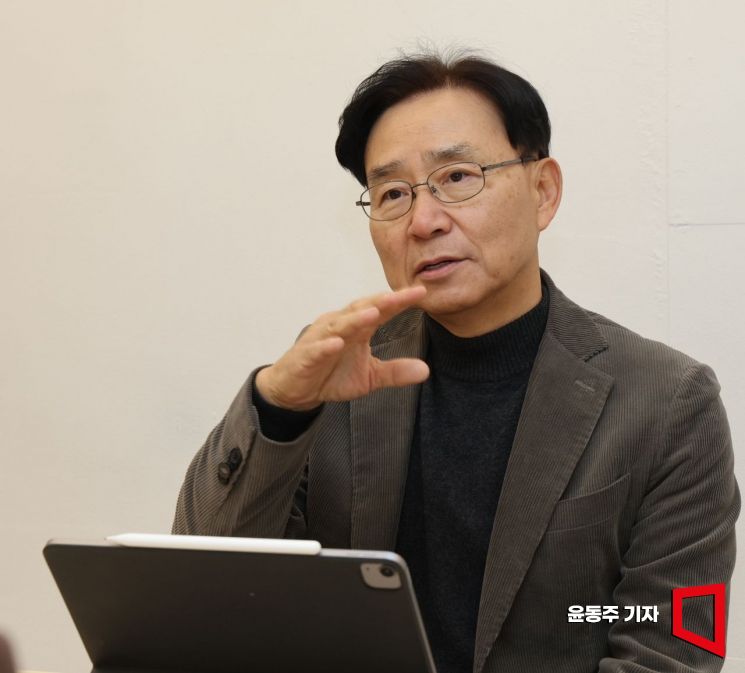 Myunghwan Kim, Head of the Next-Generation Secondary Battery Innovation Strategy Research Group, is being interviewed by The Asia Business Daily at an undisclosed location in Jongno-gu, Seoul. Photo by Dongju Yoon
The biggest challenge in the global battery market is undoubtedly "China." Kim said, "Price competition with China will continue," and emphasized, "International cooperation is essential, leveraging networks of resources and talent." He continued, "Because Korea is highly dependent on Chinese resources, it is necessary to cooperate with resource-rich countries such as Indonesia and Australia," adding, "The United States, Europe, and India are pursuing battery independence, so we should proactively propose joint ventures to gain a competitive edge against China."
Finally, Kim identified fear of failure as the greatest weakness of the Korean research environment. He said, "The project success rate in the United States is less than 20%, and about 30% in Japan, but over 90% in Korea," explaining, "This is because once you fail, it becomes difficult to participate in future projects, so only projects with little risk of failure are attempted." He advised, "We need to accept failure so that data can accumulate and global talent can be attracted."
Kim emphasized, "Every company in the battery business goes through a 'valley of death,'" adding, "The financial strength and belief in the future to withstand this period are what drive industry growth."
© The Asia Business Daily(www.asiae.co.kr). All rights reserved.
![Clutching a Stolen Dior Bag, Saying "I Hate Being Poor but Real"... The Grotesque Con of a "Human Knockoff" [Slate]](https://cwcontent.asiae.co.kr/asiaresize/183/2026021902243444107_1771435474.jpg)
















