Investigation Committee and Ministry of Land Announce Findings on March Myeongil-dong, Gangdong-gu Accident
"Discontinuity Slippage Was the Direct Cause... Indirect Factors Also Contributed"
The investigation has revealed that the sinkhole accident that occurred last March in Myeongil-dong, Gangdong-gu, Seoul, was caused by a combination of wedge-shaped discontinuities and sewage pipe leakage. The incident differed from typical sinkholes that have mainly occurred in urban areas. In response, the government has decided to strengthen pre- and post-construction investigation standards to prevent similar accidents.
Park Injun, Chairperson of the Central Underground Accident Investigation Committee and a professor at Hanseo University, stated on December 3, "The immediate cause of this accident was three discontinuities within the deep weathered zone. These discontinuities, shaped like wedges above the tunnel, weakened due to a drop in groundwater level and sewage pipe leakage, which caused them to slip. As a result, external forces exceeding the design load acted on the tunnel, leading to its collapse and the formation of the sinkhole."
The bedrock had transformed into soil layers due to various factors, and these different soil layers interlocked, forming an inverted pyramid structure between the surface and the tunnel under construction. The construction company responsible for the lower tunnel failed to detect this during their ground investigation. Typically, ground investigations for tunnel construction are conducted at 100-meter intervals, but Daewoo Engineering & Construction, the contractor, conducted them at 50-meter intervals for greater precision.
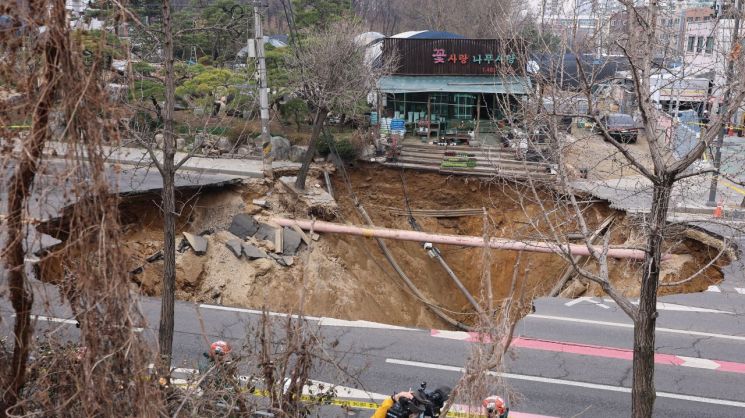 The site of a large ground subsidence accident that occurred last March in Myeongil-dong, Gangdong-gu, Seoul. One person died and another was injured in the accident. Yonhap News
Nevertheless, the discontinuities were located between these intervals and went undetected. Typical sinkholes are usually attributed to groundwater outflow or voids caused by water or sewage pipe leaks. In this respect, Park explained that the Myeongil-dong accident was different from ordinary sinkholes.
Additionally, during the construction of the Sejong-Pocheon Expressway in 2017, the groundwater level had already dropped by about 19 meters, and the stress distribution within the ground-meaning the resistance of the ground to external forces-had changed. Poor management of sewage pipes near the accident site was also cited as an indirect cause, as leaking water weakened the ground. The investigation found that while the Gangdong-gu Office, the underground facility manager, conducted a sewage pipe inspection in 2022, it failed to repair cracks and joint level differences.
Daewoo Engineering & Construction applied the New Austrian Tunneling Method (NATM) to this site, a method commonly used in tunnel construction. Park pointed out that this method has limitations when used in urban areas. The NATM involves drilling holes in bedrock, blasting, and then spraying shotcrete (a mixture of sand and cement) onto the tunnel walls, and is mainly used for solid ground. In this case, excavation was carried out using machinery instead of explosives. The construction company also implemented various reinforcement measures during the work. However, the investigation committee found that the combination of this method, the discontinuities, and the sewage pipe leakage collectively contributed to the accident.
Park emphasized, "This accident was caused by a combination of natural and human factors. In advanced countries, the NATM, which has clear limitations, is not used in urban areas. It is being used for economic reasons, but research shows it should not be applied in urban environments."
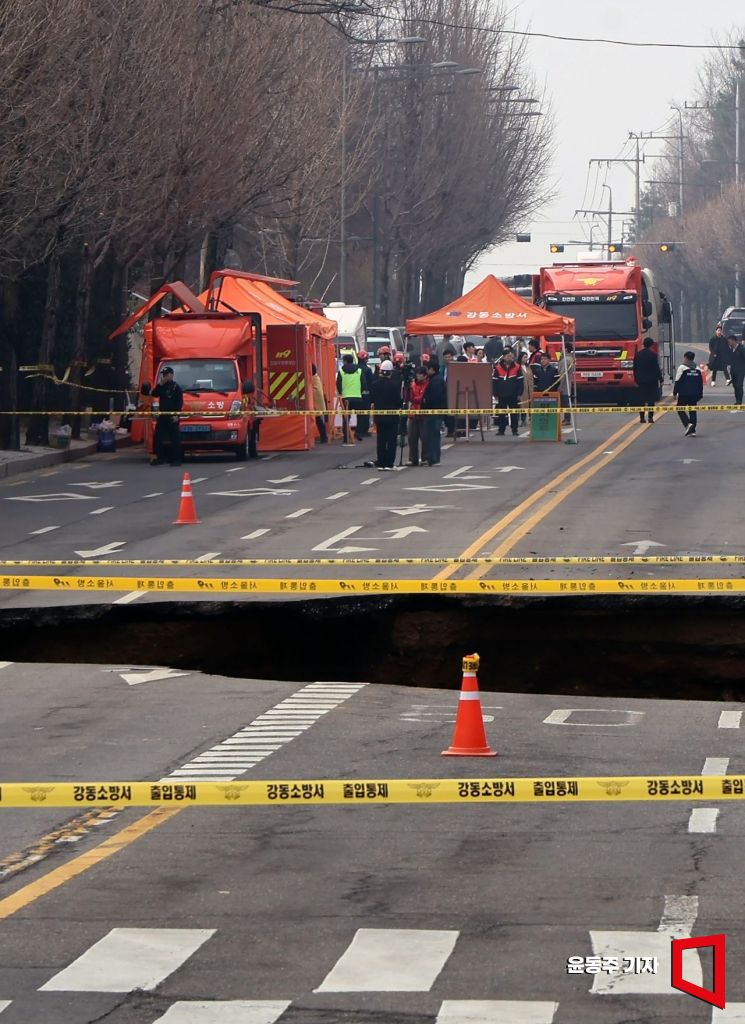
To prevent similar accidents, the investigation committee recommended reducing the interval of ground investigations and requiring daily excavation speed and volume to be reflected in construction plans. The committee also suggested using non-drainage tunnel methods, such as the Tunnel Boring Machine (TBM) method, in deep weathered zones in urban areas. The TBM method uses specialized excavation equipment to seal the excavation face with earth and water pressure, preventing groundwater or soil outflow and completing the tunnel simultaneously with excavation. Generally, the TBM method costs about 50-100% more than the NATM.
Furthermore, the committee advised strengthening underground facility management by enhancing ground surveys, replacing old sewage pipes near excavation sites, conducting groundwater component analysis inside tunnels, and establishing a consultative body among relevant agencies. To further enhance tunnel stability, the committee recommended applying the three-row overlapping steel pipe grouting method in deep weathered zones in urban areas and strengthening the excavation face evaluation system.
The government plans to incorporate these recommendations by revising ground investigation design standards, establishing new standards for ground investigations in shield tunneling projects in urban areas, and tightening relevant regulations. The government will also detail procedures for addressing cumulative groundwater level drops and require project operators to conduct ground surveys of underground facilities within three months before and after excavation. As part of the recurrence prevention measures, the government will recommend reinforced tunnel support methods, such as the TBM, when underground facilities like water and sewage pipes are present in deep weathered zones in urban areas.
The government and the investigation committee identified issues such as the failure to prepare excavation face side development diagrams and found some areas for improvement through special inspections, but did not assign specific responsibility for the accident at this time. Further investigations will be conducted by the police or local governments. Kim Taebyeong, Director of Technology and Safety Policy at the Ministry of Land, Infrastructure and Transport, stated, "We will immediately notify relevant agencies, including the police and local governments, of the investigation committee's findings, request strict administrative or investigative action, and promptly implement institutional improvements to prevent similar accidents."
© The Asia Business Daily(www.asiae.co.kr). All rights reserved.
![Clutching a Stolen Dior Bag, Saying "I Hate Being Poor but Real"... The Grotesque Con of a "Human Knockoff" [Slate]](https://cwcontent.asiae.co.kr/asiaresize/183/2026021902243444107_1771435474.jpg)
















