Chairman of the Military Committee: "Ethics, law, and jurisdiction are the issues"
The Chairman of the NATO Military Committee has stated that the North Atlantic Treaty Organization (NATO) is considering ways to respond more aggressively to Russia's "hybrid provocations," including cyberattacks, sabotage operations, and airspace violations.
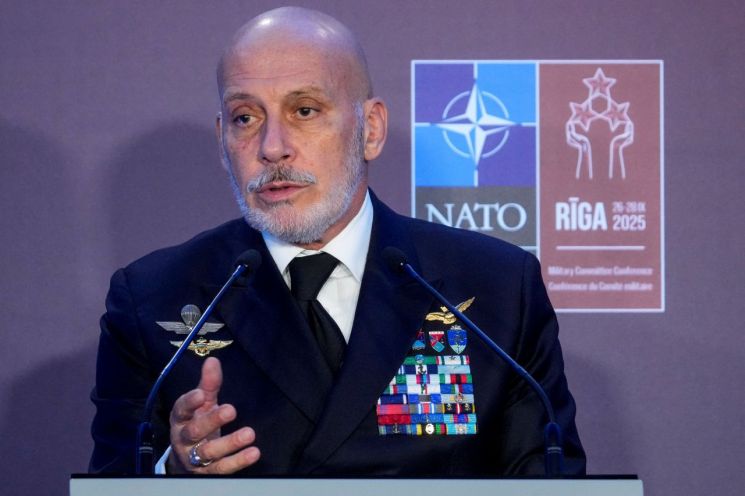
Giuseppe Cavo Dragone, Chairman of the NATO Military Committee, said in an interview with the Financial Times (FT) published on November 30 (local time) that NATO is reviewing measures to increase the intensity of its response to Russian provocations, stating, "We are studying everything." He added, "In cyberspace, we are reactive. What we are considering is to be more aggressive-in other words, to act proactively rather than reactively."
In recent years, European countries have experienced numerous hybrid provocations, ranging from the severing of undersea cables in the Baltic Sea to cyberattacks across the European continent. Some of these incidents are suspected to be orchestrated by Russia, while the origins of others remain unclear. As a result, some diplomats from Eastern European countries are calling on NATO to move away from a reactive and passive approach and instead adopt a proactive and assertive response.
Chairman Dragone stated, "Being more aggressive in response to the opponent's (Russia's) hostility could be one of the options," but he also pointed out, "The issue is the framework of legal jurisdiction." He explained that NATO and its member states "face far more restrictions than the opponent due to ethics, law, and jurisdiction. This is a problem," adding, "I'm not saying we are bound to lose, but we are in a much more challenging position than the opponent."
NATO has assessed its "Baltic Sentry" operation-which mobilized warships, aircraft, and maritime drones-as a success. Incidents in which so-called "shadow fleets" operated by Russia to circumvent Western sanctions severed undersea cables in 2023 and 2024 had occurred repeatedly, but since the implementation of the Baltic Sentry operation, such incidents have not recurred. Chairman Dragone evaluated this by saying, "This means that this type of deterrence is effective."
Chairman Dragone also stated that whether Russia's aggression can be deterred will be a key factor in validating policy effectiveness. He said, "It is an issue that requires in-depth analysis of how deterrence is achieved, whether through retaliation or preemptive strikes. There may be more pressure in the future."
© The Asia Business Daily(www.asiae.co.kr). All rights reserved.
![Clutching a Stolen Dior Bag, Saying "I Hate Being Poor but Real"... The Grotesque Con of a "Human Knockoff" [Slate]](https://cwcontent.asiae.co.kr/asiaresize/183/2026021902243444107_1771435474.jpg)















