Government to Simultaneously Advance Three Major Strategic Technology Projects
"Stable Operation Until New System Is Introduced"
The government is set to simultaneously launch large-scale projects in national strategic technology sectors, including carbon capture and utilization (CCU) demonstration, the development of next-generation environmental and marine observation satellites, and the construction of research facilities for high-level radioactive waste.
On November 28, the Ministry of Science and ICT announced at the '9th National R&D Project Evaluation General Committee for 2025' that it has finalized the approval of the preliminary feasibility study (pre-feasibility study) for the CCU megaproject, the selection of the Cheollian Satellite 6 development project as a subject for pre-feasibility study, and the exemption from pre-feasibility study for the construction of an underground research facility for high-level radioactive waste.
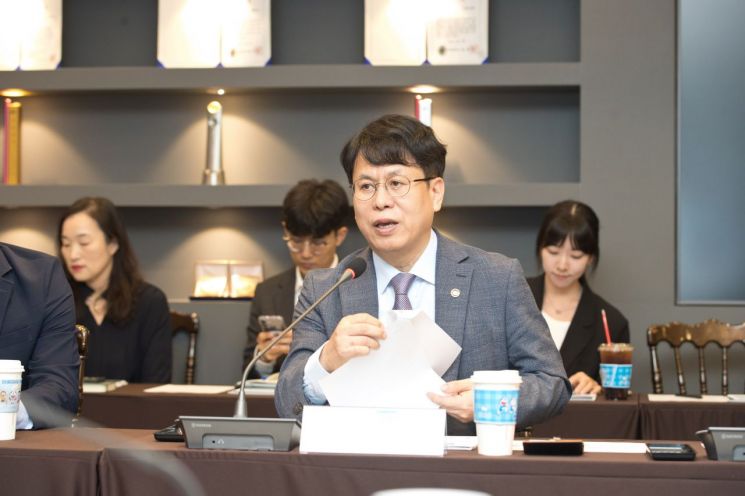 Park Ingyu, Director General of the Science and Technology Innovation Bureau at the Ministry of Science and ICT, is giving a greeting at a meeting. Photo by Yonhap News Agency
The 'CCU Megaproject,' targeting industries with high greenhouse gas emissions, involves a total project cost of 380.6 billion won. This project supports end-to-end demonstration, from carbon capture to intermediate material conversion and the production of final products such as methanol and sustainable aviation fuel (SAF). The government expects this project to help secure a pathway to achieving the national greenhouse gas reduction target by 2035 and to serve as a foundation for expanding the domestic CCU industry ecosystem.
The development of 'Cheollian Satellite 6' for geostationary environmental and marine observation has been selected as the third pre-feasibility study project for 2025. Cheollian 6 will succeed the mission of Cheollian 2B, with significantly enhanced capabilities, including improved environmental payload resolution, expanded observation wavelengths, and better marine payload resolution. Whether the project will proceed will be determined based on the results of the pre-feasibility study conducted over the next seven months.
In addition, the project to construct an underground research laboratory (URL) for high-level radioactive waste has been recognized as an essential project under the law and has been exempted from the pre-feasibility study. The government plans to build a research facility at a depth of about 500 meters in Cheoram-dong, Taebaek-si, Gangwon Province, by 2032. The facility will conduct core research necessary for the future construction of actual waste disposal sites, including the development of Korean disposal technology and verification of rock properties.
Park Ingyu, Director General of the Science and Technology Innovation Bureau at the Ministry of Science and ICT, stated, "We will ensure there are no gaps in project implementation by maintaining a stable pre-feasibility study system even during the transition period of the system," adding, "After the law comes into effect, it will be possible to launch and feedback projects more quickly."
© The Asia Business Daily(www.asiae.co.kr). All rights reserved.