Ministry of Education Releases 2025 Career Education Survey for Elementary and Secondary Schools on the 27th
High School Students' Aspiration for University Drops While Interest in Employment Rises
Top Career Choice for Elementary Students Is "Athlete"
The proportion of high school students hoping to enter university after graduation has dropped by more than 10 percentage points over the past two years. In contrast, the percentage of students aspiring to find employment has increased, highlighting a clear shift in preferences.
 Graduates are taking commemorative photos at the 2018 Spring Semester Graduation Ceremony held on the 25th at Ewha Womans University in Seodaemun-gu, Seoul. Photo by Hyunmin Kim kimhyun81@
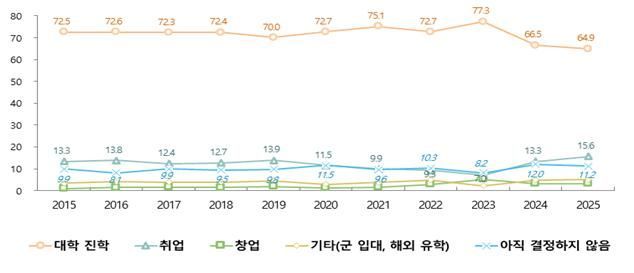
According to a survey conducted by the Ministry of Education and the Korea Research Institute for Vocational Education and Training from May 16 to June 13, targeting a total of 37,408 students, parents, and teachers from 1,200 elementary, middle, and high schools, the percentage of high school students wishing to pursue university education after graduation was 64.9%, marking a decrease for the second consecutive year. The university admission aspiration rate, which stood at 77.3% in 2023, dropped significantly to 66.5% last year and remained in the 60% range this year. This represents a decrease of 12.4 percentage points over two years.
On the other hand, the percentage of students hoping to find employment increased from 7.0% to 13.3% to 15.6% over the same period. The proportion of students who were "undecided about their career" was 11.2%, a slight decrease from 12.0% last year.
When asked about their "desired occupation," 16,145 out of 22,911 respondents (70.5%) said they had a desired job. By school level, the percentages were 78.1% for elementary school students, 59.9% for middle school students, and 71.3% for high school students.
For students who answered that they did not have a desired job, the most common reason across all school levels was "I still do not know what I like" (elementary 42.8%, middle 50.9%, high 44.0%). The next most common reason was "I do not know what I am good at (strengths) or not good at (weaknesses)" (elementary 25.1%, middle 23.4%, high 18.1%).
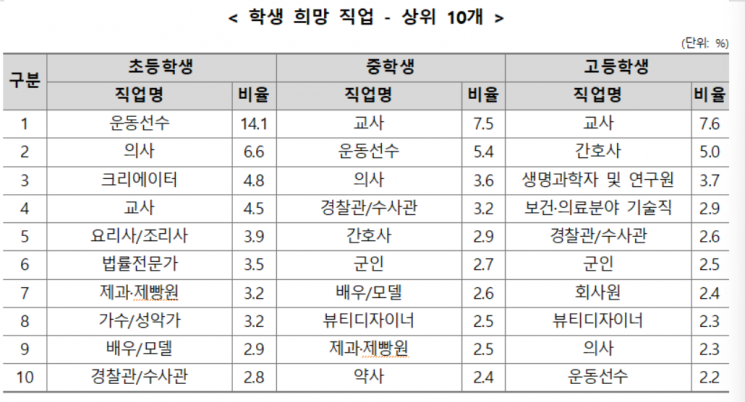
As for preferred occupations, elementary school students most frequently chose athlete (14.1%), doctor (6.6%), and creator (4.8%). Among middle school students, the top choices were teacher (7.5%), athlete (5.4%), and doctor (3.6%). For high school students, the most common aspirations were teacher (7.6%), nurse (5.0%), and life scientist or researcher (3.7%).
The top three preferred occupations among elementary school students were similar to last year, while among high school students, the ranking of life scientist or researcher rose from seventh place last year to third place this year.
The proportion of middle and high school students aspiring to become teachers increased compared to the previous year (middle: 6.8% to 7.5%, high: 6.9% to 7.6%).
In the survey on satisfaction with different types of career-related school activities, elementary and middle school students reported the highest satisfaction with "career experience" activities (elementary: 4.20 points, middle: 3.89 points), while high school students were most satisfied with "career clubs" (3.91 points). The proportion of students wishing to participate in career experience activities was high across all school levels (elementary: 83.7%, middle: 87.4%, high: 88.1%).
Among these, career aptitude tests are conducted at most middle and high schools (middle: 98.3%, high: 98.9%). For career counseling, face-to-face, group, and phone counseling are mainly used, but real-time online counseling is also being offered in parallel.
In addition, the most common source of career information was the "CareerNet" portal. For middle school students, the main sources were CareerNet (50.9%), followed by parents or family (41.5%), homeroom teachers (29.6%), friends (28.7%), social media (21.2%), and private academies (20.6%). For high school students, the top sources were CareerNet (63.0%), the university admissions information portal "Where Is" (31.9%), homeroom teachers (29.7%), and parents or family (23.9%).
The results of this survey will be uploaded and made available on the National Statistical Portal and the CareerNet website.
Kim Chunghong, Director of Policy for Responsible Education at the Ministry of Education, stated, "In light of changes in education such as the implementation of the 2022 revised curriculum, the high school credit system, and the development of artificial intelligence, career education in schools must become more substantial." He added, "Based on these survey results, we will support elementary and secondary career education to expand career activities and enhance teacher competencies in line with the characteristics of each school level."
© The Asia Business Daily(www.asiae.co.kr). All rights reserved.