Tax Revenue Rises While Education Budget Shrinks
Schools to Reach Operational Limits by 2026
Provincial and metropolitan education superintendents across the country have effectively issued a 'final ultimatum' to the government and the National Assembly, warning that the foundation of future education could collapse due to the rapid deterioration of local education finances.
The superintendents stressed that, "While national tax revenue is increasing, local education finances are paradoxically facing a sharp decline," and called for the securing of stable funding sources.
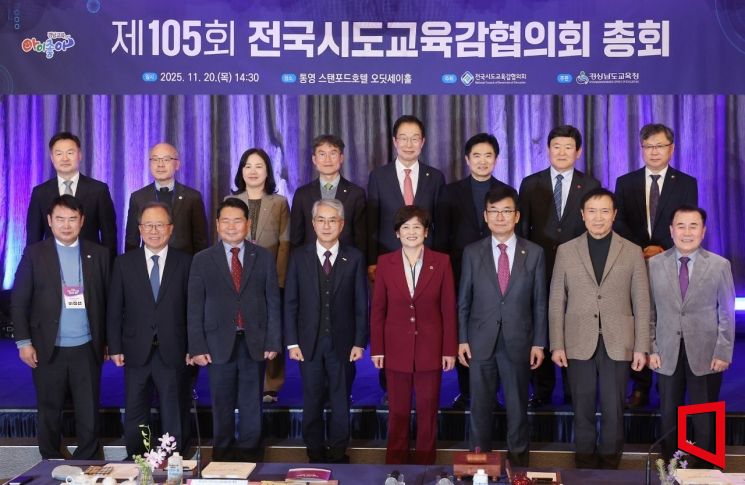
The National Council of Provincial and Metropolitan Education Superintendents (Chairperson: Kang Eunhee, Daegu Superintendent) recently discussed the local education finance crisis as a key agenda item at its 105th general meeting held in Tongyeong, South Gyeongsang Province, and issued a joint statement. The council officially expressed concern, stating, "From 2026, even the normal operation of schools will be threatened."
◆ "Unable to cover even a 2.5 trillion KRW increase in personnel costs"... Unprecedented pressure on the education budget
The council pointed out the structural contradiction that, despite an expected increase in next year's national tax revenue, local education finances are actually being reduced.
In particular, it is becoming difficult to even accommodate the natural increase in personnel costs-such as step increases and salary raises-amounting to about 2.5 trillion KRW. "The essential foundation for school operation is on the verge of collapse," they said. The superintendents emphasized, "The perception that there is a surplus in education finances is far from reality," adding, "Schools are already operating at a bare survival level of spending."
◆ Extension of the special account "erodes elementary and secondary finances"... Obstructing the support structure for higher and lifelong education
The council also criticized the extension of the special account for higher and lifelong education support, which was originally set to expire this year, saying it is intensifying the structural problem of elementary and secondary education budgets being continuously diverted to higher education. The council emphasized, "While every stage of education is important, we can no longer tolerate a system that erodes elementary and secondary education finances," and insisted, "The budget for higher education should be secured through a separate system."
◆ If the education tax is revised, "financial collapse is inevitable"... 3.4 trillion KRW to disappear in 2027
If the government's proposed revision of the education tax is realized, the impact will be even greater. According to the council's analysis, there will be a reduction of about 1.5 trillion KRW in 2026, and if the local education tax on tobacco consumption expires in 2027, the reduction will exceed 3.4 trillion KRW. This scale would force not only the suspension of essential future education initiatives such as AI education, digital transformation, and regionally tailored education, but also existing programs. The superintendents pointed out, "The uncertainty of not being able to predict even next year's school budget will directly lead to lower morale among staff and distrust among parents."
◆ "Declining student numbers are not grounds for budget cuts"... Research also emphasizes 'maintaining the budget'
The council rebutted the government's argument that declining student numbers justify reducing education finances, citing expert research. Studies indicate that the number of classes and schools will decrease only gradually by 2030, repeatedly confirming the need to maintain the scale of education finances (Um Moonyeong, "Measures for Stabilizing Education Finances"; Nam Sugyeong, "Outlook for Supply and Demand of Early Childhood, Elementary, and Secondary Education Finances").
The superintendents stressed, "A decrease in student numbers cannot be used as a pretext for reducing educational investment," adding, "Education is a public service guaranteed by the Constitution and a responsibility of the state."
◆ Three key demands from the council to the government and the National Assembly
Establish a stable financial structure that can accommodate the natural increase in personnel costs and school operating expenses; allow the special account for higher and lifelong education support to expire as scheduled or secure a separate funding source for higher education; and legislate measures to stabilize local education financial grants in preparation for the expiration of the local education tax on tobacco consumption. The council stated, "If the financial foundation is lost, the heart of education in Korea will stop," and expressed hope for a responsible decision by the state.
◆ "Future education cannot exist without finances"
The National Council of Provincial and Metropolitan Education Superintendents reiterated that "the current generation must not reduce educational investment that should go to future generations," emphasizing once again that securing stable local education finances is the foundation of national competitiveness.
The message from the superintendents, "Education is not a choice but a national obligation," clearly reflects the urgent determination at the field level to protect student-centered education despite severe financial pressures.
© The Asia Business Daily(www.asiae.co.kr). All rights reserved.
![Clutching a Stolen Dior Bag, Saying "I Hate Being Poor but Real"... The Grotesque Con of a "Human Knockoff" [Slate]](https://cwcontent.asiae.co.kr/asiaresize/183/2026021902243444107_1771435474.jpg)
















