Judicial Administration Committee to Deliberate and Decide on Judicial Personnel Authority
Ruling Party: "Consensus and Democratic Procedures Are Important"
Five-Year Ban on Retired Supreme Court Justices Representing Supreme Court Cases
Strengthening Judicial Disciplinary Actions and the Role of the Judges' Council
Concerns Over Exclusion of Judges and Potential Undermining of Political Neutrality
The Democratic Party of Korea's Task Force (TF) on Overcoming Judicial Distrust and Normalizing Judicial Administration released a draft reform proposal on November 25, centered on abolishing the Court Administration Office and establishing a Judicial Administration Committee. Notably, the proposal also includes a provision prohibiting retired Supreme Court justices from representing cases before the Supreme Court for five years, aiming to eliminate preferential treatment for former officials.
Jeon Hyunhee, a Democratic Party lawmaker and head of the TF, stated at the legislative public hearing held at the National Assembly that afternoon, "We will set the judiciary upright, create a judiciary for the people, and a judiciary that works together with the people."
Assemblywoman Jeon explained, "There has been much criticism that the Chief Justice of the Supreme Court holds excessive power, with judicial work, personnel, budget, and administration all concentrated in one person. Many have pointed out that democratic procedures and checks have not been implemented throughout the court's administration." She continued, "The basic intent of our reform proposal is to achieve democratic legitimacy and judicial reform by separating the Chief Justice's judicial and administrative work, and to promote the independence of the judiciary from within the courts."
Judicial Administration Committee to Deliberate and Decide on Judicial Personnel... Ruling Party Stresses Importance of Consensus and Democratic Procedures
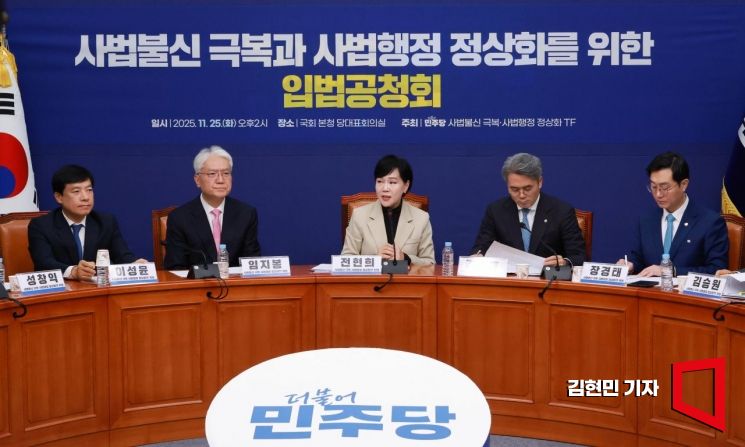 On the 5th, Jeon Hyunhee, the head of the Task Force (TF) for "Overcoming Judicial Distrust and Normalizing Judicial Administration" of the Democratic Party of Korea, spoke at the public hearing held at the National Assembly. 2025.11.25 Photo by Kim Hyunmin
The Judicial Administration Committee, which will be established to replace the Court Administration Office, will deliberate and decide on matters related to judicial administration, including court personnel, disciplinary actions, budgets, and accounting. The committee will be composed of 13 members, including one chairperson at the ministerial level and two standing members. Two options for appointing the chairperson were presented: one in which the Chief Justice appoints the chairperson from among external members of the judiciary, and another in which the Chief Justice serves as chairperson. Other committee members may be nominated as follows: one by the President of the Constitutional Court, two by the National Judges' Representative Conference, two by the Minister of Justice, one by the President of the Korean Bar Association, and one by court staff.
Judicial personnel decisions will be made by the Chief Justice after deliberation and resolution by the Judicial Administration Committee, and the National Assembly will also have the authority to submit opinions. Assemblywoman Jeon said, "Ordinary court officials are also subject to the Chief Justice's personnel authority. The exercise of this authority requires a more democratic process that gathers the consensus of the members," adding, "We have fully respected the intent of Article 104 of the Constitution, which grants the Chief Justice the authority to appoint judges." The Chief Justice's Chief Secretary will also be changed from a judge to a non-judge.
The number of Supreme Court Justice Candidate Recommendation Committee members will be increased from 10 to 13, and its composition will be diversified. The legal institutionalization of the National Judges' Representative Conference will also be pursued. The TF explained that this is necessary because the conference nominates members for the Judicial Administration Committee and the Supreme Court Justice Candidate Recommendation Committee.
Preventing Preferential Treatment for Former Officials: Five-Year Ban on Retired Supreme Court Justices Representing Supreme Court Cases... Judicial Disciplinary Actions Also Strengthened
The TF proposed a five-year ban on retired Supreme Court justices representing cases before the Supreme Court as a measure to prevent preferential treatment for former officials. The aim is to break the cycle of preferential treatment that leads to "acquittal for the wealthy, conviction for the poor," and to overcome public distrust in the judiciary. Assemblywoman Jeon explained, "This is a constitutional measure that does not infringe upon the freedom to choose one's occupation."
The TF also plans to strengthen judicial disciplinary actions and make audit functions more effective. Currently, the maximum disciplinary action for judges is one year of suspension, but this will be increased to two years. The position of Ethics Auditor will be changed to Inspector General, and individuals with a background in the courts will be excluded from this role. In addition, the composition of the Judicial Disciplinary Committee will be changed from four judges and three external members to three judges and four external members, in order to prevent favoritism among colleagues.
The reform proposal also includes strengthening the function of the Judges' Council, an advisory body on judicial administration at each level of the courts. The composition of the Judges' Council will be expanded to include all judges, and important matters defined by law must be reviewed and resolved by the council before being submitted for advice. The selection of court president candidates will also be added to the council's deliberation and decision-making responsibilities.
In addition to dispersing the authority of the Chief Justice, there were also calls to establish dedicated panels for major cases and cases requiring timely processing in order to better address practical needs.
Concerns Raised Over Exclusion of Judges from Judicial Administration and Potential Undermining of Political Neutrality
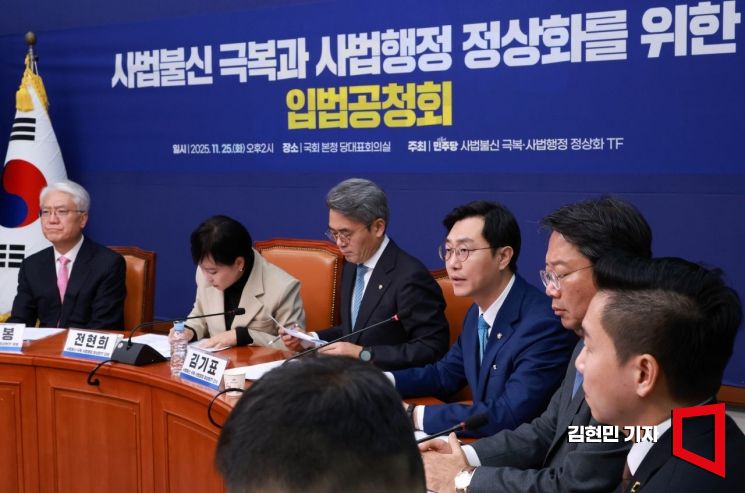 On the 5th, at the public hearing of the Democratic Party of Korea's Task Force (TF) on "Overcoming Judicial Distrust and Normalizing Judicial Administration" held at the National Assembly, TF member Jang Kyungtae is speaking. 2025.11.25 Photo by Kim Hyunmin
Concerns were also raised about the TF's push to abolish the Court Administration Office. Lee Jiyeong, Director of Judicial Support at the Court Administration Office, clarified that she was not speaking on behalf of the office, but said, "The proposal to establish the Judicial Administration Committee is similar to a bill introduced in the 21st National Assembly. Even during the tenure of former Chief Justice Kim Myeongsoo, who supported abolishing the office, the office clearly opposed this bill," adding, "Eight years have passed, and I find it difficult to agree with the opinion that the Court Administration Office should be abolished based on concerns from that time, without sufficient consideration of the efforts and changes the judiciary has made since then."
She continued, "Considering the intent to faithfully guarantee citizens' right to trial through the constitutional principles of separation of powers and judicial independence, I cannot agree with this proposal." She pointed out, "(According to the TF's proposal, where non-judges are the majority in the Judicial Administration Committee,) judges would not have the opportunity to participate meaningfully in judicial administration or to make decisions on core issues."
Concerns were also raised about potential breaches of political neutrality. Director Lee stated, "According to the TF's proposal, the Judicial Administration Committee would abolish the Judicial Personnel Committee and hold all authority over judicial appointments," adding, "Judicial personnel records require confidentiality and security, but in a committee where non-judges are the majority, there is a greater risk that sensitive information will be shared with many and leaked externally, which could expose judges and trials to political influence and create confusion."
Even those who support abolishing the Court Administration Office and establishing the Judicial Administration Committee expressed formal and legal concerns. Kim Juhyeon, Policy Director of the Korean Bar Association, cited Article 104(3) of the Constitution, which stipulates that judges other than the Chief Justice and Supreme Court justices are appointed by the Chief Justice with the consent of the Supreme Court Justices' Council, and said, "The constitutional procedure of obtaining the consent of the Supreme Court Justices' Council must not be omitted," adding, "Careful consideration is needed to ensure that the Judicial Administration Committee's decisions do not effectively undermine the Chief Justice's authority to appoint judges."
Seo Chaewan, Secretary of the Judicial Center of Lawyers for a Democratic Society, suggested, "While participation by non-judicial members should be encouraged, it would be appropriate to exclude politicians, members of the National Assembly, and members of administrative agencies."
© The Asia Business Daily(www.asiae.co.kr). All rights reserved.
![Clutching a Stolen Dior Bag, Saying "I Hate Being Poor but Real"... The Grotesque Con of a "Human Knockoff" [Slate]](https://cwcontent.asiae.co.kr/asiaresize/183/2026021902243444107_1771435474.jpg)
















