HPAI Detected in Wild Bird Carcasses at Yeongam Lake
Two Control Checkpoints and 32 Quicklime Barrier Belts Operated at Migratory Bird Habitats
Haenam County in South Jeolla Province has activated a special quarantine system to prevent the spread of highly pathogenic avian influenza (AI·HPAI).
According to Haenam County on November 25, a series of recent AI outbreaks in Hwaseong, Gyeonggi Province, and Yeongdong, North Chungcheong Province, as well as the detection of HPAI in wild bird carcasses at the nearby Yeongam Lake, have put authorities on high alert.
The county has established and is operating two control checkpoints at major migratory bird habitats and three farm checkpoints. In addition, quicklime barrier belts have been installed at 32 key access points to migratory bird habitats. Disinfection stations and the livestock disease control room are operating 24 hours a day to ensure a rapid response system.
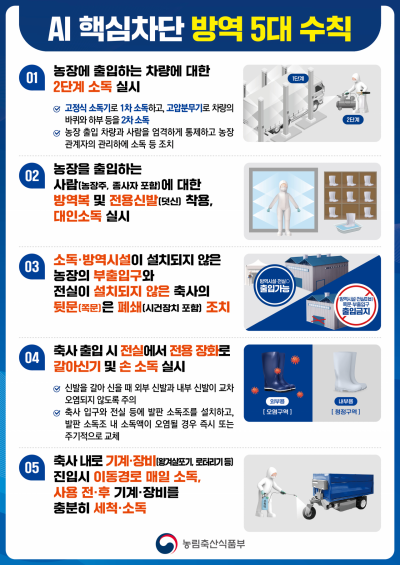 Five Key Biosecurity Rules for Core Prevention of Avian Influenza. Provided by the Ministry of Agriculture, Food and Rural Affairs
In particular, if the cold wave continues, biosecurity conditions such as disinfection are expected to worsen, requiring poultry farms to exercise extra caution. During periods of severe cold, access by people and vehicles to farms should be restricted as much as possible.
If livestock vehicles must enter, they are required to undergo a three-step disinfection process, including the base disinfection facility and a two-stage vehicle disinfection. Entry must be prohibited if disinfection facilities are unavailable or inoperable due to malfunction or freezing.
The county recommends using oxidizing, acidic, and alkaline disinfectants that are effective at low temperatures. It also urges the application of quicklime at farm entrances and the management of footbath disinfectant tanks to prevent freezing.
Previously, during the nationwide AI outbreaks in the winters of 2016 and 2020, tens of millions of poultry were culled. From November 2020 to March of the following year, more than 19 million birds were culled nationwide, causing significant losses to chicken and duck farmers.
Past AI outbreaks have resulted in massive damage. In the winter of 2016-2017, 34.3 million birds were culled at 856 farms nationwide. During the 2020-2021 winter season, 29.93 million birds were culled, again inflicting heavy losses on chicken and duck farms.
In particular, the South Jeolla region culled 2.55 million birds over 45 days in the winter of 2020-2021, resulting in damages of 15 billion won. In 2016-2017, 2.14 million birds were culled in 10 cities and counties, highlighting the region’s repeated losses.
A county official stated, "Although biosecurity conditions are poor during the winter, voluntary preventive measures by livestock farmers are most important. Please remain vigilant until the end of the special quarantine period and strictly follow biosecurity rules, such as disinfecting vehicles entering farms and refraining from visiting migratory bird habitats."
© The Asia Business Daily(www.asiae.co.kr). All rights reserved.
![Clutching a Stolen Dior Bag, Saying "I Hate Being Poor but Real"... The Grotesque Con of a "Human Knockoff" [Slate]](https://cwcontent.asiae.co.kr/asiaresize/183/2026021902243444107_1771435474.jpg)















