A Decade of Stagnation Only Deepens Public Fatigue
An Old Downtown Adrift in "Image Politics" Without Content
The Challenge of Revitalization Trapped by City-Led Barriers
The redevelopment project of Hadong Jeil Market, which stands as both a symbol of urban regeneration and a stark reminder of decline in the old downtown area of Yeoju City, Gyeonggi Province, has been adrift for a decade, dragging public trust to its lowest point.
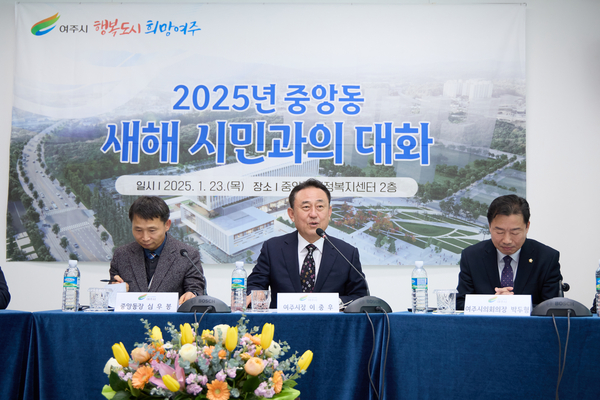 Lee Choongwoo, Mayor of Yeoju City, is explaining the development of Hadong First Market during the "2025 New Year Dialogue with Citizens" held at the Jungang-dong Administrative Welfare Center on January 23. Provided by Yeoju City
Although Mayor Lee Choongwoo of the 8th popularly elected administration has declared, “We can no longer delay,” and has put forward the option of direct city-led construction, critics overwhelmingly view this as a “belated decision” and a bitter admission of the administration’s “comprehensive lack of preparation.”
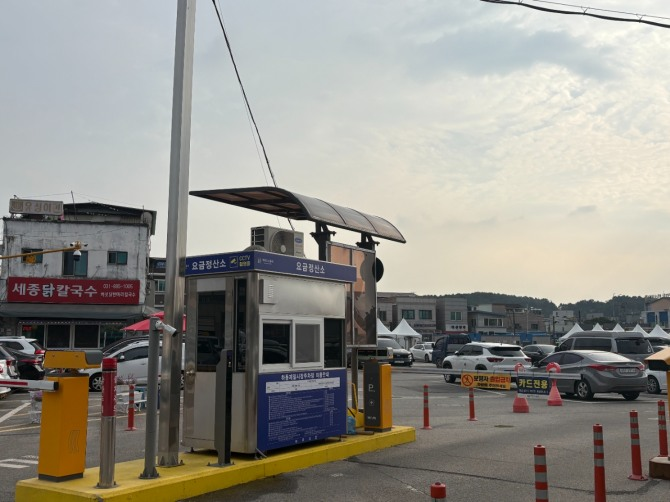
Over the past ten years, the Hadong Jeil Market project has never escaped the vicious cycle of “policy intention → plan formulation → project stagnation → repeated campaign pledges.” Currently, the market site has been demolished and now merely serves as a temporary parking lot in the heart of the city, symbolizing how time has stood still in the old downtown.
Statistics such as a 40% vacancy rate for commercial properties and 80% of buildings being outdated have already become a reality. Observers point out that Mayor Lee’s recent remarks only add to the fatigue from empty promises rather than offering hope.
The 8th administration pledged to make a large-scale complex town (mixed-use residential-commercial, cultural center, and public rental housing) the centerpiece of its “Yeoju Renaissance” strategy. However, the actual implementation process has only exposed problems such as lack of private sector participation, withdrawal of Korea Land and Housing Corporation (LH), and conflicts among merchants and residents. Critics argue that these issues are not mere variables but fundamental limitations of a plan that failed to consider a realistic balance between funding, profitability, and public interest from the outset.
Ten Years Stalled After Demolition... Where Does Responsibility Lie?
According to a media report, Mayor Lee, after benchmarking successful cases such as Arirang Market in Jeongseon County from November 20 to 21, stated at his accommodation, “If no private investor emerges, the city will directly construct commercial buildings with a budget of 33.6 billion won and seek operators.”
The report also noted, “Mayor Lee especially emphasized that the project budget must be executed by 2027, but starting from the design phase makes completion by 2027 a tight schedule. The longer the delay, the higher the costs, so a prompt decision is necessary.”
While this may appear decisive on the surface, a closer look raises fundamental questions about what the Yeoju city administration has accomplished during the three years of the 8th term.
The key to Jeongseon’s success was that residents changed and merchants revived the market themselves. In contrast, Yeoju remains stuck in a city-led, merchant-passive participation model. Before blaming merchants for “lack of participation,” the city should first reflect on why it failed to create a structure that encourages involvement.
Mayor Lee has set a “2027 completion target” and is emphasizing speed. However, as the end of the year approaches, the fact that the city is only now conducting architectural planning services reveals a clear lack of preparation. Experts view completion by 2027 as merely “wishful political rhetoric,” no matter how much the process is expedited.
The Era of 12 Million Tourists... Numbers Are Meaningless Without an Inflow Strategy
Yeoju boasts impressive numbers, such as 10 million visitors to the Shinsegae Outlet and 2 million to the suspension bridge, totaling a “12 million tourist era.” However, Mayor Lee’s strategy to attract external tourists to the old downtown, as seen in the Jeongseon case, falters when faced with the question of “how.”
Currently, the old downtown lacks any attractions that would make tourists want to visit. Critics argue that calling for tourism linkage without first addressing core elements such as revitalizing commercial areas, differentiated content, and a market branding strategy is more image politics than effective policy. Without “content that makes tourists stay,” like Jeongseon’s traditional market or cable car, emphasizing only external demand makes true regeneration impossible.
A Shift from Political Pledges to an Execution-Focused Urban Strategy Is Needed
The most serious issue is the collapse of public trust caused by project delays. What is needed now is not declarations of intent or political slogans, but accountable execution.
Since Mayor Lee himself stated, “It is no longer time for words alone,” he must now take responsibility for those words.
First, the structure should be shifted to focus on merchants and residents; if merchant participation is low, the city must first examine why and whether there were administrative design flaws. Next, if the intention to include public facilities undermines profitability through an unrealistic rebalancing of public interest and profit, the project cannot even start. Finally, unless the city redesigns the structure to attract private investment and create a virtuous cycle for the local economy, as in Jeongseon, “direct construction” will only become another burden.
Hadong Jeil Market has now become a test of whether Mayor Lee Choongwoo’s “new promise” can demonstrate consistency in execution and deliver tangible results. The future of Yeoju’s old downtown depends not on campaign pledges, but on a regeneration model built together with its citizens.
© The Asia Business Daily(www.asiae.co.kr). All rights reserved.
![Clutching a Stolen Dior Bag, Saying "I Hate Being Poor but Real"... The Grotesque Con of a "Human Knockoff" [Slate]](https://cwcontent.asiae.co.kr/asiaresize/183/2026021902243444107_1771435474.jpg)
















