Second and Third Unions Also Secure Legal Right to Strike
The Seoul Subway labor union has announced a general strike scheduled for December 12. The union has pointed out unfair wage cuts caused by workforce reductions and the total labor cost system, and stated that if management does not engage in negotiations, it will begin a work-to-rule campaign starting December 1.
The Seoul Metro Labor Union, the primary union at Seoul Metro, held a press conference in front of Seoul City Hall on November 25, declaring, "If the city and management continue to ignore the union's demands and persist with their repetitive arguments for cost-cutting and management efficiency, a full-scale strike on December 12 will be inevitable."
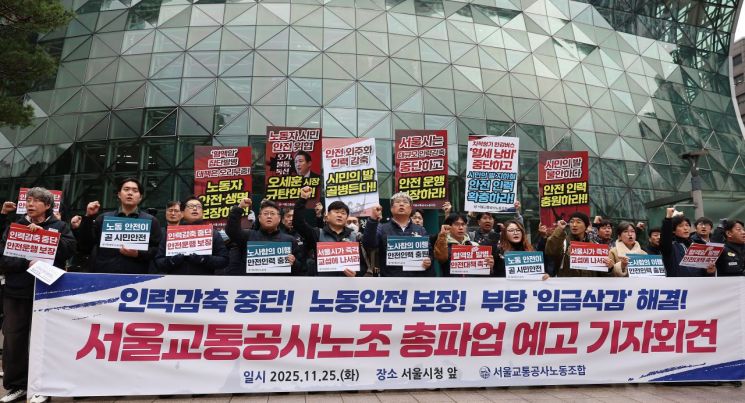
Kim Taekyun, head of the Seoul Metro Labor Union, stated, "We plan to escalate our struggle against the Seoul Metropolitan Government, starting with a large-scale rally in front of City Hall on November 27." He added, "From December 1, we will launch a work-to-rule campaign, including 'safety actions' based on laws, company regulations, and collective agreements, and refusal to perform tasks outside of official duties as stipulated by regulations. We also plan to expand our public campaign condemning the Seoul Metropolitan Government at major subway stations."
The primary union obtained the legal right to strike after the Seoul Regional Labor Relations Commission's mediation process ended on November 17, and 83.5% of union members approved the industrial action in a vote. The second union, the Seoul Metro Integrated Union, and the third union, the Right Union, have also secured legal rights to strike.
The second union has requested a meeting with the Mayor of Seoul and plans to determine further details afterward. The third union will hold a press conference on November 26 to announce its plans for industrial action. The primary union, with 9,036 members (57.4% of all unionized workers), is the largest and includes about 90% of train operators, making its influence significant in the event of a strike.
The union is demanding that Seoul Metro increase staffing. The union claims, "Seoul City has halted new hiring processes this year, including 488 mandatory retirements and about 460 replacements for vacancies, citing the 'implementation of the management innovation plan.'" The union argues that safety conditions are deteriorating due to staffing shortages and insists that positions vacated by retirement, long-term absences, and new line requirements must be filled as normal.
Regarding wages, the union maintains that the government’s total labor cost system must be amended to address real wage reductions. Since wage funds, including allowances and bonuses, are all grouped under 'total labor costs,' and because various overtime allowances that consistently occur due to the nature of the company must be covered within this total, the basic salary fund is ultimately eroded. Park Hyunwoo, deputy head of the primary union, lamented, "Right now, Seoul Subway is in the ironic situation of having to comply with the government’s total labor cost guidelines, which prevents us from following the government’s own wage increase guidelines. Every year, we face the threat of wage cuts and continue to suffer disadvantages."
Negotiations between labor and management are necessary to prevent a general strike, but no negotiation schedule has yet been discussed. A representative of the primary union stated, "Normally, at this time of year, we would be discussing a negotiation schedule with management, but since the resignation of the company president was accepted, there has been internal confusion and no discussions have taken place at all."
© The Asia Business Daily(www.asiae.co.kr). All rights reserved.
![Clutching a Stolen Dior Bag, Saying "I Hate Being Poor but Real"... The Grotesque Con of a "Human Knockoff" [Slate]](https://cwcontent.asiae.co.kr/asiaresize/183/2026021902243444107_1771435474.jpg)















