SK Hynix Falls Over 8%
US Rate Freeze and AI Bubble Concerns Spread
Amid a combination of negative factors, including the possibility of the US benchmark interest rate remaining unchanged and concerns over an artificial intelligence (AI) bubble, the KOSPI index fell into the 3800 range on November 21. The sell-off was particularly strong among AI-related stocks such as semiconductors and power equipment.
On November 21, the KOSPI closed at 3,853.26, down 151.59 points (3.79%) from the previous day. The index opened at 3,908.70, a decrease of 96.15 points (2.40%), and at one point during the session, the decline exceeded 4%. Notably, foreign investors dumped over 1 trillion won worth of shares early in the session, and by the close, their net sales totaled 2.8289 trillion won. Individual investors and institutions recorded net purchases of 2.292 trillion won and 495.5 billion won, respectively.
KOSPI and KOSDAQ Both Close Down More Than 3%
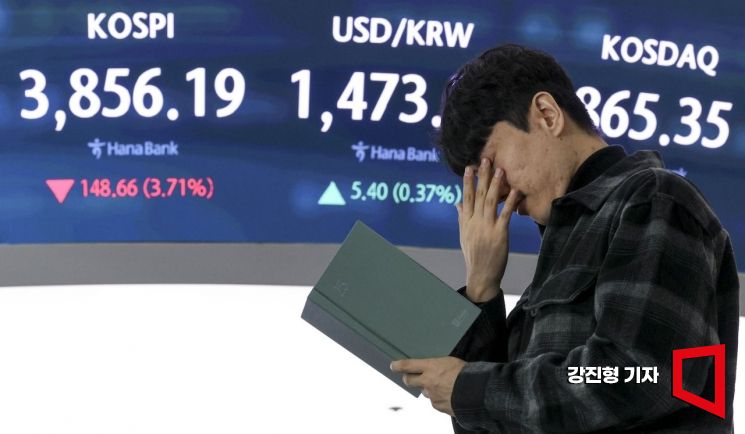 On the 21st, the KOSPI index fell more than 4% shortly after the market opened, breaking below the 4000 mark in just one day. The domestic stock index was displayed on the electronic board in the dealing room of Hana Bank in Jung-gu, Seoul. On the same day, the won-dollar exchange rate opened at 1,472.4 won, up 4.5 won. Photo by Kang Jinhyung
By sector, most categories posted significant declines: electrical and electronics (-6.43%), medical precision equipment (-5.94%), manufacturing (-4.71%), machinery and equipment (-4.38%), securities (-3.78%), transportation equipment and parts (-2.72%), chemicals (-2.63%), finance (-2.31%), and metals (-2.22%).
Among the top stocks by market capitalization, most saw sharp losses: SK Square (-9.37%), SK Hynix (-8.76%), Doosan Enerbility (-5.92%), Samsung Electronics (-5.77%), Hanwha Aerospace (-5.13%), HD Hyundai Heavy Industries (-4.80%), Samsung Electronics Preferred (-4.37%), Hanwha Ocean (-4.16%), Samsung C&T (-3.57%), LG Energy Solution (-3.51%), and HD Korea Shipbuilding & Offshore Engineering (-3.11%). NAVER (2.14%) and Kia (0.53%) were among the few gainers.
The KOSDAQ index closed at 863.95, down 27.99 points (3.14%) from the previous day. The index opened at 867.45, down 24.49 points (2.75%), and extended its losses throughout the session. Foreign investors recorded net sales of 128.1 billion won, and institutions also sold off 79.1 billion won. Individual investors purchased 220 billion won worth of shares.
Among the leading KOSDAQ stocks, Caregen (14.66%), Kolon TissueGene (11.49%), ABL Bio (0.85%), and Ligachem Bio (0.34%) posted gains. In contrast, most others closed lower, including EO Technics (-9.82%), Wonik IPS (-6.90%), Rainbow Robotics (-6.52%), Lino Tech (-6.37%), Samchundang Pharm (-5.80%), Ecopro (-5.17%), Ecopro BM (-4.82%), Peptron (-4.40%), Hugel (-3.64%), Olix (-3.62%), PharmaResearch Products (-3.35%), HLB (-3.13%), and Alteogen (-2.87%).
"Short-Term Correction After Rapid Stock Price Surge... Volatility Expected Until December FOMC"
The sharp decline is seen as the result of a combination of factors: the possibility of the US benchmark rate staying unchanged and growing concerns over an AI bubble. Comments from Lisa Cook, a US Federal Reserve Governor, also heightened market anxiety. She argued that prices are overvalued across several asset classes, including stocks, corporate bonds, and housing, and that the likelihood of a significant drop has increased. Additionally, stronger-than-expected employment data for September weakened expectations for a rate cut in December, further contributing to the stock market's weakness.
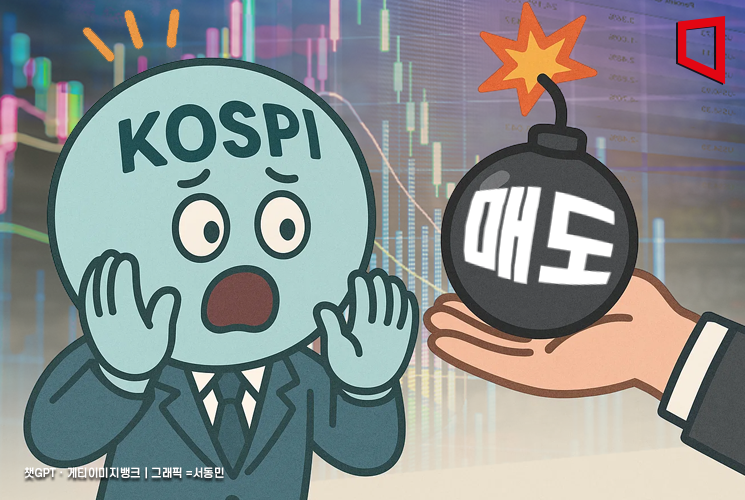
Lim Jeongeun, a researcher at KB Securities, said, "NVIDIA's strong earnings did not fully dispel concerns about an AI bubble, and as market worries intensified, the decline was even steeper than the previous day's gains." She added, "Underlying the recent market correction is concern about a hawkish Fed." She continued, "If the market comes to terms with the possibility that there may be no rate cut in December, this could actually mark a market bottom. Considering current economic conditions, a rate cut in January next year appears inevitable."
Jo Ain, a researcher at Samsung Securities, said, "High market volatility is likely to persist until around the December US Federal Open Market Committee (FOMC) meeting." She continued, "Given that the KOSPI surged to 4,200 points last month, this is seen as a short-term price correction phase." She added, "There has been a roughly 9% correction over the past three weeks, and the short-term dollar liquidity issue is likely to gradually ease." "Currently, it is important to monitor the stabilization of the short-term liquidity market and seek appropriate response strategies," she advised.
© The Asia Business Daily(www.asiae.co.kr). All rights reserved.
![Clutching a Stolen Dior Bag, Saying "I Hate Being Poor but Real"... The Grotesque Con of a "Human Knockoff" [Slate]](https://cwcontent.asiae.co.kr/asiaresize/183/2026021902243444107_1771435474.jpg)
















