Up to Fivefold Difference in Caffeine Content Among Coffee Franchises
Stricter Labeling Standards Expected to Reduce Confusion
Potential for Decaffeinated Coffee Price Adjustments
Starting in March next year, only coffee made from beans containing no more than 0.1% residual caffeine will be allowed to use the "decaffeinated" label. However, a comparison of decaffeinated beverages from major domestic coffee franchises has revealed that the amount of residual caffeine can vary by up to five times between brands. As caffeine content becomes standardized across brands, there is growing attention on whether the price of decaffeinated coffee will also increase.
On November 24, a comparison of decaffeinated coffee from major domestic coffee franchises showed that the residual caffeine content in products ranged from 3mg to 15mg. Hollys Decaffeinated Cold Brew had the lowest amount at 3mg, while Starbucks and Twosome Place contained 10mg each, and Compose Coffee had 12mg. Paik’s Coffee’s Decaffeinated Cold Brew had the highest at 15mg. Despite all being labeled "decaffeinated," there was up to a fivefold difference in caffeine content depending on the brand.
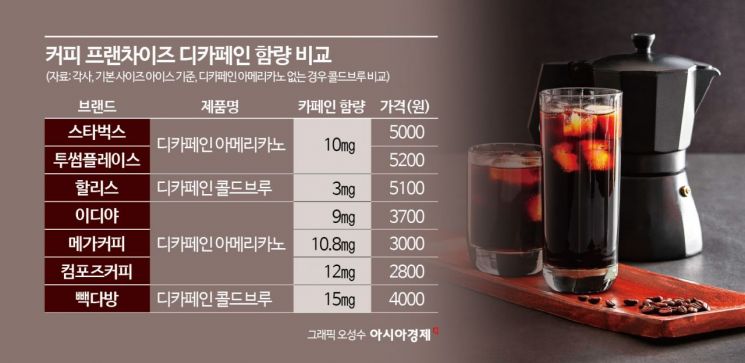
This variation occurs because the current standard only requires that "decaffeinated" coffee must have at least 90% of its caffeine removed, without regulating the final residual amount separately.
The initial caffeine content of coffee beans varies greatly depending on the variety and origin, so even if 90% of the caffeine is removed, the final residual caffeine can differ-5mg, 10mg, or 15mg, for example. For instance, if a bean contains 200mg of caffeine, removing 90% leaves 20mg, whereas a 100mg bean under the same conditions leaves only 10mg. Both can be sold as decaffeinated, but the actual caffeine content differs by a factor of two. Furthermore, differences in extraction methods (cold brew, espresso), shot and water volume, and other brand-specific manufacturing processes also contribute to these discrepancies.
As a result, there have been numerous reports of consumers experiencing symptoms such as heart palpitations, insomnia, and anxiety after consuming decaffeinated coffee. Especially for consumers who choose decaffeinated options for health reasons, such as pregnant women or those sensitive to caffeine, these brand-to-brand variations can pose real safety concerns.
To reduce this confusion, the Ministry of Food and Drug Safety has revised its labeling standards so that, starting in March next year, only coffee made from beans containing 0.1% or less residual caffeine can be labeled as decaffeinated. The new standard aligns with international guidelines, such as those in the United States (no more than 0.1% residual caffeine) and the European Union (no more than 0.3%).
The industry expects that, after the standards are revised, variations in residual caffeine between brands will be reduced, thereby increasing consumer trust. An industry representative stated, "Until now, the only thing these coffees had in common was the decaffeinated label, but there were significant differences between brands. With clearer standards for residual caffeine, consumers can expect greater safety and consistency."
However, there are predictions that brands will inevitably need to overhaul their products, including changing beans and improving processes. Currently, some franchises do not secure enough decaffeinated beans separately or use the same extraction lines as regular beans, resulting in relatively lax management of residual caffeine. To meet the 0.1% threshold, brands will need to control not only bean selection but also minute differences throughout the manufacturing process, including heating, cleaning, and extraction.
The cost burden of decaffeinated beans is also expected to rise. Since beans must undergo more intensive caffeine removal processes, material costs will increase, raising the possibility of price adjustments for decaffeinated options. Currently, decaffeinated beans are already 20-30% more expensive than regular beans due to the removal process, and consumers typically pay at least 500 won extra for decaffeinated beverages.
An industry insider commented, "It's too early to discuss price adjustments, as we have not yet reached a conclusion internally about the burden of the new standards. However, since sourcing beans and operational procedures may change, we cannot rule out the possibility of price increases for decaffeinated coffee." Another representative added, "The new standards mean that not only bean quality but also extraction time, shot volume, and machine cleaning cycles will need to be redesigned. Some brands may find it difficult to meet the new requirements with their current systems, so some initial confusion is inevitable."
Meanwhile, demand for decaffeinated coffee continues to grow each year. According to Starbucks Korea, 36.5 million cups of decaffeinated coffee were sold from January to October this year, a 35% increase compared to the same period last year-already surpassing last year's total sales of 32.7 million cups. Sales have risen from 20.2 million cups in 2022 and 21 million cups in 2023 to 32.7 million cups in 2024. Twosome Place also reported a 32% increase in decaffeinated coffee sales compared to last year.
© The Asia Business Daily(www.asiae.co.kr). All rights reserved.
![Clutching a Stolen Dior Bag, Saying "I Hate Being Poor but Real"... The Grotesque Con of a "Human Knockoff" [Slate]](https://cwcontent.asiae.co.kr/asiaresize/183/2026021902243444107_1771435474.jpg)
















