Bank of Korea Holds Currency Circulation System Council with Related Agencies
As the trend toward a cashless society spreads, the Bank of Korea has expressed concerns over the reduction of related infrastructure, such as automated teller machines (ATMs). With the foundation for cash usage weakening, there is a growing call for proactive measures to maintain the currency circulation system.
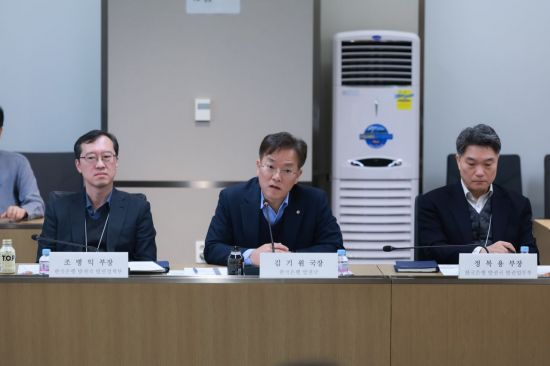 Kim Giwon, Director of the Currency Issuance Department at the Bank of Korea, is speaking at the Currency Circulation System Related Institutions Council held on the 13th. Provided by the Bank of Korea
On November 13, the Bank of Korea held the '2025 Second Half Currency Circulation System Related Institutions Council' at its headquarters in Jung-gu, Seoul, and shared these concerns. The council was launched in 2022 to manage and improve the domestic currency circulation system and consists of 24 organizations, including the Bank of Korea, Korea Minting, Security Printing & ID Card Operating Corporation, and major commercial banks.
Kim Giwon, Director of the Currency Issuance Department at the Bank of Korea and chair of the council, emphasized the need for proactive responses to maintain the currency circulation system.
Director Kim pointed out, "Recently, not only on buses and in stores but also at institutions under local governments, there are increasing cases of restricting cash payments, which is continuously weakening cash acceptance. In addition, we are witnessing a visible shift in the business environment, with cash transport companies and non-financial ATM operators suspending their operations."
Participants at the meeting evaluated and discussed the impact of demographic changes and digital transformation on the currency circulation ecosystem. They expressed concern that if the population continues to concentrate in the Seoul metropolitan area and the preference for non-cash payment methods intensifies, bank branches and ATMs providing cash access in non-metropolitan regions could rapidly decline. They agreed that appropriate policy responses are necessary.
They also discussed response measures for the rapidly changing business environment faced by cash transport companies and non-financial ATM operators. The non-financial ATM industry noted that their work environment is becoming more challenging due to the decrease in ATM usage and the financial burden of installing barrier-free ATMs in accordance with the 'Act on the Prohibition of Discrimination against Persons with Disabilities,' which will take effect in January next year. However, they stated their intention to seek compromises through coordination with the government and related organizations, rather than simply reducing the number of ATMs.
The industry is also working to improve management efficiency by introducing artificial intelligence (AI) into internal management systems and researching AI-based optimization of cash transport routes. Some retail financial institutions mentioned that, although cash transactions increase operating costs, they will continue to maintain cash-accepting infrastructure to ensure customers can use cash without inconvenience.
Meanwhile, as of the end of September this year, the outstanding balance of currency issuance stood at approximately 209 trillion won, an increase from a year earlier. This is attributed to rising demand for currency, particularly 50,000-won notes. While net issuance of banknotes continues, except for the retrieval of holiday funds, coins have generally maintained a circulation trend except for 10-won coins, whose net issuance is also rapidly declining. During the meeting, participants agreed on the need to improve the cleanliness of low-denomination notes, as their condition continues to deteriorate.
© The Asia Business Daily(www.asiae.co.kr). All rights reserved.
![Clutching a Stolen Dior Bag, Saying "I Hate Being Poor but Real"... The Grotesque Con of a "Human Knockoff" [Slate]](https://cwcontent.asiae.co.kr/asiaresize/183/2026021902243444107_1771435474.jpg)















