China and Russia Abstain Instead of Using Veto Power
Israel and Hamas Oppose... Tensions Remain
The United Nations Security Council has adopted a resolution supporting the Gaza peace initiative announced by U.S. President Donald Trump in September.
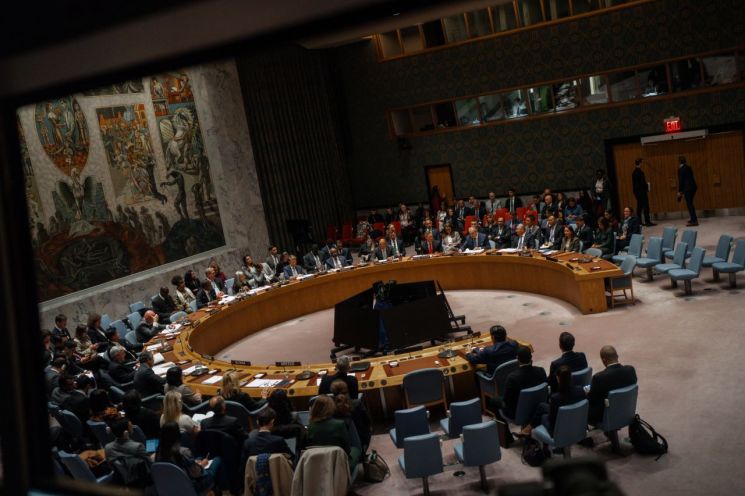 On the 17th (local time), the United Nations Security Council meeting is being held at the United Nations Headquarters in New York, USA. Photo by EPA Yonhap News
On the 17th (local time), the Security Council held an official meeting at the United Nations Headquarters in New York, USA, and passed the resolution supporting the Gaza peace initiative with 13 out of 15 member states voting in favor. For a Security Council resolution to pass, it must receive the approval of at least nine member states. Additionally, none of the five permanent members-the United States, China, Russia, the United Kingdom, and France-may exercise their veto power. On this occasion, Russia and China abstained.
The resolution supporting the Gaza peace initiative, adopted on this day, centers on endorsing President Trump’s “Comprehensive Plan to End the Gaza Conflict” presented last September, and urges the parties involved in the conflict to fully implement the peace initiative, including maintaining a ceasefire.
Within this resolution, the Security Council approved the establishment of a transitional governing body, the Board of Peace (BoP), and authorized UN member states to deploy a “Temporary International Stabilization Force (ISF)” in the Gaza Strip. The Board of Peace is a transitional governing body for Gaza, as outlined in the peace initiative, and is similar to the UN trusteeship bodies established for former colonial countries, including Korea, after World War II. The United States previously announced that President Trump would serve as the head of the Board of Peace.
The Security Council resolution grants administrative authority to the Board of Peace and calls for the implementation of reconstruction and economic recovery programs in Gaza. Furthermore, the ISF’s mandate explicitly includes not only maintaining security in Gaza but also the “permanent disarmament of non-state armed groups,” thereby assigning the force the role of disarming Hamas. Michael Waltz, the U.S. Ambassador to the United Nations, stated, “A multinational peacekeeping force, including troops from Muslim countries such as Indonesia and Azerbaijan, will be deployed under unified command to maintain public order, oversee disarmament, protect civilians, and support the delivery of humanitarian aid through secure corridors.”
This resolution also mentions the potential for future recognition of Palestinian statehood. The peace initiative resolution states that “after the reform program of the Palestinian Authority (PA) is faithfully implemented and progress is made in the reconstruction of Gaza,” the conditions could be met for Palestine to achieve state status.
The inclusion of provisions related to Palestinian statehood was a major point of contention during the drafting of the resolution, drawing strong opposition from Israel. Israeli Prime Minister Benjamin Netanyahu, ahead of the vote, reiterated his firm opposition to any attempt to establish a Palestinian state, stating the previous day, “We will oppose any attempt to establish a Palestinian state.”
Hamas also objected to the adoption of the resolution, particularly over the inclusion of the “permanent disarmament of non-state armed groups” in the ISF’s mandate. According to AFP, Hamas stated after the resolution passed, “This resolution does not meet the political and humanitarian needs and rights of the Palestinian people.”
© The Asia Business Daily(www.asiae.co.kr). All rights reserved.
![Clutching a Stolen Dior Bag, Saying "I Hate Being Poor but Real"... The Grotesque Con of a "Human Knockoff" [Slate]](https://cwcontent.asiae.co.kr/asiaresize/183/2026021902243444107_1771435474.jpg)















